Study shows human brain able to discriminate syllables three months prior to birth
February 26, 2013 by Bob Yirka in Neuroscience report

Study shows human brain able to discriminate syllables three months prior to birth

Enlarge

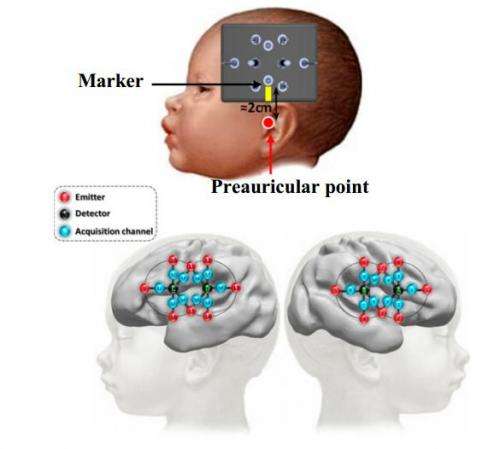
(Upper) Schematic representation of the location of the optical probe on an infant’s head relatively to anatomical landmarks. (Lower) Estimated projection of the optodes on the brain of a 30 wGA preterm infant [courtesy of Petra Huppi and Jessica Dubois]. The eight emitters (red circles) are arranged on two 1.5-cm-diameter circles centered by the two detectors (black circles), creating 10 points of measure (channels) over each hemisphere (blue circles). Credit: PNAS, doi: 10.1073/pnas.1212220110

(Medical Xpress)—A team of French researchers has discovered that the human brain is capable of distinguishing between different types of syllables as early as three months prior to full term birth. As they describe in their paper published in the Proceedings of the National Academy of Sciences, the team found via brain scans that babies born up to three months premature are capable of some language processing.

Many studies have been conducted on full term babies to try to understand the degree of mental capabilities at birth. Results from such studies have shown that babies are able to distinguish their mother's voice from others, for example, and can even recognize the elements of short stories. Still puzzling however, is whether some of what newborns are able to demonstrate is innate, or learned immediately after birth. To learn more, the researchers enlisted the assistance of several parents of and their offspring. Babies born as early as 28 weeks (full term is 37 weeks) had their brains scanned using bedside functional optical imaging, while sounds (soft voices) were played for them.

Three months prior to full term, the team notes, neurons in the brain are still migrating to what will be their final destination locations and initial connections between the upper are still forming—also neural linkages between the ears and brain are still being created. All of this indicates a brain that is still very much in flux and in the process of becoming the phenomenally complicated mass that humans are known for, which would seem to suggest that very limited if any communication skills would have developed.

This video is not supported by your browser at this time.

Infant’s hemodynamic response in the three types of blocks. The red rectangle indicates the time window during which auditory stimuli were presented to infants. Credit: (c) PNAS, doi: 10.1073/pnas.1212220110

The researchers found, however, that even at a time when the brain hasn't fully developed, the premature infants were able to tell the difference between female versus , and to distinguish between the syllables "ba" and "ga". They noted also that the same parts of the brain were used by the infants to process sounds as adults. This, the researchers conclude, shows that linguistic connections in the brain develop before birth and because of that do not need to be acquired afterwards, suggesting that at least some abilities are innate.

More information: Syllabic discrimination in premature human infants prior to complete formation of cortical layers, PNAS, Published online before print February 25, 2013, doi: 10.1073/pnas.1212220110

Abstract
The ontogeny of linguistic functions in the human brain remains elusive. Although some auditory capacities are described before term, whether and how such immature cortical circuits might process speech are unknown. Here we used functional optical imaging to evaluate the cerebral responses to syllables at the earliest age at which cortical responses to external stimuli can be recorded in humans (28- to 32-wk gestational age). At this age, the cortical organization in layers is not completed. Many neurons are still located in the subplate and in the process of migrating to their final location. Nevertheless, we observed several points of similarity with the adult linguistic network. First, whereas syllables elicited larger right than left responses, the posterior temporal region escaped this general pattern, showing faster and more sustained responses over the left than over the right hemisphere. Second, discrimination responses to a change of phoneme (ba vs. ga) and a change of human voice (male vs. female) were already present and involved inferior frontal areas, even in the youngest infants (29-wk gestational age). Third, whereas both types of changes elicited responses in the right frontal region, the left frontal region only reacted to a change of phoneme. These results demonstrate a sophisticated organization of perisylvian areas at the very onset of cortical circuitry, 3 mo before term. They emphasize the influence of innate factors on regions involved in linguistic processing and social communication in humans.

Journal reference: Proceedings of the National Academy of Sciences search and more info website

© 2013 Medical Xpress

4.8 /5 (4 votes)  

Filter


Move the slider to adjust rank threshold, so that you can hide some of the comments.


Display comments: newest first

Tausch
Feb 26, 2013

Rank: not rated yet
Even the womb is an 'external' source for stimuli.
Modeling 'attention' here will be one of the greatest stray paths ever pursued by neuroscience and psychology.
Apart from futile warning, kudos.
hemitite
Feb 26, 2013

Rank: 5 / 5 (1)

So these little tikes can discriminate the syllables "a-bor-tion"...
freethinking
Feb 26, 2013

Rank: 1 / 5 (1)
These type of studies need to be banned. Pro-abortionists need to keep saying to themselves that an unborn baby is not human. They need to keep claiming that an unborn baby isn't human. However the more unborn babies are studied, the more evidence of their humanity pro-life people have.

If you support the killing of unborn babies, you have no science to backup your claim that they are not fully human.
praos
Feb 26, 2013

Rank: 3 / 5 (2)
Unborn babies are human. The problem is that many already born and grown up are that no more.
joefarah
Feb 26, 2013

Rank: 3 / 5 (2)
Many pro-abortion people acknowledge that the unborn babies are human. They just think that it's OK to kill these human babies because they might be an inconvenience. They'll even acknowledge that they are human at conception. But God help us if we ever look at killing baby whales in the womb!
JWnTX
Feb 27, 2013

Rank: 3 / 5 (2)
But...but...but...I thought it was just a clump of cells until it's somehow miraculously transformed on the way out of the birth canal???
freethinking
Mar 01, 2013

Rank: 1 / 5 (1)
Funny thing about Progressives and Pro-abortionists, they hate free speech, love to lie, intimidate, and bully those they disagree with.

http://radio.foxn...als.html
Rank 4.8 /5 (4 votes)
Related Stories
Relevant PhysicsForums posts

More news stories

New neuron formation could increase capacity for new learning, at the expense of old memories

New research presented today shows that formation of new neurons in the hippocampus - a brain region known for its importance in learning and remembering - could cause forgetting of old memories by causing a reorganization ...

Neuroscience created 9 hours ago | popularity 3.7 / 5 (3) | comments 0

Help at hand for people with schizophrenia

How can healthy people who hear voices help schizophrenics? Finding the answer for this is at the centre of research conducted at the University of Bergen.

Neuroscience created 9 hours ago | popularity 4 / 5 (2) | comments 2

Japanese research organizations contribute to Human Brain Project

One of the major frontiers of modern science is a comprehensive understanding of the human brain and its functions to guide the development of new technologies in information and communication. In a major announcement for ...

Neuroscience created 10 hours ago | popularity 3 / 5 (2) | comments 0

Controlling mood through the motions of mitochondria

(Medical Xpress)—Regulating the distribution of power in neurons is done by a system that makes the national electric grid look simple by comparison. Each neuron has several thousand mitochondria confined ...

Neuroscience created May 23, 2013 | popularity 4.9 / 5 (9) | comments 0 | with audio podcast report

Brain uses internal 'average voice' prototype to identify who is talking

(Medical Xpress)—The human brain is able to identify individuals' voices by comparing them against an internal 'average voice' prototype, according to neuroscientists.

Neuroscience created May 23, 2013 | popularity 3 / 5 (2) | comments 3 | with audio podcast


Researchers identify first drug targets in childhood genetic tumor disorder

Two mutations central to the development of infantile myofibromatosis (IM)—a disorder characterized by multiple tumors involving the skin, bone, and soft tissue—may provide new therapeutic targets, according to researchers ...

Engineered cytomegalovirus protects monkeys from HIV equivalent

(Medical Xpress)—A new study by researchers in the US has shown that an ancient virus can be modified to help in the fight against the simian immunodeficiency virus SIV, which is the equivalent in monkeys ...

Driving and hands-free talking lead to spike in errors, study shows

Talking on a hands-free device while behind the wheel can lead to a sharp increase in errors that could imperil other drivers on the road, according to new research from the University of Alberta.

Hormone levels may provide key to understanding psychological disorders in women

Women at a particular stage in their monthly menstrual cycle may be more vulnerable to some of the psychological side-effects associated with stressful experiences, according to a study from UCL.

Going live: Immune cell activation in multiple sclerosis

Biological processes are generally based on events at the molecular and cellular level. To understand what happens in the course of infections, diseases or normal bodily functions, scientists would need to ...

Pollen count apps for smartphones are nothing to sneeze at

Kate O'Reilly's spring allergy survival kit includes the usual stuff - nasal sprays, allergy pills and a box of tissues. This season, she's added a new weapon to her line of defense: an app on her smartphone.