One-two punch strategy against bacteria and cancer
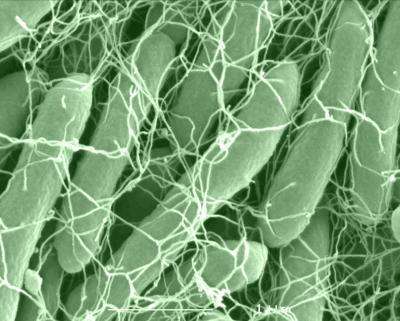
Cancer researchers from Rice University suggest that a new man-made drug that's already proven effective at killing cancer and drug-resistant bacteria could best deliver its knockout blow when used in combination with drugs made from naturally occurring toxins.
"One of the oldest tricks in fighting is the one-two punch—you distract your opponent with one attack and deliver a knockout blow with another," said José Onuchic of Rice's Center for Theoretical Biological Physics (CTBP). "Combinatorial drug therapies employ that strategy at a cellular level.
"A wealth of research in recent years has shown that both cancer and bacteria can mount sophisticated, coordinated defenses against almost any drug," said Onuchic, Rice's Harry C. and Olga K. Wiess Professor of Physics and Astronomy, professor of chemistry, and biochemistry and cell biology. "By combining drugs, particularly those that place stress on different parts of the cell, we expect it will be possible to knock out either cancer cells or bacteria while simultaneously inhibiting their ability to become drug-resistant."
Onuchic and CTBP colleagues Eshel Ben-Jacob and Patricia Jennings reached their conclusions after analyzing several studies on anti-microbial peptides (AMPs), corkscrew-shaped chains of amino acids that kill Gram-negative bacteria. The CTBP team's ideas appear this week in the Proceedings of the National Academy of Sciences (PNAS) as a commentary on new findings from MD Anderson Cancer Center about a promising synthetic AMP called D-KLAKLAK-2. In its new research, MD Anderson researchers found D-KLAKLAK-2, which was already known to kill cancer cells, is also an effective drug against antibiotic-resistant Gram-negative bacteria.
"AMPs are produced naturally by a number of animals to fight bacteria," said Ben-Jacob, professor of biochemistry and cell biology at Rice and the Maguy-Glass Chair in Physics of Complex Systems and professor of physics and astronomy at Tel Aviv University. "AMPs are corkscrew-shaped. They do not harm the animals' own cells, but they penetrate and shred the double-layered membranes of Gram-negative bacteria."
Gram-negative bacteria are a class of pathogens that includes drug-resistant varieties of bacteria that cause pneumonia, sepsis and other deadly diseases.
Ben-Jacob said cancer researchers have previously shown that they can tag AMPs with special "marker" molecules that allow the AMPs to penetrate and kill cancer cells. The markers allow the AMPs to be taken inside the cancer cells, something they cannot normally do.
"Once inside the cancer cells, the AMPs target and damage the cell's power plant, an organelle called the mitochondria, which has a double-layered membrane that is remarkably similar to that of Gram-negative bacteria," he said.
Though research has shown that AMPs can kill cancer cells, scientists are concerned that cancer cells could develop resistance to the compounds. In part, this concern arises from the fact that AMPs are fairly common in nature and that some organisms already have genetic mutations that allow them to evade AMP attacks.
To circumvent these natural defenses, MD Anderson researchers Wadih Arap and Renata Pasqualini led an effort a few years ago to create a synthetic version of a natural corkscrew-shaped AMP called KLAKLAK-2. Like all naturally occurring AMPs, KLAKLAK-2 has a left-handed twist—much like the threads of a screw that turn clockwise. To make the molecule more difficult for cancer cells to fight, the MD Anderson team built a right-handed, "counterclockwise" version of the molecule called D-KLAKLAK-2, with the "D" denoting right-handedness. In its most recent studies, which also appear this week in PNAS, the MD Anderson team found that D-KLAKLAK-2 is an effective killer of Gram-negative bacterial pathogens, including several types that have grown resistant to traditional antibiotics.
"Bacteria are notorious for their rapid development of drug resistance," Ben-Jacob said. "However, both bacteria and cancer have impaired ability to resist these man-made 'mirror' compounds because they cannot use the machinery they have evolved to disarm the right-handed weapons."
Onuchic said another advantage of therapies involving synthetic AMPs like D-KLAKLAK-2 is that the drugs can be administered in extremely small doses, which will reduce side effects.
The Rice team suggests maximizing the benefits of synthetic AMPs by using them in drug cocktails that act like a one-two punch for either bacteria or cancer.
Naturally occurring AMPs are chemical weapons that bacteria themselves have developed over millions of years in their never-ending war among themselves. The team reasons that combining these natural toxins with man-made mirror drugs will create the drug equivalent of a one-two punch. The combination should "confuse" bacteria and cancer and prevent them from rapidly becoming resistant to the man-made drugs.
"Nature is smarter than we are," Ben-Jacob said. "Time and again, we have seen that seemingly simple cellular foes like bacteria and cancer can learn to mount effective defenses against any new drug we create. It is time to accept them as sophisticated enemies. We should attack them in much the same way that a well-trained boxer or military commander would go after a wily opponent—with multiple, coordinated blows of very different kinds."


