Asterix's Roman foes: Researchers have a better idea of how cancer cells move and grow
March 12, 2013 in Cancer

Asterix's Roman foes -- Researchers have a better idea of how cancer cells move and grow

Enlarge

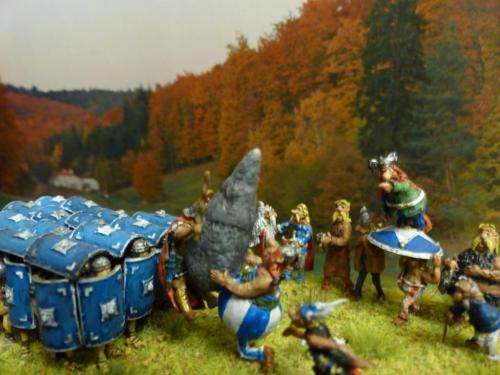
Researchers at the University of Montreal's Institute for Research in Immunology and Cancer (IRIC) have discovered a new mechanism that allows some cells in our body to move together, in some ways like the tortoise formation used by Roman soldiers depicted in the Asterix series. Credit: Université de Montréal

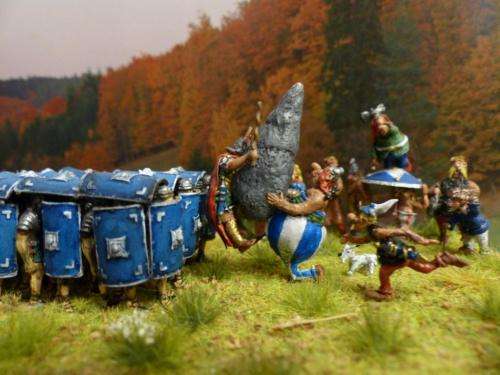
Researchers at the University of Montreal's Institute for Research in Immunology and Cancer (IRIC) have discovered a new mechanism that allows some cells in our body to move together, in some ways like the tortoise formation used by Roman soldiers depicted in the Asterix series. Collective cell migration is an essential part of our body's growth and defense system, but it is also used by cancerous cells to disseminate efficiently in the body. "We have found a key mechanism that allows cells to coordinate their movement as a group and we believe that this mechanism is used by malignant cells in a number of cancers, including some types of breast, prostate and skin cancers" explained lead researcher Gregory Emery. Roman soldiers formed the tortoise, or testudo formation, by coming closely together and aligning their shields side-by-side in order to defend themselves as they broke their enemy lines.

"As for the Romans, if some are migrating efficiently, it is because their movements are tightly coordinated. To stop their progression, we have first to understand how they coordinate. Then, we will aim at blocking this coordination in to abrogate ."

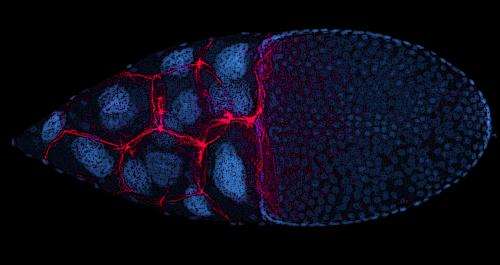
IRIC's scientists and their colleagues from the Johns Hopkins School of Medicine in Baltimore, USA studied the movement of the "border-cells" in the of fruit flies, a that is well understood by scientists and that they can reproduce easily. Researchers often use these kinds of cells as a model to get insight into metastatic cell migration – the process by which leave the original tumor– as they can be easily manipulated and observed. Researchers look at how chemicals known as proteins that our body produces influence what goes on in cells. In this study for instance, the researchers from IRIC were able to aim a laser with sufficient precision to activate or inactivate an engineered protein in a single living cell, and observe directly the consequences of these alterations.

Asterix's Roman foes -- Researchers have a better idea of how cancer cells move and grow
Enlarge

Researchers at the University of Montreal's Institute for Research in Immunology and Cancer (IRIC) have discovered a new mechanism that allows some cells in our body to move together, in some ways like the tortoise formation used by Roman soldiers depicted in the Asterix series. Credit: Stéphane Paillat

Asterix's Roman foes -- Researchers have a better idea of how cancer cells move and grow
Enlarge

Researchers at the University of Montreal's Institute for Research in Immunology and Cancer (IRIC) have discovered a new mechanism that allows some cells in our body to move together, in some ways like the tortoise formation used by Roman soldiers depicted in the Asterix series. Credit: Stéphane Paillat

They found that a protein known as Rab11 enables individual cells to sense what the others are doing and organize into a tight structure to move together. Rab11 achieves this by regulating another protein, called Moesin which is involved in controlling the shape and rigidity of cells. Reducing the level of Moesin reduces the cohesion of the cluster and impedes cell movement. "Here, we have identified a mechanism by which the cells share information to coordinate movements. By disrupting this mechanism, we are able to block their migration." Dr Emery explained.

Although the findings were in a specific kind of cells in an insect model, the proteins involved, Rab11 and Moesin, have already been shown to play a role in some human cancers. "This indicates that the new regulatory mechanism we identified in fly cells is most likely also important in human cancers," Dr. Emery said. "Our work will allow us to identify molecular targets to disrupt collective and hopefully to fight metastasis formation" he concludes.

More information: Gregory Emery and his co-authors published "Rab11 regulates cell-cell communication during collective cell movements" in Nature Cell Biology online on February 3, 2013.

Journal reference: Nature Cell Biology search and more info website

Provided by University of Montreal search and more info website

5 /5 (1 vote)  

Rank 5 /5 (1 vote)
Related Stories
Relevant PhysicsForums posts

More news stories

New smartphone application improves colonoscopy preparation

The use of a smartphone application significantly improves patients' preparation for a colonoscopy, according to new research presented today at Digestive Disease Week (DDW). The preparation process, which begins days in ...

Cancer created 8 hours ago | popularity not rated yet | comments 0

Research examines new methods for managing digestive health

Research presented at Digestive Disease Week (DDW) explores new methods for managing digestive health through diet and lifestyle.

Cancer created 8 hours ago | popularity not rated yet | comments 1

New colonoscope provides ground-breaking view of colon

A ground-breaking advance in colonoscopy technology signals the future of colorectal care, according to research presented today at Digestive Disease Week(DDW). Additional research focuses on optimizing the minimal withdrawal ...

Cancer created 23 hours ago | popularity 5 / 5 (2) | comments 0

ASCO: combo antibody therapy effective for melanoma

(HealthDay)—Concurrent use of two immune checkpoint antibodies—ipilimumab and nivolumab—may be effective for the treatment of advanced melanoma, according to a proof-of-principal study presented in ...

Cancer created May 17, 2013 | popularity not rated yet | comments 0

Risk factors ID'd for poor cutaneous cell CA outcomes

(HealthDay)—The risks of metastasis and death associated with cutaneous squamous cell carcinoma (CSCC) are low, but significant, and risk factors for poor outcome include tumor diameter, invasion beyond ...

Cancer created May 17, 2013 | popularity not rated yet | comments 0 | with audio podcast


'Gap' for HIV vaccine efforts after latest setback

The hunt for an HIV vaccine has gobbled up $8 billion in the past decade, and the failure of the most recent efficacy trial has delivered yet another setback to 26 years of efforts.

Consuming coffee linked to lower risk of detrimental liver disease, study finds

Regular consumption of coffee is associated with a reduced risk of primary sclerosing cholangitis (PSC), an autoimmune liver disease, Mayo Clinic research shows. The findings were being presented at the Digestive Disease ...

Ketamine shows significant therapeutic benefit in people with treatment-resistant depression

Patients with treatment-resistant major depression saw dramatic improvement in their illness after treatment with ketamine, an anesthetic, according to the largest ketamine clinical trial to-date led by researchers from the ...

New research identifies risks, interventions for children's GI health

An increasing number of U.S. children are experiencing gastrointestinal issues that require interventions to resolve, according to research presented at Digestive Disease Week (DDW).

New research identifies practice changes to improve value and quality of GI procedures

There are significant cost and risk factors associated with two procedures commonly used to diagnose or treat gastrointestinal problems, according to research presented at Digestive Disease Week (DDW).

US psychiatry gets makeover in new manual

The latest makeover to a massive psychiatric tome honored by some, reviled by others and even called the "Bible" of mental disorders is being released Saturday with a host of new changes.