Researchers identify the molecules allowing mice to sniff out the genes of other mice
March 22, 2013 in Medical research

Researchers identify the molecules allowing mice to sniff out the genes of other mice

Enlarge

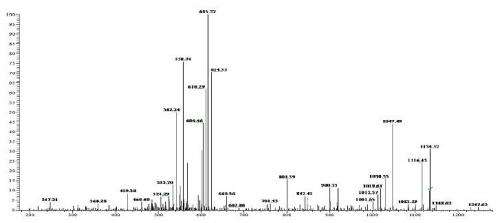
A mass spectrum image of a single peptide, showing researchers the composition of the protein.

(Medical Xpress)—It's a theory much discussed in the media – that animals and humans are able to smell certain genes linked to the immune system – which in turn influences their choice of mate. The genes in question are known as MHC (major histocompatibility complex) genes. Selecting a mate with very different MHC genes from one's own makes sense, because your offspring will then have a greater variety of immunity genes – and a correspondingly greater resistance to disease. But until now, no scent offering information about MHC genes had been discovered among those emitted by humans and animals.

Now researchers from the University of Tübingen's Immunology department and the Proteome Center, working with their colleagues from the University of Saarland, have managed to do just that. Their results, just published in Nature Communications, will lead scientists to review the "sniff out a mate" theory.

It is well known that the determine which MHC a cell presents at its surface to the immune system's . These peptides are usually composed of the body's own proteins and therefore do not set off any reaction. But if the MHC peptides come from a , the immune system's killer cells can recognize that and attack it. According to one current theory, the MHC peptides also communicate the smell which offers information about MHC genes – a theory tested in mice. Special sensor cells were found which are able to recognize and distinguish the various MHC peptides from one another. Experiments have shown that synthetic MHC peptides in high concentrations were able to influence the behavior of mice, and that mouse urine carries what is believed to be the smell of MHC genes. Until now, it was not known whether MHC peptides even occurred naturally in urine.

The researchers have now been able to identify in mouse urine an MHC peptide indicating a corresponding MHC gene. Yet the concentration was extremely low – the urine contained around one-millionth of the amount of MHC peptides than had been used in previous behavioral experiments. And hundreds of other peptides were identified in the mouse urine along with this MHC peptide – those peptides were derived from all kinds of genes but had nothing to do with MHC genes. These peptides should enable mice to map most of the fellow mouse's genes. They appear in concentrations up to a million times higher than that of the MCH peptide, coming closer to the amount used in the behavioral experiments. Both kinds of peptides can activate specific olfactory cells in mice, as researchers from the University of Saarland showed.

These results suggest that "smelling" similarities and differences in the overall genome plays a far greater role than the smell of immuno-genes. Smell could provide comprehensive information on the relationship between two individuals. The researchers found that non-MHC peptides that were dif-ferent between two of the same species could be precisely distinguished by their smell recep-tor cells. This raises the question of how the previous experiments carried out with unnaturally high concentrations of synthetic MHC peptides ought to be interpreted. To this day, no MHC peptide has been detected in human urine, sweat, or saliva. The large number of other peptides – giving a picture of nearly all other and occurring in far greater concentrations – needs to be taken into account in future behavioral experiments. It may be that these frequent peptides completely cover up the influence of other peptides providing information on the .

More information: Sturm, T.et al. Mouse urinary pep-tides provide a molecular basis for genotype discrimination by nasal sensory neurons. Nature Communications. doi: 10.1038/ncomms2610; 19. März 2013.

Journal reference: Nature Communications search and more info website

Provided by University of Tübingen search and more info website

not rated yet  

Rank not rated yet
Related Stories
Relevant PhysicsForums posts

More news stories

Study reveals new mechanism for estrogen suppression of liver lipid synthesis

By discovering the new mechanism by which estrogen suppresses lipid synthesis in the liver, UC Irvine endocrinologists have revealed a potential new approach toward treating certain liver diseases.

Medical research created May 23, 2013 | popularity 5 / 5 (1) | comments 0 | with audio podcast

MRI-based measurement helps predict vascular disease in the brain

Aortic arch pulse wave velocity, a measure of arterial stiffness, is a strong independent predictor of disease of the vessels that supply blood to the brain, according to a new study published in the June issue the journal ...

Medical research created May 23, 2013 | popularity not rated yet | comments 0

Antibiotics: A new understanding of sulfonamide nervous system side effects

Since the discovery of Prontosil in 1932, sulfonamide antibiotics have been used to combat a wide spectrum of bacterial infections, from acne to chlamydia and pneumonia. However, their side effects can include serious neurological ...

Medical research created May 23, 2013 | popularity 3 / 5 (1) | comments 0 | with audio podcast

Scientists discover molecule triggers sensation of itch

Scientists at the National Institutes of Health report they have discovered in mouse studies that a small molecule released in the spinal cord triggers a process that is later experienced in the brain as ...

Medical research created May 23, 2013 | popularity 5 / 5 (3) | comments 0 | with audio podcast

Discarded immune cells induce the relocation of stem cells

Spanish researchers have discovered that the daily clearance of neutrophils from the body stimulates the release of hematopoietic stem cells from the bone marrow into the bloodstream, according to a report published today ...

Medical research created May 23, 2013 | popularity 5 / 5 (2) | comments 0


First drug to improve heart failure mortality in over a decade

Coenzyme Q10 decreases all cause mortality by half, according to the results of a multicentre randomised double blind trial presented today at Heart Failure 2013 congress. It is the first drug to improve heart failure mortality ...

Heart failure accelerates male 'menopause'

Heart failure accelerates the aging process and brings on early andropausal syndrome (AS), according to research presented today at the Heart Failure Congress 2013. AS, also referred to as male 'menopause', was four times ...

Death highest in heart failure patients admitted in January, on Friday, and overnight

Mortality and length of stay are highest in heart failure patients admitted in January, on Friday, and overnight, according to research presented today at the Heart Failure Congress 2013. The analysis of nearly 1 million ...

Feds fight morning-after pill age ruling in NY

(AP)—Department of Justice lawyers have again asked a federal appeals court in New York to delay lifting age restrictions and prescription requirements on an emergency contraceptive popularly known as the morning-after ...

Researchers identify first drug targets in childhood genetic tumor disorder

Two mutations central to the development of infantile myofibromatosis (IM)—a disorder characterized by multiple tumors involving the skin, bone, and soft tissue—may provide new therapeutic targets, according to researchers ...

Driving and hands-free talking lead to spike in errors, study shows

Talking on a hands-free device while behind the wheel can lead to a sharp increase in errors that could imperil other drivers on the road, according to new research from the University of Alberta.