Scientists identify gene that is consistently altered in obese individuals
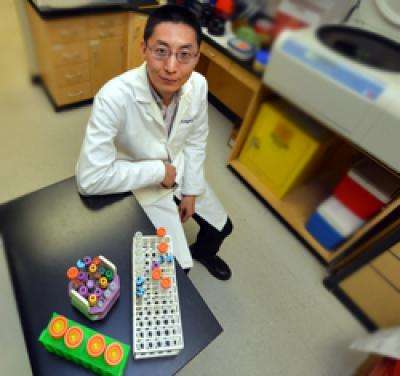
Food and environment can chemically alter your gene function and scientists have identified a gene that is consistently altered in obesity. Credit: Phil Jones, GRU campus photographer
Food and environment can chemically alter your gene function and scientists have identified a gene that is consistently altered in obesity.
The gene LY86 was among a group of 100 genes identified as likely contributors to obesity through genome-wide association studies comparing the DNA of thousands of obese and lean individuals, said Dr. Shaoyong Su, genetic epidemiologist at the Medical College of Georgia at Georgia Regents University.
Su looked at progressively larger groups of obese versus lean individuals and found LY86 consistently and highly chemically altered, or methylated, in the obese individuals. "The association is solid; the methylation of this gene is important in obesity," Su said.
It's known that obesity is highly inheritable; that if parents are obese, children are at higher risk. However environment, including high-fat foods and chemical exposure, can put you at risk as well, said Su. Methylation is one way the body adjusts to its environment.
He received the 2013 Scott Grundy Fellowship Award for Excellence in Metabolism Research for his studies and is presenting the work this week during the Epidemiology and Prevention/Nutrition, Physical Activity and Metabolism Scientific Session of the American Heart Association in New Orleans.
Previously LY86 had been known as an inflammation gene and Su's studies show, in fact, it may be contributing to more than just obesity. He found high methylation of LY86 also was associated with increased inflammation – a risk factor for a variety of maladies such as heart disease and cancer – as well as insulin resistance, a cause of diabetes. This association also held up among a group of about 703 subjects that, like the general public, included obese, lean and average-weight individuals.
Now he wants to go back to the animal model to see whether methylation changes gene expression up or down in fat mice as well as fat, pregnant mice and their offspring. He believes that a lot of methylation starts in the womb and there are unfortunate real-life circumstances that support that theory.
For example, in the Dutch famine of 1944 near the end of World War II, babies born to starving mothers experienced DNA methylation that made them better able to survive such depravation, but in the more plentiful environment in which they grew up, put them at increased risk for cardiovascular disease as well as diabetes, obesity and other health problems.
He's already moving forward with more human studies as well, looking at a new group of lean and obese individuals, analyzing their DNA expression to see if increased methylation of LY86 means the gene is expressed more or less. Generally, higher methylation is thought to translate to lower gene expression.
He also wants to pin down whether methylation results from things like a high-fat diet, unfortunate genetics or both. These types of details may help explain why some individuals grow obese with a bad diet and little physical activity while others don't, Su said. It also may mean that positive environmental change, such as a better diet or more physical activity, can reverse at least some of the methylation. People may not get thin, for example, but they may reduce their risk for obesity-related disease, Su said.
LY86's clear importance in obesity emerged by first merging the gene list from the genome wide association studies with a genome wide methylation database on a small cohort of seven obese and seven lean individuals. The finding of increased methylation held up in subsequent groups of 46 obese/46 leans, 230 obese/413 leans as well as the general population panel of 703 at the GRU Institute of Public and Preventive Health. The research was supported by the National Institutes of Health.
Provided by
Medical College of Georgia
-
Fat associated with chemical changes in DNA that may help explain obesity-related disease
Jan 20, 2011 |
not rated yet |
0
-
Paternal obesity impacts child's chances of cancer
Feb 05, 2013 |
not rated yet |
0
-
Obese moms give birth to heart healthier kids following bariatric surgery
Oct 29, 2012 |
not rated yet |
0
-
Obese father rats have unhealthy daughters
Oct 21, 2010 |
not rated yet |
0
-
New insights into why humans are more susceptible to cancer and other diseases
Aug 23, 2012 |
not rated yet |
0
-
Motion perception revisited: High Phi effect challenges established motion perception assumptions
Apr 23, 2013 |
3 / 5 (2) |
2
-
Anything you can do I can do better: Neuromolecular foundations of the superiority illusion (Update)
Apr 02, 2013 |
4.5 / 5 (11) |
5
-
The visual system as economist: Neural resource allocation in visual adaptation
Mar 30, 2013 |
5 / 5 (2) |
9
-
Separate lives: Neuronal and organismal lifespans decoupled
Mar 27, 2013 |
4.9 / 5 (8) |
0
-
Sizing things up: The evolutionary neurobiology of scale invariance
Feb 28, 2013 |
4.8 / 5 (10) |
14
-
Classical and Quantum Mechanics via Lie algebras
Apr 15, 2011
- More from Physics Forums - Independent Research
More news stories
Researchers identify new circadian clock component
Northwestern University scientists have shown a gene involved in neurodegenerative disease also plays a critical role in the proper function of the circadian clock.
Genetics
May 16, 2013 |
3 / 5 (1) |
0
|
Returning genetic incidental findings without patient consent violates basic rights, experts say
Informed consent is the backbone of patient care. Genetic testing has long required patient consent and patients have had a "right not to know" the results. However, as 21st century medicine now begins to use the tools of ...
Genetics
May 16, 2013 |
5 / 5 (1) |
3
|
Ethicists provide framework supporting new recommendations on reporting incidental findings in gene sequencing
In a paper published in Science Express, a group of experts led by bioethicists in the Center for Medical Ethics and Health Policy at Baylor College of Medicine provide a framework for the new American College of Medical Geneti ...
Genetics
May 16, 2013 |
not rated yet |
0
Experts urge caution over use of new genetic sequencing techniques
The use of genome-wide analysis (GWA), where the entirety of an individual's DNA is examined to look for the genomic mutations or variants which can cause health problems is a massively useful technology for diagnosing disease. ...
Genetics
May 16, 2013 |
not rated yet |
0
Collecting DNA for human rights: How to help while safeguarding privacy
DNA databases might help identify victims of crime and human trafficking, but how do we safeguard the personal privacy of innocent victims and family members? A new report online May 15 in the Cell Press journal Trends in ...
Genetics
May 15, 2013 |
not rated yet |
0
Researchers identify a potential new risk for sleep apnea: Asthma
Researchers at the University of Wisconsin have identified a potential new risk factor for obstructive sleep apnea: asthma. Using data from the National Institutes of Health (Heart, Lung, and Blood Institute)-funded Wisconsin ...
Study finds that sleep apnea and Alzheimer's are linked
A new study looking at sleep-disordered breathing (SDB) and markers for Alzheimer's disease (AD) risk in cerebrospinal fluid (CSF) and neuroimaging adds to the growing body of research linking the two.
Computational tool translates complex data into simplified 2-dimensional images
In their quest to learn more about the variability of cells between and within tissues, biomedical scientists have devised tools capable of simultaneously measuring dozens of characteristics of individual ...
New theory on genesis of osteoarthritis comes with successful therapy in mice
Scientists at Johns Hopkins have turned their view of osteoarthritis (OA) inside out. Literally. Instead of seeing the painful degenerative disease as a problem primarily of the cartilage that cushions joints, ...
Ginger compounds may be effective in treating asthma symptoms
Gourmands and foodies everywhere have long recognized ginger as a great way to add a little peppery zing to both sweet and savory dishes; now, a study from researchers at Columbia University shows purified components of the ...
'Gap' for HIV vaccine efforts after latest setback
The hunt for an HIV vaccine has gobbled up $8 billion in the past decade, and the failure of the most recent efficacy trial has delivered yet another setback to 26 years of efforts.