Whoa there! A quick switch to 'barefoot' shoes can be bad to the bone
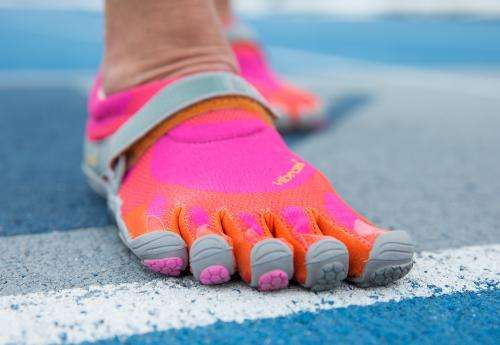
Minimalist five-finger running shoes, subject of a new BYU exercise science study.
(Medical Xpress)—For the growing number of runners who are considering trying "barefoot" five-finger running shoes, researchers at BYU have a message for you: Take it slow!
A new study from a team of exercise science professors found that runners who transition too quickly to minimalist shoes suffer an increased risk of injury to bones in the foot, including possible stress fractures.
With minimalist shoes now making up 15 percent of the $6.5 billion running shoe market, the findings are nothing to run from.
"Transitioning to minimalist shoes is definitely stressful to the bones," said Sarah Ridge, study lead author and assistant professor of exercise science at BYU. "You have to be careful in how you transition and most people don't think about that; they just want to put the shoes on and go."
The research, appearing online ahead of print in the journal Medicine & Science in Sports & Exercise, studied 36 experienced runners over a 10-week period.
This video is not supported by your browser at this time.
Each runner first underwent MRIs on their feet prior to the study period. Half of the runners were then asked to gradually transition into five-finger minimalist shoes while the other half continued to run in traditional running shoes.Subjects in the experimental group followed an industry suggested protocol. They did one short (1-2 mile) run in the minimalist shoes the first week, and added an additional short run each week so that they ran at least 3 miles in the new shoes by week three. They were then told to add mileage in the minimal shoes as they felt comfortable, with the goal of replacing one short run per week in traditional shoes with the new shoes.
At the end of the 10-week period, MRIs were again conducted. The MRIs revealed that those who had transitioned to the minimalist shoes suffered greater increases in bone marrow edema (inflammation causing excessive fluid in the bone) and more stress injuries than those in traditional shoes.
"Whenever a bone is impacted by running (or some other repetitive action), it goes through a normal remodeling process to get stronger," Ridge said. "Injury occurs when the impact is coming too quickly or too powerfully, and the bone doesn't have a chance to properly remodel before impact reoccurs."
Interestingly, the study found the majority of those who suffered stress injuries were women.
Ridge and her coauthors, which include BYU exercise science faculty Wayne Johnson, Ulrike Mitchell and Iain Hunter, said the study does not mean minimalist shoes are bad.
Rather, to minimize the risk of injuries, runners should transition over a longer duration than 10 weeks and at a lower intensity (miles per week).
"People need to remember they've grown up their whole life wearing a certain type of running shoes and they need to give their muscles and bones time to make the change," Johnson said. "If you want to wear minimalist shoes, make sure you transition slowly."
This is the first of many studies looking at minimalist running shoes, the authors said. Over the next several months they plan to publish enough research to begin to establish clear recommendations for anyone considering making the switch.
More information: journals.lww.com/a… o.98436.aspx
Journal reference:
Medicine & Science in Sports & Exercise
Provided by
Brigham Young University
-
Study examines link between runners' foot injuries, ill-fitting shoes
Oct 09, 2012 |
not rated yet |
0
-
The Olympics and bare feet: What have we learned?
Jul 27, 2012 |
not rated yet |
0
-
Expensive trainers are a waste of money
Oct 11, 2007 |
not rated yet |
0
-
Running shoes may cause damage to knees, hips and ankles
Jan 04, 2010 |
not rated yet |
0
-
Runners: Prevent injury by avoiding common mistakes
Oct 12, 2012 |
not rated yet |
0
-
Motion perception revisited: High Phi effect challenges established motion perception assumptions
Apr 23, 2013 |
3 / 5 (2) |
2
-
Anything you can do I can do better: Neuromolecular foundations of the superiority illusion (Update)
Apr 02, 2013 |
4.5 / 5 (11) |
5
-
The visual system as economist: Neural resource allocation in visual adaptation
Mar 30, 2013 |
5 / 5 (2) |
9
-
Separate lives: Neuronal and organismal lifespans decoupled
Mar 27, 2013 |
4.9 / 5 (8) |
0
-
Sizing things up: The evolutionary neurobiology of scale invariance
Feb 28, 2013 |
4.8 / 5 (10) |
14
-
Classical and Quantum Mechanics via Lie algebras
Apr 15, 2011
- More from Physics Forums - Independent Research
More news stories
Seniors more likely to crash when driving with pet, study finds
(HealthDay)—Animals make great companions for senior citizens, but elderly people who always drive with a pet in the car are far more likely to crash than those who never drive with a pet, researchers have ...
Health
11 hours ago |
not rated yet |
1
Driving and hands-free talking lead to spike in errors, study shows
Talking on a hands-free device while behind the wheel can lead to a sharp increase in errors that could imperil other drivers on the road, according to new research from the University of Alberta.
Health
May 24, 2013 |
not rated yet |
1
About one in four uninsured could be excluded from ACA
(HealthDay)—More than one in four of those eligible for new premium assistance tax credits under the Affordable Care Act (ACA) do not have a checking account and will not be able to receive premiums from ...
Health
May 24, 2013 |
not rated yet |
0
Audiologists recommend smart phone apps to monitor noise levels
After studying noise in one French Quarter neighborhood of New Orleans to determine whether or not noise levels exceeded municipal ordinances, Annette Hurley, PhD, Assistant Professor of Audiology at LSU Health Sciences Center ...
Health
May 24, 2013 |
not rated yet |
0
Young children who miss well-child visits are more likely to be hospitalized
Young children who missed more than half of recommended well-child visits had up to twice the risk of hospitalization compared to children who attended most of their visits, according to a study published today in the American Jo ...
Health
May 24, 2013 |
not rated yet |
0
First drug to improve heart failure mortality in over a decade
Coenzyme Q10 decreases all cause mortality by half, according to the results of a multicentre randomised double blind trial presented today at Heart Failure 2013 congress. It is the first drug to improve heart failure mortality ...
Heart failure accelerates male 'menopause'
Heart failure accelerates the aging process and brings on early andropausal syndrome (AS), according to research presented today at the Heart Failure Congress 2013. AS, also referred to as male 'menopause', was four times ...
New immune system discovered
(Medical Xpress)—A research team, led by Jeremy Barr, a biology post-doctoral fellow, unveils a new immune system that protects humans and animals from infection.
Death highest in heart failure patients admitted in January, on Friday, and overnight
Mortality and length of stay are highest in heart failure patients admitted in January, on Friday, and overnight, according to research presented today at the Heart Failure Congress 2013. The analysis of nearly 1 million ...
Feds fight morning-after pill age ruling in NY
(AP)—Department of Justice lawyers have again asked a federal appeals court in New York to delay lifting age restrictions and prescription requirements on an emergency contraceptive popularly known as the morning-after ...
Brain can be trained in compassion, study shows
Until now, little was scientifically known about the human potential to cultivate compassion—the emotional state of caring for people who are suffering in a way that motivates altruistic behavior.