Brain regions can take short naps during wakefulness, leading to errors
April 27, 2011 in Neuroscience
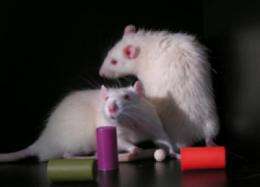
A photo of rats with objects introduced into their cages to keep them awake. Credit: Giulio Tononi, M.D., Ph.D., University of Wisconsin-Madison
If you've ever lost your keys or stuck the milk in the cupboard and the cereal in the refrigerator, you may have been the victim of a tired brain region that was taking a quick nap.
Researchers at the University of Wisconsin-Madison have a new explanation. They've found that some nerve cells in a sleep-deprived yet awake brain can briefly go "off line," into a sleep-like state, while the rest of the brain appears awake.
"Even before you feel fatigued, there are signs in the brain that you should stop certain activities that may require alertness," says Dr. Chiara Cirelli, professor of psychiatry at the School of Medicine and Public Health. "Specific groups of neurons may be falling asleep, with negative consequences on performance."
Until now, scientists thought that sleep deprivation generally affected the entire brain. Electroencephalograms (EEGs) show network brain-wave patterns typical of either being asleep or awake.
"We know that when we are sleepy, we make mistakes, our attention wanders and our vigilance goes down," says Cirelli. "We have seen with EEGs that even while we are awake, we can experience shorts periods of 'micro sleep.' "
Periods of micro sleep were thought to be the most likely cause of people falling asleep at the wheel while driving, Cirelli says.
But the new research found that even before that stage, brains are already showing sleep-like activity that impairs them, she says.
• Follow Medical Xpress on Facebook!
• Follow Medical Xpress on Twitter!
As reported in the current issue of Nature, the researchers inserted probes into specific groups of neurons in the brains of freely-behaving rats. After the rats were kept awake for prolonged periods, the probes showed areas of "local sleep" despite the animals' appearance of being awake and active.
"Even when some neurons went off line, the overall EEG measurements of the brain indicated wakefulness in the rats," Cirelli says.
And there were behavioral consequences to the local sleep episodes.
"When we prolonged the awake period, we saw the rats start to make mistakes," Cirelli says.
When animals were challenged to do a tricky task, such as reaching with one paw to get a sugar pellet, they began to drop the pellets or miss in reaching for them, indicating that a few neurons might have gone off line.
"This activity happened in few cells," Cirelli adds. "For instance, out of 20 neurons we monitored in one experiment, 18 stayed awake. From the other two, there were signs of sleepbrief periods of activity alternating with periods of silence."
The researchers tested only motor tasks, so they concluded from this study that neurons affected by local sleep are in the motor cortex.
More information: Local sleep in awake rats. Vyazovskiy VV, Olcese U, Hanlon EC, Nir Y, Cirelli C, Tononi G. Nature. 2011 April 28.
Provided by
University of Wisconsin-Madison
-
Brain responds same to acute and chronic sleep loss
Aug 09, 2010 |
not rated yet |
0
-
Sleep: Spring cleaning for the brain?
Apr 02, 2009 |
not rated yet |
0
-
Brain's energy restored during sleep, suggests animal study
Jun 29, 2010 |
not rated yet |
0
-
What happens when we sleep
Jan 28, 2009 |
not rated yet |
0
-
Brain tweak lets sleep-deprived flies stay sharp
Jul 31, 2008 |
not rated yet |
0
-
Motion perception revisited: High Phi effect challenges established motion perception assumptions
Apr 23, 2013 |
3 / 5 (2) |
2
-
Anything you can do I can do better: Neuromolecular foundations of the superiority illusion (Update)
Apr 02, 2013 |
4.5 / 5 (11) |
5
-
The visual system as economist: Neural resource allocation in visual adaptation
Mar 30, 2013 |
5 / 5 (2) |
9
-
Separate lives: Neuronal and organismal lifespans decoupled
Mar 27, 2013 |
4.9 / 5 (8) |
0
-
Sizing things up: The evolutionary neurobiology of scale invariance
Feb 28, 2013 |
4.8 / 5 (10) |
14
-
Why is zone 1 in liver more prone to ischemic injury?
May 23, 2013
-
How can there be villous adenoma in colon, if there are no villi there
May 22, 2013
-
How can there be a term called "intestinal metaplasia" of stomach
May 21, 2013
-
Pressure-volume curve: Elastic Recoil Pressure don't make sense
May 18, 2013
-
If you became brain-dead, would you want them to pull the plug?
May 17, 2013
-
MRI bill question
May 15, 2013
- More from Physics Forums - Medical Sciences
More news stories
New neuron formation could increase capacity for new learning, at the expense of old memories
New research presented today shows that formation of new neurons in the hippocampus - a brain region known for its importance in learning and remembering - could cause forgetting of old memories by causing a reorganization ...
Neuroscience
May 24, 2013 |
4 / 5 (4) |
0
Help at hand for people with schizophrenia
How can healthy people who hear voices help schizophrenics? Finding the answer for this is at the centre of research conducted at the University of Bergen.
Neuroscience
May 24, 2013 |
4 / 5 (2) |
2
Japanese research organizations contribute to Human Brain Project
One of the major frontiers of modern science is a comprehensive understanding of the human brain and its functions to guide the development of new technologies in information and communication. In a major announcement for ...
Neuroscience
May 24, 2013 |
3.7 / 5 (3) |
0
Controlling mood through the motions of mitochondria
(Medical Xpress)—Regulating the distribution of power in neurons is done by a system that makes the national electric grid look simple by comparison. Each neuron has several thousand mitochondria confined ...
Neuroscience
May 23, 2013 |
4.9 / 5 (10) |
0
|
Brain uses internal 'average voice' prototype to identify who is talking
(Medical Xpress)—The human brain is able to identify individuals' voices by comparing them against an internal 'average voice' prototype, according to neuroscientists.
Neuroscience
May 23, 2013 |
3.7 / 5 (3) |
3
|
First drug to improve heart failure mortality in over a decade
Coenzyme Q10 decreases all cause mortality by half, according to the results of a multicentre randomised double blind trial presented today at Heart Failure 2013 congress. It is the first drug to improve heart failure mortality ...
Seniors more likely to crash when driving with pet, study finds
(HealthDay)—Animals make great companions for senior citizens, but elderly people who always drive with a pet in the car are far more likely to crash than those who never drive with a pet, researchers have ...
Heart failure accelerates male 'menopause'
Heart failure accelerates the aging process and brings on early andropausal syndrome (AS), according to research presented today at the Heart Failure Congress 2013. AS, also referred to as male 'menopause', was four times ...
Death highest in heart failure patients admitted in January, on Friday, and overnight
Mortality and length of stay are highest in heart failure patients admitted in January, on Friday, and overnight, according to research presented today at the Heart Failure Congress 2013. The analysis of nearly 1 million ...
Feds fight morning-after pill age ruling in NY
(AP)—Department of Justice lawyers have again asked a federal appeals court in New York to delay lifting age restrictions and prescription requirements on an emergency contraceptive popularly known as the morning-after ...
New immune system discovered
(Medical Xpress)—A research team, led by Jeremy Barr, a biology post-doctoral fellow, unveils a new immune system that protects humans and animals from infection.
Apr 28, 2011
Rank: 1 / 5 (1)
Apr 28, 2011
Rank: 1 / 5 (1)
We know that sleep is triggered by a chemical "sleep factor", and it is reasonable to presume that not all neurons are going to be exactly tuned to the same concentration of this sleep factor.
So the ones that are most sensitive, are triggered first. They metabolize the sleep factor and become awake again, and should fall asleep as the sleep factor molecules continue to slowly bind to the sensing proteins.
A good proof of this model would be to show that it is the same neurons that are triggered first in each instance, since this would indicate their chemical sensitivity.
Neural nets are somewhat immune to point defects so would continue to perform - although subnormally - even with some neurons non-functional.
Apr 30, 2011
Rank: not rated yet
May 04, 2011
Rank: not rated yet
May 08, 2011
Rank: not rated yet
The neurotransmitter that you are referring to is known as "Adenosine". It is more likely that neuronal activity suppresses the effects of the neurotransmitter, meaning that parts of the brain that are not directly in use have a chance to fall asleep, rather than some of them being more or less sensitive to the chemical signal. Sleep deprivation studies have shown that while it becomes less effective, and may cause psychological issues, the human brain can technically stay awake indefinitely.
This is rather unsurprising however, when you consider whales and dolphins are able to allow one half of the brain to sleep while the other stays awake.