Discovery helps explain why chemo causes drop in platelet numbers
September 25, 2011 in Cancer

Discovery helps explain why chemo causes drop in platelet numbers

Enlarge

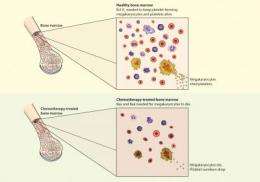
Healthy bone marrow (top) contains many cell types including platelet-producing megakaryocytes (brown). The pro-survival protein Bcl-xL is important for keeping megakaryocytes alive. After chemotherapy (below) many cell types in the bone marrow, including megakaryocytes, are killed through a process requiring the pro-death proteins Bax and Bak. Platelet numbers can be depleted in the blood by chemotherapy because of its toxicity for both platelets and megakaryocytes. Credit: Walter and Eliza Hall Institute of Medical Research

Scientists at the Walter and Eliza Hall Institute have identified a way that chemotherapy causes platelet numbers to drop, answering in the process a decade-old question about the formation of platelets, tiny cells that allow blood to clot.

Platelets are formed by a process called 'shedding' where small fragments break off megakaryocytes (large cells normally found in the ).

Drs Emma Josefsson, Chloé James and Benjamin Kile from the institute's Molecular Medicine and Cancer and Haematology divisions have been investigating how the survival of platelet- forming megakaryocytes is controlled at a molecular level.

The life-or-death decisions of cells are controlled by the Bcl-2 family of proteins. Some 'pro-death' Bcl-2 family proteins cause cells to die, while an opposing 'pro-survival' faction prevents cell death, allowing to survive.

In the past decade it has been thought that platelets are formed by megakaryocytes through a process similar to cell death, Dr Josefsson said. "Our research tested this assumption by examining the molecules that are required for programmed . We found that, at a molecular level, platelet formation does not occur by a death-like process.

"We found that pro-death Bcl-2 family proteins were not required for platelet formation from megakaryocytes," Dr Josefsson said. "In fact, pro-survival Bcl-2 family proteins are essential for keeping megakaryocytes alive so they can make platelets."

Low platelet numbers are a side-effect of chemotherapy and, whilst this has long been ascribed to the death of megakaryocytes and their precursors, the mechanisms responsible have remained unclear. The research team showed that chemotherapy kills megakaryocytes by its action on Bcl-2 family proteins, Dr Josefsson said. "Our work has shown that activates 'pro-death' Bcl-2 proteins to kill megakaryocytes, meaning patients are less capable of producing platelets as they recover from cancer treatment." The research was published today in the Journal of Experimental Medicine.

Institute scientist Professor Don Metcalf has researched blood formation for the past 50 years and was part of the research team. "For the past decade many researchers around the world have been wondering what role Bcl-2-family proteins play in platelet formation," he said. "This study is important for resolving a longstanding debate about platelet formation, and in the long term may lead to new strategies to prevent chemotherapy-induced thrombocytopenia (a deficiency in )."

Provided by Walter and Eliza Hall Institute

not rated yet  

Rank not rated yet
Relevant PhysicsForums posts

More news stories

Cancer survivors need more support to stop smoking and drinking

Cancer survivors are no more likely to stop smoking, cut down on alcohol, or exercise more often than the general population, according to new research published in the British Journal of Cancer today (Wednesday)

Cancer created 20 minutes ago | popularity not rated yet | comments 0

Beta-blockers may boost chemo effect in childhood cancer

Beta-blockers, normally used for high blood pressure, could enhance the effectiveness of chemotherapies in treating neuroblastoma, a type of children's cancer, according to a new study published in the British Jo ...

Cancer created 30 minutes ago | popularity not rated yet | comments 0

Japan hospital tests powerful breast cancer therapy

A Japanese cancer specialist said Wednesday she has started the world's first clinical trial of a powerful, non-surgical, short-term radiation therapy for breast cancer.

Cancer created 40 minutes ago | popularity not rated yet | comments 0

Small cancer risk following CT scans in childhood and adolescence confirmed

The gap between life expectancy in patients with a mental illness and the general population has widened since 1985 and efforts to reduce this gap should focus on improving physical health, suggest researchers in a paper ...

Cancer created 13 hours ago | popularity not rated yet | comments 0

Changing cancer's environment to halt its spread

By studying the roles two proteins, thrombospondin-1 and prosaposin, play in discouraging cancer metastasis, a trans-Atlantic research team has identified a five-amino acid fragment of prosaposin that significantly reduces ...

Cancer created 14 hours ago | popularity not rated yet | comments 0


A molecular explanation for age-related fertility decline in women

(Medical Xpress)—Scientists supported by the National Institutes of Health have a new theory as to why a woman's fertility declines after her mid-30s. They also suggest an approach that might help slow ...

Medical researchers discover new ways to target, develop and design drugs to prevent and treat viral infection

Researchers at the University of Alberta have discovered a new drug target, developed a new drug and identified a new way to design drugs—all of which could be a winning combination in the battle against viruses.

Italy approves law on controversial stem cell therapy

Italian lawmakers on Wednesday gave their final approval to a law that allows limited use of a controversial type of stem cell therapy which has been condemned by many scientists but has given hope to families of terminally-ill ...

Ethicists' behavior not more moral, study finds

(Medical Xpress)—Do ethicists engage in better moral behavior than other professors? The answer is no. Nor are they more likely than nonethicists to act according to values they espouse, according to researchers from the ...

American, Nepalese kids a world apart on social duties

(Medical Xpress)—Preschoolers universally recognize that one's choices are not always free – that our decisions may be constrained by social obligations to be nice to others or follow rules set by parents ...

Targeting the X-factor to tackle cardiovascular disease

New research at The University of Nottingham aimed at preventing harmful blood clots associated with heart disease and stroke has recently received a major funding boost from the British Heart Foundation.