Exercise can produce healthy chatter between bone, fat and pancreatic cells
September 19, 2011 in Medical research
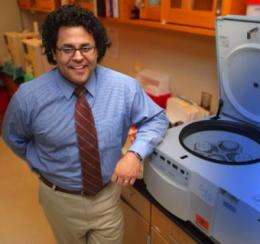
Dr. Norman Pollock of Georgia Health Sciences University has evidence of crosstalk between bone, fat and pancreatic cells in humans. Credit: Phil Jones/GHSU photographer
Cells in bone, fat and the pancreas appear to be talking to each other and one thing they likely are saying is, "Get moving."
A small study of obese children enrolled in after-school exercise programs showed 12 weeks of vigorous exercise resulted in stronger bones, improved insulin sensitivity (reduced diabetes risk) and less of the most-deadly belly, or visceral, fat, Georgia Health Sciences University researchers report.
It also indicated that blood levels of the hormone osteocalcin, made by bone-producing osteoblasts, might be a good indicator of how things are going in all three areas, said Dr. Norman Pollock, bone biologist at GHSU's Georgia Prevention Institute.
Pollock's finding is some of the earliest human evidence of this crosstalk among the divergent cell types. Dr. Gerard Karsenty, Chairman of Genetics and Development at Columbia University Medical Center, provided the first evidence of their conversation in animals. In those studies, animals receiving osteocalcin experienced improved insulin sensitivity, less belly fat and denser bones. Osteocalcin levels have primarily been associated with bone growth.
The work earned Pollock a 2011 American Society for Bone and Mineral Research Young Investigator Award. He is presenting the finding during the society's annual September meeting in San Diego.
There have been pieces of evidence of this communication in humans: people with diabetes get a lot of bone fractures; those with more visceral fat are at risk for diabetes; and bone cells have insulin receptors. Ask Pollock why a bone cell would have an insulin receptor and he says it's a question that many are trying to answer with studies such as this one.
"The idea is that bones can possibly sense environmental stimuli such as being physically active or sedentary and dictate energy regulation accordingly," he said. The reality is bones get bigger and stronger with exercise and they appear to be sharing the good news. "When osteocalcin is released in your blood, that hormone is talking back to the adipocytes, the cells that store fat, and the pancreatic cells that release insulin to improve energy metabolism." Bone researchers like Pollock have previously believed bones were just listening.
His study looked at children who were inactive as well as those who exercised 20 or 40 minutes daily. Osteocalcin levels were measured at the start and finish of the 12-week period in addition to standard assessments such as a glucose tolerance test for insulin sensitivity. They found a consistent dose-response so that the children who exercised the most experienced the most bone formation, improved insulin sensitivity and reduced visceral and total body fat.
Pollock notes that bone and fat cells do have a common ancestry: they are both derived from mesenchymal stem cells. "It's possible that children's early lifestyle habits and experiences may induce alterations in body composition and predispose them to a lifetime of obesity," he said. "As parents, we must ensure that our children balance out their screen time with enjoyable physical activity."
Provided by Georgia Health Sciences University
-
Some overweight adolescents may be at risk for weak bones
Mar 04, 2011 |
not rated yet |
0
-
Diabetes risk in children increases risk for weak bones
Aug 16, 2010 |
not rated yet |
0
-
Bone-cell control of energy generation is regulated by the protein Atf4
Aug 10, 2009 |
not rated yet |
0
-
Study suggests link between metabolic disease, bone mass in mice
Jul 22, 2010 |
not rated yet |
0
-
Breakdown of bone keeps blood sugar in check, new study finds
Jul 22, 2010 |
not rated yet |
0
-
Of mice and mental models: Neuroscientific implications of risk-optimized behavior in the mouse
19 hours ago |
not rated yet |
0
-
Limits to growth: Scientists identify key metastasis-enabling enzyme
May 22, 2012 |
5 / 5 (4) |
0
-
Seeing is as seeing does: Spatially-structured retinal input in early development of cortical maps
Apr 26, 2012 |
5 / 5 (4) |
1
-
Dreamless nights: Brain activity during nonrapid eye movement sleep
Apr 09, 2012 |
4.4 / 5 (12) |
0
-
Take your time: Neurobiology sheds light on the superiority of spaced vs. massed learning
Mar 28, 2012 |
4.5 / 5 (21) |
3
-
A question about drug tolerance
May 23, 2012
-
Poor nutrition leading to overeating?
May 23, 2012
-
Math and dyslexia?
May 21, 2012
-
portable metabolism meter?
May 21, 2012
-
Rare medical conditions on 20/20 tonight
May 18, 2012
-
"Good" Cholesterol in Doubt
May 17, 2012
- More from Physics Forums - Medical Sciences
More news stories
Implantable pain disk may help those with cancer
An estimated 3.5 million cancer patients around the globe are in severe pain from their disease, but many get no relief.
Medical research
17 hours ago |
not rated yet |
0
|
Energy levels link sleep control mechanisms
Sleep, or lack of it, can determine level of cognitive performance which is linked with accidents as well as increased risk of serious health problems. Links between cell energy levels, gene transcription ...
Medical research
19 hours ago |
not rated yet |
0
Researchers identify key brain cell in antidepressant action
(Medical Xpress) -- Antidepressant medications such as Prozac have helped improve mood and lessen anxiety in millions of people with major depression. But scientists know surprisingly little about how these drugs work.
Medical research
19 hours ago |
4.5 / 5 (2) |
0
|
Rockefeller scientists pioneer new method to determine mechanisms of drug action
(Medical Xpress) -- Knowing that a drug works is great. Knowing how it works is a luxury. And until now, determining a drugs mechanism of action has been a tedious and difficult process for scientists.
Medical research
20 hours ago |
not rated yet |
0
|
Like curry? New biological role identified for compound used in ancient medicine
Scientists have just identified a new reason why some curry dishes, made with spices humans have used for thousands of years, might be good for you.
Medical research
May 25, 2012 |
4.3 / 5 (9) |
2
|
Of mice and mental models: Neuroscientific implications of risk-optimized behavior in the mouse
(Medical Xpress) -- Regardless of an organism’s biological complexity, every encephalized animal continuously makes under-informed behavioral choices that can have serious consequences. Despite its ubiquity, ...
Tongue analysis software uses ancient Chinese medicine to warn of disease
For 5,000 years, the Chinese have used a system of medicine based on the flow and balance of positive and negative energies in the body. In this system, the appearance of the tongue is one of the measures used to classify ...
Cancer may require simpler genetic mutations than previously thought
Chromosomal deletions in DNA often involve just one of two gene copies inherited from either parent. But scientists haven't known how a deletion in one gene from one parent, called a "hemizygous" deletion, can contribute ...
Inherited DNA change explains overactive leukemia gene
A small inherited change in DNA is largely responsible for overactivating a gene linked to poor treatment response in people with acute leukemia.
Skp2 activates cancer-promoting, glucose-processing Akt
HER2 and its epidermal growth factor receptor cousins mobilize a specialized protein to activate a major player in cancer development and sugar metabolism, scientists report in the May 25 issue of Cell.
Early physical therapist treatment associated with reduced risk of healthcare utilization and reduced overall healthcare
A new study published in Spine shows that early treatment by a physical therapist for low back pain (LBP), as compared to delayed treatment, was associated with reduced risk of subsequent healthcare utilization and lower ...