Scientists track neuronal stem cells using MRI
September 29, 2011 in Neuroscience
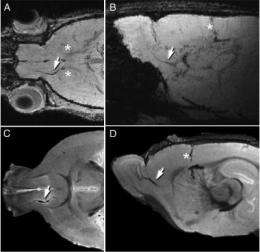
MRI imaging can be used to follow the migration of neuroblasts tagged with a ferritin-based reporter. Tagged cells are pointed out by the white arrows. Credit: Carnegie Mellon University
Carnegie Mellon University biologists have developed an MRI-based technique that allows researchers to non-invasively follow neural stem cells in vivo.
The recently patented technology could be used to further the study of neural stem cells and inform the development of new treatments for brain injury caused by trauma, stroke, Parkinson's disease and other neurological disorders. The findings, authored by Associate Professor of Biological Sciences Eric Ahrens and Biological Sciences postdoctoral student Bistra Iordanova, are published online in the journal NeuroImage.
Legend had it that once a brain cell dies, it's lost forever. Neuroscientists now know that this is purely myth, having proved that the brain is constantly producing new neurons. These neural stem cells are born deep in an area of the brain called the subventricular zone. As time goes on, the cells, also called neuroblasts, make their way to other areas of the brain where they mature into functioning neurons. The brain's ability to regenerate its cells is of great interest to scientists.
"If we could better understand the molecular migratory signals that guide neuroblasts, we could try to redirect these cells to areas of the brain harmed by stroke or traumatic brain injury. With this information, scientists might be able to one day repair the brain," said Ahrens, who also is a member of the Pittsburgh NMR Center for Biomedical Research.
Studying cells in a living brain is problematic. Common forms of in vivo cell imaging like fluorescence and bioluminescence rely on light to produce images, making them unsuitable for viewing neuroblasts buried deep beneath the skull and layers of opaque tissue. Until now, scientists had only been able to study neuronal stem cells by looking at slices of the brain under a microscope. Ahrens was able to surmount this problem using MRI technology.
Rather than light, MRI uses magnets to create high-resolution images. A typical MRI scan uses a magnetic field and radio frequency pulses to cause the hydrogen protons found in the body's water molecules to give off signals. Those signals are converted into a high-resolution image.
At the foundation of this work is a technology Ahrens developed. As reported in a 2005 issue of Nature Medicine, Ahrens developed a method that causes cells to produce their own contrast agent allowing them to be imaged with MRI. Using a viral vector, Ahrens incorporated the gene that produces the naturally occurring metalloprotein ferritin into living cells. Ferritin, which is present in all biological cells, harvests and stores naturally occurring iron. When the cells tagged with ferritin began to produce increased amounts of the protein, they draw in additional iron, turning themselves into nanomagnets. This disrupts the magnetic field surrounding the tagged cells, changing the signal given off by adjacent water molecules. This change appears as dark spots on the MRI image indicating the cells' presence. Since then, Ahrens' team has improved on the process, developing an engineered form of ferritin that is a more effective MRI reporter than naturally occurring ferritin.
In the current study, Iordanova and Ahrens used the same technique as in the initial study, this time tagging neuroblasts with the engineered ferritin. They incorporated the DNA sequence for the engineered metalloprotein into an adenovirus vector, which they then injected into the subventricular zone of a rat brain. The adenovirus infected the neural stem cells giving the cells the genetic instructions to begin producing the ferritin reporter. Iordanova then imaged the brain with MRI and found that she was able to follow in real time the neuroblasts as they traveled toward the olfactory bulb and ultimately formed new inhibitory neurons. These results mirrored what had been observed in histology studies.
Recently, Carnegie Mellon received a patent for the reporter. Ahrens hopes to continue to develop the technology in order to allow researchers to better understand neuronal stem cells and how neurons regenerate. Ahrens also plans to use the reporters to improve clinical trials of cell-based therapies. By incorporating the reporter into the cells before implantation, researchers would be able to find the answer to a number of critical questions.
"Where do these cells go, days, weeks and months later? How do we know that they've grafted to the right cells? Or have they grafted in the wrong place? Or died?" Ahrens asked. "The reporter can show us the answers."
Provided by
Carnegie Mellon University
-
Carnegie Mellon MRI technology that non-invasively locates, quantifies specific cells in the body
Aug 21, 2008 |
not rated yet |
0
-
Study: Neural stem cells are long-lived
Oct 05, 2005 |
not rated yet |
0
-
Researchers Stimulate Growth of Neural Stem Cells in Adult Brain for Treatment of Neurological Disorders
Nov 15, 2006 |
not rated yet |
0
-
Scientists investigate role of stem cells in adult brain cell production
Feb 16, 2009 |
not rated yet |
0
-
Study: How stem cells become brain cells
Dec 15, 2005 |
not rated yet |
0
-
Of mice and mental models: Neuroscientific implications of risk-optimized behavior in the mouse
May 25, 2012 |
not rated yet |
0
-
Limits to growth: Scientists identify key metastasis-enabling enzyme
May 22, 2012 |
5 / 5 (4) |
0
-
Seeing is as seeing does: Spatially-structured retinal input in early development of cortical maps
Apr 26, 2012 |
5 / 5 (4) |
1
-
Dreamless nights: Brain activity during nonrapid eye movement sleep
Apr 09, 2012 |
4.4 / 5 (12) |
0
-
Take your time: Neurobiology sheds light on the superiority of spaced vs. massed learning
Mar 28, 2012 |
4.5 / 5 (21) |
3
-
Potential Breakthrough in Seizure Control
5 hours ago
-
Popping/Cracked sternum.
10 hours ago
-
Which Mental Illness Encompasses This Problem?
10 hours ago
-
A question about drug tolerance
May 23, 2012
-
Poor nutrition leading to overeating?
May 23, 2012
-
Math and dyslexia?
May 21, 2012
- More from Physics Forums - Medical Sciences
More news stories
Of mice and mental models: Neuroscientific implications of risk-optimized behavior in the mouse
(Medical Xpress) -- Regardless of an organism’s biological complexity, every encephalized animal continuously makes under-informed behavioral choices that can have serious consequences. Despite its ubiquity, ...
Neuroscience
May 25, 2012 |
not rated yet |
0
|
Persistent sensory experience is good for aging brain
Despite a long-held scientific belief that much of the wiring of the brain is fixed by the time of adolescence, a new study shows that changes in sensory experience can cause massive rewiring of the brain, even as one ages. ...
Neuroscience
May 24, 2012 |
not rated yet |
0
Boundary stops molecule right where it needs to be
A molecule responsible for the proper formation of a key portion of the nervous system finds its way to the proper place not because it is actively recruited, but instead because it can't go anywhere else.
Neuroscience
May 24, 2012 |
not rated yet |
0
|
Locating ground zero: How the brain's emergency workers find the disaster area
Like emergency workers rushing to a disaster scene, cells called microglia speed to places where the brain has been injured, to contain the damage by 'eating up' any cellular debris and dead or dying neurons. ...
Neuroscience
May 24, 2012 |
5 / 5 (2) |
0
|
Genetic 'reset switch' enables signaling pathway to induce multiple developmental outcomes for olfactory neurons
Within the nervous system, a handful of signaling pathways modulate development of a cornucopia of different neuronal subtypes. Even small alterations in neuron differentiation pathways can disrupt subsequent ...
Neuroscience
May 24, 2012 |
not rated yet |
0
Travel to high altitudes tied to Crohn's, colitis flare-ups
(HealthDay) -- People with inflammatory bowel disease, which includes Crohn's disease and colitis, may be at increased risk for flare-ups when they fly or travel to high altitudes for skiing or mountain climbing, ...
Transvaginal mesh op restores pelvic organ prolapse at price
(HealthDay) -- Transvaginal mesh (TVM) procedures are effective for anatomical restoration of pelvic organ prolapse (POP), but patients report a worsening of sexual function following surgery, according to ...
Cancer may require simpler genetic mutations than previously thought
Chromosomal deletions in DNA often involve just one of two gene copies inherited from either parent. But scientists haven't known how a deletion in one gene from one parent, called a "hemizygous" deletion, can contribute ...
Inherited DNA change explains overactive leukemia gene
A small inherited change in DNA is largely responsible for overactivating a gene linked to poor treatment response in people with acute leukemia.
Tongue analysis software uses ancient Chinese medicine to warn of disease
For 5,000 years, the Chinese have used a system of medicine based on the flow and balance of positive and negative energies in the body. In this system, the appearance of the tongue is one of the measures used to classify ...
Skp2 activates cancer-promoting, glucose-processing Akt
HER2 and its epidermal growth factor receptor cousins mobilize a specialized protein to activate a major player in cancer development and sugar metabolism, scientists report in the May 25 issue of Cell.