Eating fish can reduce the risk of diabetes
November 11, 2011 in Health
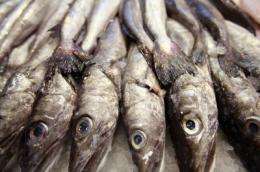
Various hypotheses have been put forward that attempt to explain why the consumption of fish can be related to diabetes. The increase of omega-3 in the cells of the skeletal muscles improves insulin sensitivity. Credit: SINC
A study analyses the dietary patterns of the adult Spanish population with high cardiovascular risk. The results reveal a high consumption of both red meat and fish. However, whilst eating lots of cured meats is associated with greater weight gain and a higher obesity rate, the consumption of fish is linked to lower glucose concentrations and a smaller risk of developing diabetes.
Mercedes Sotos Prieto, lead author of the study which forms part of the Predimed study (Prevention with a Mediterranean Diet) and researcher at the University of Valencia explains how "in Mediterranean countries, consumption of foods that typically form part of the diet here has decreased in recent decades. The consumption of saturated fats mainly from red meats and industrial baking has increased and this is really worrying."
Conducted in the Valencian Community on 945 people (340 men and 605 women) between 55 and 80 years of age and with a high cardiovascular risk, the aim of the study was to understand dietary patterns in terms of meat and fish consumption. It also sought to understand the correlation between the Mediterranean diet and its association with cardiovascular risk factors.
The results were published in the Nutrición Hospitalaria journal and show that the studied Mediterranean population eat a large amount of red meat and fish. However, the consumption of fish is associated with a decreased prevalence of diabetes and lower glucose concentrations whereas the consumption of red meat, especially cured meats is related to increased weight gain and obesity.
The researcher points out that "the red meat consumption of the sample population reaches an average of once a day, which is high in comparison to dietary recommendations. This could be influenced by many weight-loss diets which recommend eating grilled veal."
Eating red meat in excess is linked to higher cardiovascular risk, higher blood pressure, diabetes and a moderate decrease in life expectancy mainly due to cancer or heart disease. In contrast, fish appears in the Mediterranean diet and has health benefits for the heart.
Despite being a cross-sectional study that does not determine a causal effect, its authors confirm that there are many similar studies where the consumption of fish, both white and, even more so oily fish, is associated with a lower risk of developing diabetes type 2.
"Various hypotheses have been put forward that attempt to explain why the consumption of fish can be related to diabetes," they explain. "The increase of omega-3 in the cells of the skeletal muscles improves insulin sensitivity."
"It is important to understand the dietary patterns of the Spanish population in order to learn whether dietary habits are changing. We should therefore strengthen dietary education," outlines Mercedes Sotos Prieto, who goes on to say that "we ought to establish dietary intervention programmes so that we do not stray from the Mediterranean diet. In other words, such a diet involves decreasing the amount of red meat that we eat and maintaining equal levels of fish consumption."
Gender Differences
The high intake of saturated fats from red and cured meat consumption (7.4 +/- 4.7 times a week) was more frequent in men. Women proved to eat more white meat, especially chicken and turkey.
As for fish consumption (4.5 +/- 2.6 times a week), no significant differences were found between men and women. In general, women scored higher for "healthy dietary patterns" or "healthy diets" compared to men.
Provided by FECYT - Spanish Foundation for Science and Technology
-
Diet high in vegetables and fruit associated with less weight gain in African-American women
May 20, 2011 |
not rated yet |
0
-
Mediterranean diet: A heart-healthy plan for life
Mar 07, 2011 |
not rated yet |
0
-
Women who consume olive oil preserve their bone mass better
Feb 18, 2009 |
not rated yet |
0
-
Red meat linked to increased risk of type 2 diabetes
Aug 10, 2011 |
not rated yet |
0
-
Burgers, fries, diet soda: Metabolic syndrome blue-plate special
Jan 22, 2008 |
not rated yet |
0
-
Of mice and mental models: Neuroscientific implications of risk-optimized behavior in the mouse
May 25, 2012 |
not rated yet |
0
-
Limits to growth: Scientists identify key metastasis-enabling enzyme
May 22, 2012 |
5 / 5 (4) |
0
-
Seeing is as seeing does: Spatially-structured retinal input in early development of cortical maps
Apr 26, 2012 |
5 / 5 (4) |
1
-
Dreamless nights: Brain activity during nonrapid eye movement sleep
Apr 09, 2012 |
4.4 / 5 (12) |
0
-
Take your time: Neurobiology sheds light on the superiority of spaced vs. massed learning
Mar 28, 2012 |
4.5 / 5 (21) |
3
-
Classical and Quantum Mechanics via Lie algebras
Apr 15, 2011
- More from Physics Forums - Independent Research
More news stories
Most occupational injury and illness costs are paid by the government and private payers
UC Davis researchers have found that workers' compensation insurance is not used nearly as much as it should be to cover the nation's multi-billion dollar price tag for workplace illnesses and injuries. Instead, almost 80 ...
Health
21 hours ago |
not rated yet |
0
Early physical therapist treatment associated with reduced risk of healthcare utilization and reduced overall healthcare
A new study published in Spine shows that early treatment by a physical therapist for low back pain (LBP), as compared to delayed treatment, was associated with reduced risk of subsequent healthcare utilization and lower ...
Health
May 25, 2012 |
not rated yet |
0
|
Cancer patients share web info with docs for insight, advice
(HealthDay) -- Cancer patients' primary goal in talking with their doctors about information they've found on the Internet is to get more insight and advice on the online information, new research indicates.
Health
May 25, 2012 |
not rated yet |
0
P&G to add latches to make detergent packs safer
(AP) -- Procter & Gamble says it will change the design of packaging for its miniature laundry detergent product to deter children from eating the brightly colored packets that look like candy.
Health
May 25, 2012 |
not rated yet |
0
In Spain, 70 percent of women use contraceptives during their first sexual encounter
Contraceptive use in Spain during the first sexual encounter is similar to other European countries. However, there are some geographical differences between Spanish regions: women in Murcia use contraceptives ...
Health
May 25, 2012 |
not rated yet |
0
Travel to high altitudes tied to Crohn's, colitis flare-ups
(HealthDay) -- People with inflammatory bowel disease, which includes Crohn's disease and colitis, may be at increased risk for flare-ups when they fly or travel to high altitudes for skiing or mountain climbing, ...
Family history of Alzheimer's affects functional connectivity
(HealthDay) -- Cognitively normal individuals with a family history of late-onset Alzheimer's disease (AD) may display lower resting state functional connectivity in the default mode network (DMN) of the brain, ...
Transvaginal mesh op restores pelvic organ prolapse at price
(HealthDay) -- Transvaginal mesh (TVM) procedures are effective for anatomical restoration of pelvic organ prolapse (POP), but patients report a worsening of sexual function following surgery, according to ...
Tongue analysis software uses ancient Chinese medicine to warn of disease
For 5,000 years, the Chinese have used a system of medicine based on the flow and balance of positive and negative energies in the body. In this system, the appearance of the tongue is one of the measures used to classify ...
Of mice and mental models: Neuroscientific implications of risk-optimized behavior in the mouse
(Medical Xpress) -- Regardless of an organism’s biological complexity, every encephalized animal continuously makes under-informed behavioral choices that can have serious consequences. Despite its ubiquity, ...
Weight struggles? Blame new neurons in your hypothalamus
New nerve cells formed in a select part of the brain could hold considerable sway over how much you eat and consequently weigh, new animal research by Johns Hopkins scientists suggests in a study published in the May issue ...
Nov 12, 2011
Rank: not rated yet