New discovery expected to significantly change biomedical research
December 19, 2011 in Cancer

The method borrows from a simple method used in stem cell research

Enlarge

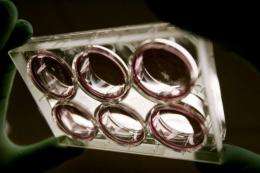
File illustration photo shows a dish of stem cell cultures in a lab. US researchers said Monday they have discovered how to keep tumor cells alive in a lab, generating buzz in the scientific community about a potential breakthrough that could transform cancer treatment.

In a major step that could revolutionize biomedical research, scientists have discovered a way to keep normal cells as well as tumor cells taken from an individual cancer patient alive in the laboratory — which previously had not been possible. Normal cells usually die in the lab after dividing only a few times, and many common cancers will not grow, unaltered, outside of the body.

This new technique, described today online in the , could be the critical advance that ushers in a new era of personalized cancer medicine, and has potential application in regenerative medicine, says the study's senior investigator, Richard Schlegel, M.D., Ph.D., chairman of the department of pathology at Georgetown Lombardi Comprehensive Cancer Center, a part of Georgetown University Medical Center.

"Because every tumor is unique, this advance will make it possible for an oncologist to find the right therapies that both kills a patient's cancer and spares normal from toxicity," he says. "We can test resistance as well chemosensitivity to single or combination therapies directly on the cancer cell itself."

The research team, which also includes several scientists from the National Institutes of Health, found that adding two different substances to cancer and in a laboratory pushes them to morph into stem-like cells — adult cells from which other cells are made.

The two substances are a Rho kinase (ROCK) inhibitor and fibroblast feeder cells. ROCK inhibitors help stop cell movement, but it is unclear why this agent turns on stem cell attributes, Schlegel says. His co-investigator Alison McBride, Ph.D., of the National Institute of Allergy and Infectious Diseases, had discovered that a ROCK inhibitor allowed skin cells (keratinocytes) to reproduce in the laboratory while feeder cells kept them alive.

The Georgetown researchers — 13 investigators in the departments of pathology and oncology — tried ROCK inhibitors and fibroblast feeder cells on the non-keratinocyte epithelial cells that line glands and organs to see if they had any effect. They found that both were needed to produce a dramatic effect in which the cells visibly changed their shape as they reverted to a stem-like state.

"We tried breast cells and they grew well. We tried prostate cells and their growth was fantastic, which is amazing because it is normally impossible to grow these cells in the lab," Schlegel says. "We found the same thing with lung and colon cells that have always been difficult to grow."

"In short, we discovered we can grow normal and from the same patient forever, and nobody has been able to do that," he says. "Normal cell cultures for most organ systems can't be established in the lab, so it wasn't possible previously to compare normal and tumor cells directly."

The ability to immortalize cancer cells will also make biobanking both viable and relevant, Schlegel says. The researchers further discovered that the stem-like behavior in these cells is reversible. Withdrawing the ROCK inhibitor forces the cells to differentiate into the adult cells that they were initially. This "conditional immortalization" could help advance the field of regenerative medicine, Schlegel says.

However, the most immediate change in medical practice from these findings is the potential they have in "revolutionizing what pathology departments do," Schlegel says.

"Today, pathologists don't work with living tissue. They make a diagnosis from biopsies that are either frozen or fixed and embedded in wax," he says. "In the future, pathologists will be able to establish live cultures of normal and cancerous cells from patients, and use this to diagnose tumors and screen treatments. That has fantastic potential."

Provided by Georgetown University Medical Center search and more info website

5 /5 (7 votes)  

Filter


Move the slider to adjust rank threshold, so that you can hide some of the comments.


Display comments: newest first

kevinrtrs
Dec 19, 2011

Rank: 1 / 5 (3)
Great stuff! It also implies the generation of experimental enzymes becomes possible. The potential for designing and controlling enzyme expression at large is at hand.
dweeb
Dec 19, 2011

Rank: 1 / 5 (2)
"it is unclear why this agent turns on stem cell attributes"
"Withdrawing the ROCK inhibitor forces the cells to differentiate ..."


OMG ! 'fist pump' ... WHOOT WHOOT WHOOT !!!
kochevnik
Dec 19, 2011

Rank: 3 / 5 (2)
@kevinrtrs You do realize that this, like all feats of man, is the work of the devil? By going down that path you are straying from your one true gawd, and in doing so turning against him and the promise of eternity?
PaulRC
Dec 19, 2011

Rank: 5 / 5 (1)
sounds like a step towards growing new organs, or regeneration....awesome!
aroc91
Dec 19, 2011

Rank: not rated yet
Great stuff! It also implies the generation of experimental enzymes becomes possible. The potential for designing and controlling enzyme expression at large is at hand.


Not until we know the ins and outs of protein folding, which is quite a ways off, based on current folding computational research.
Argiod
Dec 19, 2011

Rank: 1 / 5 (3)
@kochevnik

I suppose it never occurred to you that scientific research may have been a God given gift to mankind as a means of achieving the promised everlasting life spoken of in the Bible? In that case, it would be you who are in jeopardy, not us. Not good to question God's Plan, lest you place yourself in a position of criticizing Him. Of course, this is just my opinion; I could also be wrong. But it is something to consider.
Rank 5 /5 (7 votes)
Relevant PhysicsForums posts

More news stories

Japan hospital tests powerful breast cancer therapy

A Japanese cancer specialist said Wednesday she has started the world's first clinical trial of a powerful, non-surgical, short-term radiation therapy for breast cancer.

Cancer created 9 minutes ago | popularity not rated yet | comments 0

Small cancer risk following CT scans in childhood and adolescence confirmed

The gap between life expectancy in patients with a mental illness and the general population has widened since 1985 and efforts to reduce this gap should focus on improving physical health, suggest researchers in a paper ...

Cancer created 13 hours ago | popularity not rated yet | comments 0

Changing cancer's environment to halt its spread

By studying the roles two proteins, thrombospondin-1 and prosaposin, play in discouraging cancer metastasis, a trans-Atlantic research team has identified a five-amino acid fragment of prosaposin that significantly reduces ...

Cancer created 14 hours ago | popularity not rated yet | comments 0

Novel RNA-based classification system for colorectal cancer

A novel transcriptome-based classification of colon cancer that improves the current disease stratification based on clinicopathological variables and common DNA markers is presented in a study published in PLOS Medicine this w ...

Cancer created 14 hours ago | popularity not rated yet | comments 0

Low radiation scans help identify cancer in earliest stages

A study of veterans at high risk for developing lung cancer shows that low-dose computed tomography (LDCT) can be highly effective in helping clinicians spot tiny lung nodules which, in a small number of patients, may indicate ...

Cancer created 16 hours ago | popularity not rated yet | comments 0


Italy approves law on controversial stem cell therapy

Italian lawmakers on Wednesday gave their final approval to a law that allows limited use of a controversial type of stem cell therapy which has been condemned by many scientists but has given hope to families of terminally-ill ...

Portland, Ore., rejecting water fluoridation

(AP)—The mayor of Portland, Ore., has conceded defeat in an effort to add fluoride to the city's drinking water.

Mysterious illness kills two in southeast Alabama

(AP)—Alabama health officials say a mysterious respiratory illness has left five people hospitalized and two dead in the southeastern part of the state.

Targeting the X-factor to tackle cardiovascular disease

New research at The University of Nottingham aimed at preventing harmful blood clots associated with heart disease and stroke has recently received a major funding boost from the British Heart Foundation.

Study focuses on new mums' sleepiness and injury risk on the road

New mothers throughout Australia are needed to help QUT sleep researchers investigate whether the disrupted sleep experienced by mothers when caring for their new baby raises the risk of injury while driving.

Study says empathy plays a key role in moral judgments

Is it permissible to harm one to save many? Those who tend to say "yes" when faced with this classic dilemma are likely to be deficient in a specific kind of empathy, according to a report published in the scientific journal ...