Learning left from right
December 21, 2011 By Jonathan Wood in Neuroscience

Learning left from right

Enlarge

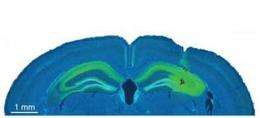
Image: Optogenetics meant only the key neurons in the right side of the mouse hippocampus fired. Credit: Olivia Shipton

(Medical Xpress) -- Pop psychology assertions about left-brain/right-brain differences are pretty much tosh. Our personalities are not dominated by a battle between the creative skills residing in one half of the brain competing with the hard reasoning in the other.

But that’s not to say there aren’t any differences between the left and right sides of our brains. There are some anatomical details that differ between the opposite hemispheres of the brain. Language appears to be localised more to networks in the left brain, and differences in the brain can be seen according to whether we are right-handed or left-handed.

Understanding the detail of these left-right differences – how they occur and how they underlie the processing going on in our brains – is tricky, though.

A research group based at Oxford and Cambridge universities led by Professor Ole Paulsen has been using some of the latest, most precise neuroscience techniques to get a handle on this problem.

The scientists studied recently discovered asymmetries among nerve cells involved in and memory processes in the mouse brain. Their findings were published in Nature Neuroscience.

These particular nerve cells, or neurons, are found in the mouse hippocampus, part of the brain intimately involved in memory.

Neurons in one part of the hippocampus have different numbers of brain-chemical-responding proteins according to whether they are contacted by the left or right side of another region of the hippocampus.

The question is whether this finding of a molecular left-brain/right-brain difference is important: does it play any role in learning and memory?

Standard lab techniques for probing neurons and working out what’s going on tend to use electric currents to stimulate the nerves to fire. But such approaches would not be fine enough or accurate enough to pinpoint differences according to whether signals came from the left or right side of the hippocampus.

So the researchers used laser light and gene technology to gain extra control and be able to define exactly which neurons were being stimulated to fire. The technique, known as optogenetics, was pioneered by Professor Gero Miesenböck at Oxford.

"It enables us to be far more precise about which cells are being activated. We really gain control over what’s happening in a cell," explains Oxford DPhil student Olivia Shipton.

Olivia and her colleagues used this approach to stimulate only the key neurons on the left side of the hippocampus, or alternatively only the neurons on the right.

They then measured what this did in the neurons receiving these connections. They reasoned that if the left-right asymmetry in the hippocampus is important, there may be differences according to which side of the brain the signals came from.

They found that signals coming from the left hippocampus led to a strengthening of long-term electrical connections between . This strengthening of connections is a widely accepted model of learning and memory in the .

"It is thought to be associated with how we lay down new memories," says Olivia.

In contrast, there were no such changes with signals coming from the right hippocampus.

"There was a striking difference. It suggests that the left and right hippocampus in the mouse have distinct functions in learning and memory processes," says Olivia.

She adds that it’s possible to speculate that the right hippocampus may provide a constant signal or context against which new learning could be compared through the left side.

The group now want to explore if this functional difference between the left and right sides of the hippocampus is important in guiding the learning of mice.

They believe it should be possible to use the same techniques to control which sides of the hippocampus fire and whether this affects a mouse’s spatial memory as it learns how to navigate mazes.

Provided by Oxford University search and more info website

3.8 /5 (6 votes)  

Filter


Move the slider to adjust rank threshold, so that you can hide some of the comments.


Display comments: newest first

brodix
Dec 21, 2011

Rank: 1 / 5 (1)
If the left side of the brain is a serial processor, thus forming logical cause and effect connections, it would make sense that these neural connections grow stronger, as we incorporate information. On the other hand, if the right brain is more of a parallel processor and constantly monitoring non-linear input from the environment, possibly it is better not to form too many pre-conclusions that slow down response time. Thought and reaction being necessarily separate survival techniques.
antialias_physorg
Dec 21, 2011

Rank: not rated yet
If the left side of the brain is a serial processor
...
if the right brain is more of a parallel processor

Is there any basis for these statements?

And anyhow: comparing the brain to processors is not a good analogy on any level.
brodix
Dec 21, 2011

Rank: 1 / 5 (1)
antialias,
I googled "brain hemisphere serial processor parallel processor" and came up with 65,700 hits.
E.O. Wilson described the insect brain as a thermostat, in that it responds to non-linear environmental input. Possibly we could use that to describe the right side and the left as a clock, since it records serial events, ie. memory. That work?
The brain is an evolved organ, for navigating and surviving potentially hostile environments. If we want to understand and describe its evolution, these are primary functions.
Egleton
Dec 22, 2011

Rank: not rated yet
Dr Jill Bolte Taylor describes the difference between the left and Right in this TED talk.
http://www.ted.co...ght.html

Iain McGilcrist writes eloquently about the nuance here.
http://en.wikiped...Emissary

A potted version of his work is found on this TED talk
http://www.ted.co...ain.html
Big revelation. You do not have a brain, you have two.
antialias_physorg
Dec 22, 2011

Rank: not rated yet
I googled "brain hemisphere serial processor parallel processor" and came up with 65,700 hits.

So? I googled the wrong spelling for satellite and came up with 600000 hits. What does that prove?

Yes, it was popular at one time to make analogies between nerve cells and processors. Just like it was popular to draw comparisons between entropy and information. Or humans and machines.

But the more we learn about the brain the less it is like a (computer) processor. That only applies in the loosest sense of the term (a processor then being something that taxes in X and creates some transformed reaction Y)

Possibly we could use that to describe the right side and the left as a clock, since it records serial events, ie. memory.

Processors and clocks invoke a sequential image. The brain is highly parallel, reentrant, and non-linear (e.g. nerve cells react vastly different to the same stimulus beind presented twice in rapid succession - something a processor does not)
brodix
Dec 22, 2011

Rank: not rated yet
Antialias,
I certainly agree both analogies are facile and limited. Yes, the brain is an incredibly complex network, but you sounded as though the comparison has something I just dreamed up.
While they are physical networks, they do have both serial and network/non-linear processes, of an organic nature. Does your consciousness form multiple thoughts simultaneously, or generally one at a time? Yes, there is a stew of activity going on in the subconscious, from which interesting connections/insights bubble to the surface. So while it might be a very simplistic description, there are both linear and non-linear processes going on. The evolutionary need is to both sense/analyze the environment and navigate an individual path through it.
Rank 3.8 /5 (6 votes)
Relevant PhysicsForums posts

More news stories

For combat veterans suffering from post-traumatic stress disorder, 'fear circuitry' in the brain never rests

Chronic trauma can inflict lasting damage to brain regions associated with fear and anxiety. Previous imaging studies of people with post-traumatic stress disorder, or PTSD, have shown that these brain regions can over-or ...

Neuroscience created 10 hours ago | popularity not rated yet | comments 0 | with audio podcast

Temporal processing in the olfactory system

The neural machinery underlying our olfactory sense continues to be an enigma for neuroscience. A recent review in Neuron seeks to expand traditional ideas about how neurons in the olfactory bulb might encode information about ...

Neuroscience created 21 hours ago | popularity not rated yet | comments 0 | with audio podcast report

Melon focus headband turns to Kickstarter for rollout plans

(Medical Xpress)—What if the quality of your work depends more on your focus on the piano keys or canvas or laptop than your musical or painting or computing skills? If target users can be convinced, they ...

Neuroscience created 21 hours ago | popularity 3.7 / 5 (3) | comments 0 | with audio podcast weblog

Deep brain stimulation: A fix when the drugs don't work

Neurological disorders can have a devastating impact on the lives of sufferers and their families.

Neuroscience created May 17, 2013 | popularity 5 / 5 (1) | comments 0 | with audio podcast

Brain makes call on which ear is used for cell phone

If you're a left-brain thinker, chances are you use your right hand to hold your cell phone up to your right ear, according to a newly published study from Henry Ford Hospital in Detroit.

Neuroscience created May 16, 2013 | popularity 2 / 5 (2) | comments 0 | with audio podcast


New research identifies risks, interventions for children's GI health

An increasing number of U.S. children are experiencing gastrointestinal issues that require interventions to resolve, according to research presented at Digestive Disease Week (DDW).

New colonoscope provides ground-breaking view of colon

A ground-breaking advance in colonoscopy technology signals the future of colorectal care, according to research presented today at Digestive Disease Week(DDW). Additional research focuses on optimizing the minimal withdrawal ...

AIDS science at 30: 'Cure' now part of lexicon

Big names in medicine are set to give an upbeat assessment of the war on AIDS on Tuesday, 30 years after French researchers identified the virus that causes the disease.

Now we know why old scizophrenia medicine works on antibiotics-resistant bacteria

In 2008 researchers from the University of Southern Denmark showed that the drug thioridazine, which has previously been used to treat schizophrenia, is also a powerful weapon against antibiotic-resistant bacteria such as ...

Individuals who drink heavily and smoke may show 'early aging' of the brain

Treatment for alcohol use disorders works best if the patient actively understands and incorporates the interventions provided in the clinic. Multiple factors can influence both the type and degree of neurocognitive abnormalities ...

College women exceed NIAAA drinking guidelines more frequently than college men

In order to avoid harms associated with alcohol consumption, in 2009 the National Institute on Alcohol Abuse and Alcoholism issued guidelines that define low-risk drinking. These guidelines differ for men and women: no more ...