Scientists identify an innate function of vitamin E
December 20, 2011 in Medical research
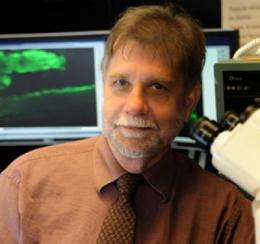
Dr. Paul McNeil, cell biologist at Georgia Health Sciences University, has discovered one of the innate functions of vitamin E. Credit: Phil Jones/GHSU photographer
It's rubbed on the skin to reduce signs of aging and consumed by athletes to improve endurance but scientists now have the first evidence of one of vitamin E's normal body functions.
The powerful antioxidant found in most foods helps repair tears in the plasma membranes that protect cells from outside forces and screen what enters and exits, Georgia Health Sciences University researchers report in the journal Nature Communications.
Everyday activities such as eating and exercise can tear the plasma membrane and the new research shows that vitamin E is essential to repair. Without repair of muscle cells, for example, muscles eventually waste away and die in a process similar to what occurs in muscular dystrophy. Muscle weakness also is a common complaint in diabetes, another condition associated with inadequate plasma membrane repair.
"Without any special effort we consume vitamin E every day and we don't even know what it does in our bodies," said Dr. Paul McNeil, GHSU cell biologist and the study's corresponding author. He now feels confident about at least one of its jobs.
Century-old animal studies linked vitamin E deficiency to muscle problems but how that happens remained a mystery until now, McNeil said. His understanding that a lack of membrane repair caused muscle wasting and death prompted McNeil to look at vitamin E.
Vitamin E appears to aid repair in several ways. As an antioxidant, it helps eliminate destructive byproducts from the body's use of oxygen that impede repair. Because it's lipid-soluble, vitamin E can actually insert itself into the membrane to prevent free radicals from attacking. It also can help keep phospholipids, a major membrane component, compliant so they can better repair after a tear.
For example, exercise causes the cell powerhouse, the mitochondria, to burn a lot more oxygen than normal. "As an unavoidable consequence you produce reactive oxygen species," McNeil said. The physical force of exercise tears the membrane. Vitamin E enables adequate plasma membrane repair despite the oxidant challenge and keeps the situation in check.
When he mimicked what happens with exercise by using hydrogen peroxide to produce free radicals, he found that tears in skeletal muscle cells would not heal unless pretreated with vitamin E.
Next steps, which will be aided by two recent National Institutes of Health grants, include examining membrane repair in vitamin E-deficient animals.
McNeil also wants to further examine membrane repair failure in diabetes. Former GHSU graduate student Dr. Amber C. Howard showed in a recent paper in the journal Diabetes that cells taken from animal models of types 1 and 2 diabetes have faulty repair mechanisms. Howard found high glucose was a culprit by soaking cells in a high-glucose solution for eight to 12 weeks, during which time they developed a repair defect. It's also well documented that reactive oxygen species levels are elevated in diabetes.
The Nature Communications paper showed that vitamin E treatment in an animal model of diabetes restored some membrane repair ability. Also, an analogue of the most biologically active form of vitamin E significantly reversed membrane repair deficits caused by high glucose and increased cell survival after tearing cells in culture.
Now McNeil wants to know if he can prevent the development of advanced glycation end products a sugar that high glucose adds to proteins that his lab has shown can also impede membrane repair in the animal models of diabetes. The researchers have a drug that at least in cultured animal cells, prevents repair defects from advanced glycation end products.
Provided by Georgia Health Sciences University
-
Faulty cell membrane repair causes heart disease
Jul 03, 2007 |
not rated yet |
0
-
Discovery Links Proteins Necessary to Repair Membranes
Jun 11, 2009 |
not rated yet |
0
-
Poor athletic performance linked to vitamin deficiency
Nov 16, 2006 |
not rated yet |
0
-
Vitamin D tied to muscle power in adolescent girls
Feb 03, 2009 |
not rated yet |
0
-
Vitamin D deficiency is associated with different types of obesity in black and white children
Apr 27, 2011 |
not rated yet |
0
-
Motion perception revisited: High Phi effect challenges established motion perception assumptions
Apr 23, 2013 |
3 / 5 (2) |
2
-
Anything you can do I can do better: Neuromolecular foundations of the superiority illusion (Update)
Apr 02, 2013 |
4.5 / 5 (11) |
5
-
The visual system as economist: Neural resource allocation in visual adaptation
Mar 30, 2013 |
5 / 5 (2) |
9
-
Separate lives: Neuronal and organismal lifespans decoupled
Mar 27, 2013 |
4.9 / 5 (8) |
0
-
Sizing things up: The evolutionary neurobiology of scale invariance
Feb 28, 2013 |
4.8 / 5 (10) |
14
-
Why is zone 1 in liver more prone to ischemic injury?
May 23, 2013
-
How can there be villous adenoma in colon, if there are no villi there
May 22, 2013
-
How can there be a term called "intestinal metaplasia" of stomach
May 21, 2013
-
Pressure-volume curve: Elastic Recoil Pressure don't make sense
May 18, 2013
-
If you became brain-dead, would you want them to pull the plug?
May 17, 2013
-
MRI bill question
May 15, 2013
- More from Physics Forums - Medical Sciences
More news stories
Study reveals new mechanism for estrogen suppression of liver lipid synthesis
By discovering the new mechanism by which estrogen suppresses lipid synthesis in the liver, UC Irvine endocrinologists have revealed a potential new approach toward treating certain liver diseases.
Medical research
May 23, 2013 |
5 / 5 (1) |
0
|
MRI-based measurement helps predict vascular disease in the brain
Aortic arch pulse wave velocity, a measure of arterial stiffness, is a strong independent predictor of disease of the vessels that supply blood to the brain, according to a new study published in the June issue the journal ...
Medical research
May 23, 2013 |
not rated yet |
0
Antibiotics: A new understanding of sulfonamide nervous system side effects
Since the discovery of Prontosil in 1932, sulfonamide antibiotics have been used to combat a wide spectrum of bacterial infections, from acne to chlamydia and pneumonia. However, their side effects can include serious neurological ...
Medical research
May 23, 2013 |
3 / 5 (1) |
0
|
Scientists discover molecule triggers sensation of itch
Scientists at the National Institutes of Health report they have discovered in mouse studies that a small molecule released in the spinal cord triggers a process that is later experienced in the brain as ...
Medical research
May 23, 2013 |
5 / 5 (3) |
0
|
Discarded immune cells induce the relocation of stem cells
Spanish researchers have discovered that the daily clearance of neutrophils from the body stimulates the release of hematopoietic stem cells from the bone marrow into the bloodstream, according to a report published today ...
Medical research
May 23, 2013 |
5 / 5 (2) |
0
First drug to improve heart failure mortality in over a decade
Coenzyme Q10 decreases all cause mortality by half, according to the results of a multicentre randomised double blind trial presented today at Heart Failure 2013 congress. It is the first drug to improve heart failure mortality ...
Heart failure accelerates male 'menopause'
Heart failure accelerates the aging process and brings on early andropausal syndrome (AS), according to research presented today at the Heart Failure Congress 2013. AS, also referred to as male 'menopause', was four times ...
Seniors more likely to crash when driving with pet, study finds
(HealthDay)—Animals make great companions for senior citizens, but elderly people who always drive with a pet in the car are far more likely to crash than those who never drive with a pet, researchers have ...
New immune system discovered
(Medical Xpress)—A research team, led by Jeremy Barr, a biology post-doctoral fellow, unveils a new immune system that protects humans and animals from infection.
Brain can be trained in compassion, study shows
Until now, little was scientifically known about the human potential to cultivate compassion—the emotional state of caring for people who are suffering in a way that motivates altruistic behavior.
Do salamanders hold the solution to regeneration?
Salamanders' immune systems are key to their remarkable ability to regrow limbs, and could also underpin their ability to regenerate spinal cords, brain tissue and even parts of their hearts, scientists have ...
Dec 20, 2011
Rank: 5 / 5 (2)
Dec 20, 2011
Rank: not rated yet
Now, can anyone explain to me just why prior to this apparent discovery we referred to this substance as a 'vitamin'.. having no idea if it is needed? 'Consuming' a substance does not imply that it is any 'requirement'..
Dec 20, 2011
Rank: 5 / 5 (1)
Dec 24, 2011
Rank: not rated yet