'Exergames' may provide cognitive benefit for older adults
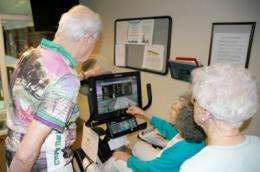
This photo shows a cybercycle demonstration for study participants from the Glen Eddy retirement community in Niskayuna, N.Y. Credit: American Journal of Preventive Medicine
Virtual reality-enhanced exercise, or "exergames," combining physical exercise with computer-simulated environments and interactive videogame features, can yield a greater cognitive benefit for older adults than traditional exercise alone, according to a new study published in the February issue of the American Journal of Preventive Medicine.
"We found that for older adults, virtual-reality enhanced interactive exercise, or 'cybercycling' two to three times per week for 3 months, yielded greater cognitive benefit, and perhaps added protection against mild cognitive impairment (MCI), than a similar dose of traditional exercise," explains lead investigator Cay Anderson-Hanley, PhD, from the Healthy Aging and Neuropsychology Lab and Department of Psychology at Union College, Schenectady, NY.
Research shows that exercise may prevent or delay dementia and improve cognitive functioning in normal aging. However, only 14% of adults aged 65-74 years old, and only 7% of those over 75 report regular exercise. Exergames have the potential to increase exercise by shifting attention from aversive aspects toward motivating features such as competition and three-dimensional scenery, leading to greater frequency and intensity, and enhanced health outcomes.
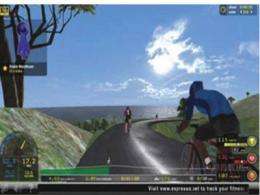
This is a sample screenshot showing scenery and competitors/avatars on an Expresso cybercycle bike tour. Credit: Courtesy of Interactive Fitness Holdings, LLC; American Journal of Preventive Medicine
The Cybercycle Study enrolled 101 volunteers, ranging in age from 58 to 99 years, from independent living facilities with indoor access to an exercise bike. 79 participants completed initial evaluations and training, and rode identical recumbent stationary bikes, except the experimental bike was equipped with a virtual reality display. Cybercycle participants experienced 3D tours and raced against a "ghost rider," an avatar based on their last best ride. 63 adults completed the study, averaging three rides per week. Cognitive assessment to evaluate executive functions such as planning, working memory, attention, and problem solving was conducted at enrollment, 1 month later (pre-intervention) and 3 months after (post-intervention). Blood plasma was tested to measure whether a change in brain-derived neurotrophic growth factor (BDNF) indicated possible neuroplasticity, a mechanism of change that could link exercise to cognition.
The cybercycle riders had significantly better executive function than those who rode a traditional stationary bike, and cybercyclists experienced a 23% reduction in progression to MCI compared to traditional exercisers. Co-principal investigator on the project, Paul Arciero, PhD, professor of health and exercise sciences at Skidmore College, comments, "No difference in exercise frequency, intensity, or duration was found between the two groups, indicating that factors other than effort and fitness were responsible for the cognitive benefit."
"Navigating a 3D landscape, anticipating turns, and competing with others require additional focus, expanded divided attention, and enhanced decision making. These activities depend in part on executive function, which was significantly affected," notes Dr. Anderson-Hanley.
The study also found a significantly greater increase of BDNF in cybercyclists than in traditional riders, suggesting that interactive/combined mental and physical exercise may lead to cognitive benefits by way of biomarkers linked to neurotrophic effects.
"Further research will be needed to tease apart the contributions of a variety of factors in the cybercycling condition," says Dr. Anderson-Hanley. "Consistency across conditions for goal setting and competition suggests virtual reality imagery and interactive decision-making might be potent factors of the cybercycle." Exit interviews provided anecdotal evidence of the value of these unique features. Participants commented on their enjoyment of visual stimulation and the challenge of outpacing avatars.
"The implication of our study is that older adults who choose exergaming with interactive physical and cognitive exercise over traditional exercise may garner added cognitive benefit, and perhaps prevent decline, all for the same exercise effort," concludes Dr. Anderson-Hanley.
More information: The article is "Exergaming and Older Adult Cognition: A Cluster Randomized Clinical Trial," by C. Anderson-Hanley, P.J. Arciero, A.M. Brickman, J.P. Nimon, N. Okuma, S.C. Westen, M.E. Merz, B.D. Pence, J.A. Woods, A.F. Kramer, and E.A. Zimmerman (doi:10.1016/j.amepre.2011.10.016). The article appears in the American Journal of Preventive Medicine, Volume 42, Issue 2 (February 2012)
Provided by
Elsevier
-
Aerobic exercise may reduce the risk of dementia
Sep 07, 2011 |
not rated yet |
0
-
Exercise and mental stimulation bothboost mouse memory late in life
Aug 06, 2007 |
not rated yet |
0
-
Aerobic exercise can increase mental fitness in older people
Apr 16, 2008 |
not rated yet |
0
-
Exercise has numerous beneficial effects on brain health and cognition, review suggests
Jul 25, 2011 |
not rated yet |
0
-
Exercise/memory research for Parkinson's
Dec 12, 2011 |
not rated yet |
0
-
Motion perception revisited: High Phi effect challenges established motion perception assumptions
Apr 23, 2013 |
3 / 5 (2) |
2
-
Anything you can do I can do better: Neuromolecular foundations of the superiority illusion (Update)
Apr 02, 2013 |
4.5 / 5 (11) |
5
-
The visual system as economist: Neural resource allocation in visual adaptation
Mar 30, 2013 |
5 / 5 (2) |
9
-
Separate lives: Neuronal and organismal lifespans decoupled
Mar 27, 2013 |
4.9 / 5 (8) |
0
-
Sizing things up: The evolutionary neurobiology of scale invariance
Feb 28, 2013 |
4.8 / 5 (10) |
14
-
Classical and Quantum Mechanics via Lie algebras
Apr 15, 2011
- More from Physics Forums - Independent Research
More news stories
Driving and hands-free talking lead to spike in errors, study shows
Talking on a hands-free device while behind the wheel can lead to a sharp increase in errors that could imperil other drivers on the road, according to new research from the University of Alberta.
Health
18 hours ago |
not rated yet |
0
About one in four uninsured could be excluded from ACA
(HealthDay)—More than one in four of those eligible for new premium assistance tax credits under the Affordable Care Act (ACA) do not have a checking account and will not be able to receive premiums from ...
Health
20 hours ago |
not rated yet |
0
Audiologists recommend smart phone apps to monitor noise levels
After studying noise in one French Quarter neighborhood of New Orleans to determine whether or not noise levels exceeded municipal ordinances, Annette Hurley, PhD, Assistant Professor of Audiology at LSU Health Sciences Center ...
Health
22 hours ago |
not rated yet |
0
Young children who miss well-child visits are more likely to be hospitalized
Young children who missed more than half of recommended well-child visits had up to twice the risk of hospitalization compared to children who attended most of their visits, according to a study published today in the American Jo ...
Health
22 hours ago |
not rated yet |
0
Do doctors understand the individualisation of treatments?
The individualisation of drug treatments to support patients to self-manage their conditions is a concept that sits at the heart of policy, but a recent study in BMJ Open shows that there is no concrete defini ...
Health
May 24, 2013 |
3 / 5 (1) |
0
First drug to improve heart failure mortality in over a decade
Coenzyme Q10 decreases all cause mortality by half, according to the results of a multicentre randomised double blind trial presented today at Heart Failure 2013 congress. It is the first drug to improve heart failure mortality ...
Heart failure accelerates male 'menopause'
Heart failure accelerates the aging process and brings on early andropausal syndrome (AS), according to research presented today at the Heart Failure Congress 2013. AS, also referred to as male 'menopause', was four times ...
Hormone levels may provide key to understanding psychological disorders in women
Women at a particular stage in their monthly menstrual cycle may be more vulnerable to some of the psychological side-effects associated with stressful experiences, according to a study from UCL.
Researchers identify first drug targets in childhood genetic tumor disorder
Two mutations central to the development of infantile myofibromatosis (IM)—a disorder characterized by multiple tumors involving the skin, bone, and soft tissue—may provide new therapeutic targets, according to researchers ...
Feds fight morning-after pill age ruling in NY
(AP)—Department of Justice lawyers have again asked a federal appeals court in New York to delay lifting age restrictions and prescription requirements on an emergency contraceptive popularly known as the morning-after ...
Death highest in heart failure patients admitted in January, on Friday, and overnight
Mortality and length of stay are highest in heart failure patients admitted in January, on Friday, and overnight, according to research presented today at the Heart Failure Congress 2013. The analysis of nearly 1 million ...
