Research shows brain more flexible, trainable than previously thought
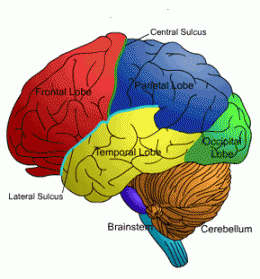
Brain diagram. Credit: dwp.gov.uk
Opening the door to the development of thought-controlled prosthetic devices to help people with spinal cord injuries, amputations and other impairments, neuroscientists at the University of California, Berkeley, and the Champalimaud Center for the Unknown in Portugal have demonstrated that the brain is more flexible and trainable than previously thought.
Their new study, to be published Sunday, March 4, in the advanced online publication of the journal Nature, shows that through a process called plasticity, parts of the brain can be trained to do something it normally does not do. The same brain circuits employed in the learning of motor skills, such as riding a bike or driving a car, can be used to master purely mental tasks, even arbitrary ones.
Over the past decade, tapping into brain waves to control disembodied objects has moved out of the realm of parlor tricks and parapsychology and into the emerging field of neuroprosthetics. This new study advances work by researchers who have been studying the brain circuits used in natural movement in order to mimic them for the development of prosthetic devices.
"What we hope is that our new insights into the brain's wiring will lead to a wider range of better prostheses that feel as close to natural as possible," said Jose Carmena, UC Berkeley associate professor of electrical engineering, cognitive science and neuroscience. "They suggest that learning to control a BMI (brain-machine interface), which is inherently unnatural, may feel completely normal to a person, because this learning is using the brain's existing built-in circuits for natural motor control."
Carmena and co-lead author Aaron Koralek, a UC Berkeley graduate student in Carmena's lab, collaborated on this study with Rui Costa, co-principal investigator of the study and principal investigator at the Champalimaud Neuroscience Program, and co-lead author Xin Jin, a post-doctoral fellow in Costa's lab.
Previous studies have failed to rule out the role of physical movement when learning to use a prosthetic device.
"This is key for people who can't move," said Carmena, who is also co-director of the UC Berkeley-UCSF Center for Neural Engineering and Prostheses. "Most brain-machine interface studies have been done in healthy, able-bodied animals. What our study shows is that neuroprosthetic control is possible, even if physical movement is not involved."
To clarify these issues, the scientists set up a clever experiment in which rats could only complete an abstract task if overt physical movement was not involved. The researchers decoupled the role of the targeted motor neurons needed for whisker twitching with the action necessary to get a food reward.
The rats were fitted with a brain-machine interface that converted brain waves into auditory tones. To get the food reward either sugar-water or pellets the rats had to modulate their thought patterns within a specific brain circuit in order to raise or lower the pitch of the signal.
Auditory feedback was given to the rats so that they learned to associate specific thought patterns with a specific pitch. Over a period of just two weeks, the rats quickly learned that to get food pellets, they would have to create a high-pitched tone, and to get sugar water, they needed to create a low-pitched tone.
If the group of neurons in the task were used for their typical function whisker twitching there would be no pitch change to the auditory tone, and no food reward.
"This is something that is not natural for the rats," said Costa. "This tells us that it's possible to craft a prosthesis in ways that do not have to mimic the anatomy of the natural motor system in order to work."
The study was also set up in a way that demonstrated intentional, as opposed to habitual, behavior. The rats were able to vary the amount of pellets or sugar water received based upon their own level of hunger or thirst.
"The rats were aware; they knew that controlling the pitch of the tone was what gave them the reward, so they controlled how much sugar water or how many pellets to take, when to do it, and how to do it in absence of any physical movement," said Costa.
Researchers hope these findings will lead to a new generation of prosthetic devices that feel natural.
"We don't want people to have to think too hard to move a robotic arm with their brain," said Carmena.
Provided by
University of California - Berkeley
-
Brain develops motor memory for prosthetics, study finds
Jul 21, 2009 |
not rated yet |
0
-
What do animals 'know'? More than you may think
Dec 09, 2011 |
not rated yet |
0
-
Neurobiologists uncover evidence of a 'memory code'
Sep 08, 2005 |
not rated yet |
0
-
Researchers discover mechanism that determines when detailed memories are retained
Oct 13, 2006 |
not rated yet |
0
-
Brain rhythms are key to learning
Sep 27, 2011 |
not rated yet |
0
-
Motion perception revisited: High Phi effect challenges established motion perception assumptions
Apr 23, 2013 |
3 / 5 (2) |
2
-
Anything you can do I can do better: Neuromolecular foundations of the superiority illusion (Update)
Apr 02, 2013 |
4.5 / 5 (11) |
5
-
The visual system as economist: Neural resource allocation in visual adaptation
Mar 30, 2013 |
5 / 5 (2) |
9
-
Separate lives: Neuronal and organismal lifespans decoupled
Mar 27, 2013 |
4.9 / 5 (8) |
0
-
Sizing things up: The evolutionary neurobiology of scale invariance
Feb 28, 2013 |
4.8 / 5 (10) |
14
-
Pressure-volume curve: Elastic Recoil Pressure don't make sense
May 18, 2013
-
If you became brain-dead, would you want them to pull the plug?
May 17, 2013
-
MRI bill question
May 15, 2013
-
Ratio of Hydrogen of Oxygen in Dessicated Animal Protein
May 13, 2013
-
Alcohol and acetaminophen
May 13, 2013
-
Marie Curie's leukemia
May 13, 2013
- More from Physics Forums - Medical Sciences
More news stories
Leading researchers report on the elusive search for biomarkers in Huntington's disease
While Huntington's disease (HD) is currently incurable, the HD research community anticipates that new disease-modifying therapies in development may slow or minimize disease progression. The success of HD research depends ...
Neuroscience
2 hours ago |
not rated yet |
0
Study shows premature birth interrupts vital brain development processes leading to reduced cognitive abilities
Researchers from King's College London have for the first time used a novel form of MRI to identify crucial developmental processes in the brain that are vulnerable to the effects of premature birth. This new study, published ...
Neuroscience
5 hours ago |
not rated yet |
0
|
Researchers find far-reaching, microvascular damage in uninjured side of brain after stroke
While the effects of acute stroke have been widely studied, brain damage during the subacute phase of stroke has been a neglected area of research. Now, a new study by the University of South Florida reports that within a ...
Neuroscience
7 hours ago |
not rated yet |
0
|
Neurons that can multitask greatly enhance the brain's computational power, study finds
Over the past few decades, neuroscientists have made much progress in mapping the brain by deciphering the functions of individual neurons that perform very specific tasks, such as recognizing the location ...
Neuroscience
10 hours ago |
4.9 / 5 (7) |
0
|
For combat veterans suffering from post-traumatic stress disorder, 'fear circuitry' in the brain never rests
Chronic trauma can inflict lasting damage to brain regions associated with fear and anxiety. Previous imaging studies of people with post-traumatic stress disorder, or PTSD, have shown that these brain regions can over-or ...
Neuroscience
May 18, 2013 |
5 / 5 (1) |
0
|
The compound in the Mediterranean diet that makes cancer cells 'mortal'
New research suggests that a compound abundant in the Mediterranean diet takes away cancer cells' "superpower" to escape death. By altering a very specific step in gene regulation, this compound essentially re-educates cancer ...
New immune system discovered
(Medical Xpress)—A research team, led by Jeremy Barr, a biology post-doctoral fellow, unveils a new immune system that protects humans and animals from infection.
Practice makes perfect? Not so much
Turns out, that old "practice makes perfect" adage may be overblown. New research led by Michigan State University's Zach Hambrick finds that a copious amount of practice is not enough to explain why people ...
Older prostate cancer patients should think twice before undergoing treatment
Older prostate cancer patients with other underlying health conditions should think twice before committing to surgery or radiation therapy for their cancer, according to a multicenter study led by researchers in the UCLA ...
New test better detects elephantiasis worm infection
A new diagnostic test for a worm infection that can lead to severe enlargement and deformities of the legs and genitals is far more sensitive than the currently used test, according to results of a field ...
Scientists identify molecular trigger for Alzheimer's disease
Researchers have pinpointed a catalytic trigger for the onset of Alzheimer's disease – when the fundamental structure of a protein molecule changes to cause a chain reaction that leads to the death of neurons ...
Mar 04, 2012
Rank: not rated yet
Mar 04, 2012
Rank: not rated yet
Mar 04, 2012
Rank: not rated yet
Mar 04, 2012
Rank: not rated yet
"so they controlled how much sugar water or how many pellets to take, when to do it, and how to do it in absence of any physical movement,".
Mar 05, 2012
Rank: not rated yet
You all remember the first time you saw a keyboard. Nothing is more astonishing than seeing hands and fingers being placed on a keyboard and simultaneously hearing sound.
Imagine my surprise when I placed my hands and fingers on a keyboard and no sound was heard. I had no concept of the word "pressure" and no conscious awareness of "pressure" in relationship with the moving objects.
I had no vocabulary for the motor skills of actions associated with the missing word in my vocabulary called "press". I had 'other' associations for 'moving' the keys.
In the beginning all our abilities perform without the labels we assign them later on.
Musical scores sometimes require "unnatural" fingering.
Ability and task can be "natural".
For humans, their imaginations never lead them to venture beyond repetition to bring abilities and tasks together.
The 'closer' the task and ability are 'related', the less repetition of the task is needed to "feel" "natural".
Mar 05, 2012
Rank: not rated yet
Really? Who would have thunk it after all these stroke patients relearning abilities that were situated in the now destroyed parts of their brains. Isn't the plasticity of gray matter like brain-101?
But the conclusion is valid (and important): neural interfaces need not be too specifically tailored to a brain reagion or neuron type in order to acomplish a given task (e.g. move a prosthetic). AND the feedback must not be omitted.
Mar 05, 2012
Rank: not rated yet