Researchers show that memories reside in specific brain cells
March 23, 2012 by Cathryn Delude in Neuroscience
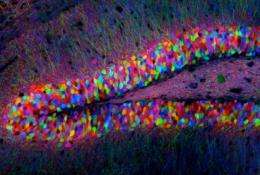
An image of a transgenic mouse hippocampus. Image: Nikon Small World Gallery
Our fond or fearful memories that first kiss or a bump in the night leave memory traces that we may conjure up in the remembrance of things past, complete with time, place and all the sensations of the experience. Neuroscientists call these traces memory engrams.
But are engrams conceptual, or are they a physical network of neurons in the brain? In a new MIT study, researchers used optogenetics to show that memories really do reside in very specific brain cells, and that simply activating a tiny fraction of brain cells can recall an entire memory explaining, for example, how Marcel Proust could recapitulate his childhood from the aroma of a once-beloved madeleine cookie.
We demonstrate that behavior based on high-level cognition, such as the expression of a specific memory, can be generated in a mammal by highly specific physical activation of a specific small subpopulation of brain cells, in this case by light, says Susumu Tonegawa, the Picower Professor of Biology and Neuroscience at MIT and lead author of the study reported online today in the journal Nature. This is the rigorously designed 21st-century test of Canadian neurosurgeon Wilder Penfields early-1900s accidental observation suggesting that mind is based on matter.
In that famous surgery, Penfield treated epilepsy patients by scooping out parts of the brain where seizures originated. To ensure that he destroyed only the problematic neurons, Penfield stimulated the brain with tiny jolts of electricity while patients, who were under local anesthesia, reported what they were experiencing. Remarkably, some vividly recalled entire complex events when Penfield stimulated just a few neurons in the hippocampus, a region now considered essential to the formation and recall of episodic memories.
Scientists have continued to explore that phenomenon but, until now, it has never been proven that the direct reactivation of the hippocampus was sufficient to cause memory recall.
Shedding light on the matter
Fast forward to the introduction, seven years ago, of optogenetics, which can stimulate neurons that are genetically modified to express light-activated proteins. We thought we could use this new technology to directly test the hypothesis about memory encoding and storage in a mimicry experiment, says co-author Xu Liu, a postdoc in Tonegawas lab.
We wanted to artificially activate a memory without the usual required sensory experience, which provides experimental evidence that even ephemeral phenomena, such as personal memories, reside in the physical machinery of the brain, adds co-author Steve Ramirez, a graduate student in Tonegawas lab.
The researchers first identified a specific set of brain cells in the hippocampus that were active only when a mouse was learning about a new environment. They determined which genes were activated in those cells, and coupled them with the gene for channelrhodopsin-2 (ChR2), a light-activated protein used in optogenetics.
Next, they studied mice with this genetic couplet in the cells of the dentate gyrus of the hippocampus, using tiny optical fibers to deliver pulses of light to the neurons. The light-activated protein would only be expressed in the neurons involved in experiential learning an ingenious way to allow for labeling of the physical network of neurons associated with a specific memory engram for a specific experience.
Finally, the mice entered an environment and, after a few minutes of exploration, received a mild foot shock, learning to fear the particular environment in which the shock occurred. The brain cells activated during this fear conditioning became tagged with ChR2. Later, when exposed to triggering pulses of light in a completely different environment, the neurons involved in the fear memory switched on and the mice quickly entered a defensive, immobile crouch.
False memory
This light-induced freezing suggested that the animals were actually recalling the memory of being shocked. The mice apparently perceived this replay of a fearful memory but the memory was artificially reactivated. Our results show that memories really do reside in very specific brain cells, Liu says, and simply by reactivating these cells by physical means, such as light, an entire memory can be recalled.
Referring to the 17th-century French philosopher who wrote, I think, therefore I am, Tonegawa says, René Descartes didnt believe the mind can be studied as a natural science. He was wrong. This experimental method is the ultimate way of demonstrating that mind, like memory recall, is based on changes in matter.
This remarkable work exhibits the power of combining the latest technologies to attack one of neurobiologys central problems, says Charles Stevens, a professor in the Molecular Neurobiology Laboratory at the Salk Institute who was not involved in this research. Showing that the reactivation of those nerve cells that were active during learning can reproduce the learned behavior is surely a milestone.
The method may also have applications in the study of neurodegenerative and neuropsychiatric disorders. The more we know about the moving pieces that make up our brains, Ramirez says, the better equipped we are to figure out what happens when brain pieces break down.
Other contributors to this study were Karl Deisseroth of Stanford University, whose lab developed optogenetics, and Petti T. Pang, Corey B. Puryear and Arvind Govindarajan of the RIKEN-MIT Center for Neural Circuit Genetics at the Picower Institute for Learning and Memory at MIT. The work was supported by the National Institutes of Health and the RIKEN Brain Science Institute.
Provided by
Massachusetts Institute of Technology
This story is republished courtesy of MIT News (web.mit.edu/newsoffice/), a popular site that covers news about MIT research, innovation and teaching.
-
Neuroscientists identify a master controller of memory
Dec 22, 2011 |
not rated yet |
0
-
Researchers illuminate the gap between experience and association
Dec 12, 2011 |
not rated yet |
0
-
Neuroscientists find cellular mechanism that shapes your memories
Sep 12, 2011 |
not rated yet |
0
-
Scientists reveal molecular sculptor of memories
Sep 26, 2011 |
not rated yet |
0
-
Neuroscientists pinpoint brain site for rapid learning
Oct 23, 2006 |
not rated yet |
0
-
Motion perception revisited: High Phi effect challenges established motion perception assumptions
Apr 23, 2013 |
3 / 5 (2) |
2
-
Anything you can do I can do better: Neuromolecular foundations of the superiority illusion (Update)
Apr 02, 2013 |
4.5 / 5 (11) |
5
-
The visual system as economist: Neural resource allocation in visual adaptation
Mar 30, 2013 |
5 / 5 (2) |
9
-
Separate lives: Neuronal and organismal lifespans decoupled
Mar 27, 2013 |
4.9 / 5 (8) |
0
-
Sizing things up: The evolutionary neurobiology of scale invariance
Feb 28, 2013 |
4.8 / 5 (10) |
14
-
Pressure-volume curve: Elastic Recoil Pressure don't make sense
May 18, 2013
-
If you became brain-dead, would you want them to pull the plug?
May 17, 2013
-
MRI bill question
May 15, 2013
-
Ratio of Hydrogen of Oxygen in Dessicated Animal Protein
May 13, 2013
-
Alcohol and acetaminophen
May 13, 2013
-
Marie Curie's leukemia
May 13, 2013
- More from Physics Forums - Medical Sciences
More news stories
For combat veterans suffering from post-traumatic stress disorder, 'fear circuitry' in the brain never rests
Chronic trauma can inflict lasting damage to brain regions associated with fear and anxiety. Previous imaging studies of people with post-traumatic stress disorder, or PTSD, have shown that these brain regions can over-or ...
Neuroscience
May 18, 2013 |
5 / 5 (1) |
0
|
Temporal processing in the olfactory system
The neural machinery underlying our olfactory sense continues to be an enigma for neuroscience. A recent review in Neuron seeks to expand traditional ideas about how neurons in the olfactory bulb might encode information about ...
Neuroscience
May 17, 2013 |
4 / 5 (1) |
0
|
Melon focus headband turns to Kickstarter for rollout plans
(Medical Xpress)—What if the quality of your work depends more on your focus on the piano keys or canvas or laptop than your musical or painting or computing skills? If target users can be convinced, they ...
Neuroscience
May 17, 2013 |
3.7 / 5 (3) |
0
|
Deep brain stimulation: A fix when the drugs don't work
Neurological disorders can have a devastating impact on the lives of sufferers and their families.
Neuroscience
May 17, 2013 |
5 / 5 (1) |
0
|
Brain makes call on which ear is used for cell phone
If you're a left-brain thinker, chances are you use your right hand to hold your cell phone up to your right ear, according to a newly published study from Henry Ford Hospital in Detroit.
Neuroscience
May 16, 2013 |
2 / 5 (2) |
0
|
US adviser on board of firm that sold anthrax drug
(AP)—Former Navy Secretary Richard J. Danzig, who has served as a bio-warfare adviser to the president, the Pentagon, and the Department of Homeland Security, urged the government to stockpile an anti-anthrax drug while ...
Consumer group flags high SPF ratings on sunscreen
(AP)—Sunbathers this summer will find new sunscreen labels that are designed to make the products more effective and easier to use.
Treatment of sleep apnea improves glucose levels in prediabetes
Optimal treatment of sleep apnea in patients with prediabetes improves blood sugar (glucose) levels and thus can reduce cardiometabolic risk, according to a study to be presented at the ATS 2013 International Conference in ...
Whole-cell vaccine was more effective than acellular vaccine during CA pertussis outbreak
Whole-cell pertussis vaccines were more effective at protecting against pertussis than acellular pertussis vaccines during a large recent outbreak, according to a new Kaiser Permanente study published in Pediatrics.
Blame your parents for bunion woes
A novel study reports that white men and women of European descent inherit common foot disorders, such as bunions (hallux valgus) and lesser toe deformities, including hammer or claw toe. Findings from the Framingham Foot ...
Genetic diversity within tumors predicts outcome in head and neck cancer
A new measure of the heterogeneity – the variety of genetic mutations – of cells within a tumor appears to predict treatment outcomes of patients with the most common type of head and neck cancer. In the May 20 issue ...
Mar 23, 2012
Rank: not rated yet
"This experimental method is the ultimate way of demonstrating that mind, like memory recall, is based on changes in matter."
No, I'm afraid it is not. It is the ultimate way of demonstrating that: what is experienced by the mind is stored by the brain. Shocking. The statement is expressed in the same cocksure way that neuroscientists tout that brain structure definitely is what shapes thought; when time and time again, thought has been shown to shape brain structure.
You can infer absolutely nothing about the mind from your tests, much less that it is based on matter!
I can just as easily make the opposite statement asserting causation, using the same data:
"This experimental method is the ultimate way of demonstrating that brain, like memory recall, is based on changes in mind."
Mar 23, 2012
Rank: not rated yet
"This experimental method is the ultimate way of demonstrating that mind, like memory recall, is based on changes in matter."
No, I'm afraid it is not. It is the ultimate way of demonstrating that: what is experienced by the mind is stored by the brain. Shocking. The statement is expressed in the same cocksure way neuroscientists tout that brain structure surely is what shapes thought; when time and time again, thought has been shown to shape brain structure.
You can infer absolutely nothing about the mind from your tests, much less that it is based on matter!
I can just as easily make the opposite statement asserting causation, using the same exact data:
"This experimental method is the ultimate way of demonstrating that the brain, like memory recall, is based on changes in mind."
Mar 23, 2012
Rank: not rated yet
Mar 23, 2012
Rank: not rated yet
Mar 23, 2012
Rank: not rated yet
Mar 23, 2012
Rank: not rated yet
Mar 23, 2012
Rank: 1 / 5 (1)
Mar 24, 2012
Rank: not rated yet
I can just as easily make the opposite statement asserting causation, using the same data"
But by your criteria, no experiment whatsoever could challenge your preconceived notion of what the mind is. You can always say, "yes, your experiment explains every single detail of what is experienced by a mind in terms of brain cells, and nothing 'extra' is needed, but I believe there IS something extra and you can't disprove there isn't anything extra, so your experiment doesn't really tell us anything about my conception of what mind really is." Do you see that you are putting "mind" in the same category as "god", that is, something that can never be proven or disproven and will always remain a matter of belief?
Mar 24, 2012
Rank: not rated yet
It's a nature publication. You guys might want to consider a lil background knowledge of the field before spouting your gut feelings about how brains work.
Mar 25, 2012
Rank: 1 / 5 (1)
By the way feel free to label associations any way this suits neuroscience and you best... ..."engrams".
There. Do you feel better now? Neuropsychology/psychiatry will accommodate and cater to your every label and whim.
Many paths lead to the same memory/experience.
Mar 25, 2012
Rank: 1 / 5 (1)
to dupe readers into believing every neuron was monitored that harbored the potential to be involved in the experiential learning.
Kudos. Duping successful.
Mar 31, 2012
Rank: 1 / 5 (1)
Rediscovered Pavlov And That Genes Are Organisms,
RNA Nucleotides Genes Organisms Complying With Pavlov
From
http://strokereve...e-in-spe
Showing that the reactivation of those nerve cells that were active during learning can reproduce the learned behavior is surely a milestone.
Dov Henis (comments from 22nd century)
http://universe-l...enetics/
Apr 04, 2012
Rank: 1 / 5 (1)
http://strokereve...e-in-spe
Our results show that memories really do reside in very specific brain cells, says says co-author Xu Liu, a postdoc in Tonegawas lab, and simply by reactivating these cells by physical means, such as light, an entire memory can be recalled.
Oh. Alright. Hint:
..."very specific brain cells"...
SPECIFIC to the event/experience are to be found everywhere (scattered) throughout the brain.
You have no idea which "of ANY nerve cells" are "active" during "learning". If you manage to find them all, the hypothesis of localization for a learned behavior will be abandoned.
Susumu Tonegawa, I have patience. You will abandoned this nonsense. Do not retract the paper. Nature will never do this - their reputation/selling is at sake - clever on your part.