Researchers use brain-injury data to map intelligence in the brain
April 10, 2012 in Neuroscience

Researchers use brain-injury data to map intelligence in the brain

Enlarge

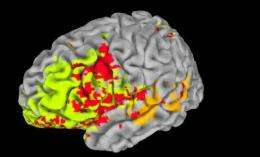
A new study found that specific structures, primarily on the left side of the brain, are vital to general intelligence and executive function (the ability to regulate and control behavior). Brain regions that are associated with general intelligence and executive function are shown in color, with red indicating common areas, orange indicating regions specific to general intelligence, and yellow indicating areas specific to executive function. Credit: Aron Barbey

Scientists report that they have mapped the physical architecture of intelligence in the brain. Theirs is one of the largest and most comprehensive analyses so far of the brain structures vital to general intelligence and to specific aspects of intellectual functioning, such as verbal comprehension and working memory.

Their study, published in Brain: A , is unique in that it enlisted an extraordinary pool of volunteer participants: 182 with highly localized brain damage from penetrating .

"It's a significant challenge to find patients (for research) who have brain damage, and even further, it's very hard to find patients who have focal brain damage," said University of Illinois neuroscience professor Aron Barbey, who led the study. Brain damage – from stroke, for example – often impairs multiple brain areas, he said, complicating the task of identifying the cognitive contributions of specific brain structures.
Researchers use brain-injury data to map intelligence in the brain
Enlarge

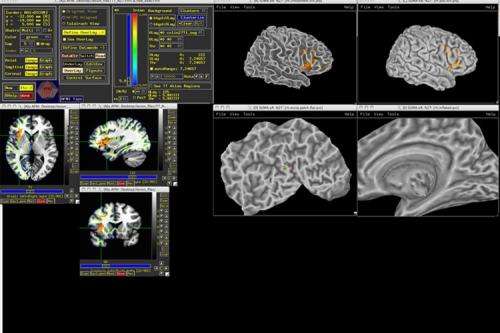
Aron Barbey discusses his work linking specific brain injuries, seen here in a brain scan, to impairment on particular cognitive functions. To view video, return to story and click on link in this cutline. Photo courtesy Aron Barbey

But the very focal brain injuries analyzed in the study allowed the researchers "to draw inferences about how specific brain structures are necessary for performance," Barbey said. "By studying how damage to particular brain regions produces specific forms of cognitive impairment, we can map the architecture of the mind, identifying brain structures that are critically important for specific intellectual abilities."

The researchers took CT scans of the participants' brains and administered an extensive battery of cognitive tests. They pooled the CT data to produce a collective map of the cortex, which they divided into more than 3,000 three-dimensional units called voxels. By analyzing multiple patients with damage to a particular voxel or cluster of voxels and comparing their cognitive abilities with those of patients in whom the same structures were intact, the researchers were able to identify brain regions essential to specific cognitive functions, and those structures that contribute significantly to intelligence.

"We found that general intelligence depends on a remarkably circumscribed neural system," Barbey said. "Several brain regions, and the connections between them, were most important for general intelligence."

These structures are located primarily within the left prefrontal cortex (behind the forehead), left temporal cortex (behind the ear) and left parietal cortex (at the top rear of the head) and in "white matter association tracts" that connect them. (Watch a video about the findings.)

The researchers also found that for planning, self-control and other aspects of executive function overlap to a significant extent with regions vital to general intelligence.

The study provides new evidence that intelligence relies not on one brain region or even the brain as a whole, Barbey said, but involves specific brain areas working together in a coordinated fashion.

"In fact, the particular regions and connections we found support an emerging body of evidence indicating that intelligence depends on the brain's ability to integrate information from verbal, visual, spatial and executive processes," he said.

The findings will "open the door to further investigations into the biological basis of , exploring how the , genes, nutrition and the environment together interact to shape the development and continued evolution of the remarkable intellectual abilities that make us human," Barbey said.

Provided by University of Illinois at Urbana-Champaign search and more info website

4.7 /5 (12 votes)  

Rank 4.7 /5 (12 votes)
Related Stories
Relevant PhysicsForums posts

More news stories

For combat veterans suffering from post-traumatic stress disorder, 'fear circuitry' in the brain never rests

Chronic trauma can inflict lasting damage to brain regions associated with fear and anxiety. Previous imaging studies of people with post-traumatic stress disorder, or PTSD, have shown that these brain regions can over-or ...

Neuroscience created 5 hours ago | popularity not rated yet | comments 0 | with audio podcast

Temporal processing in the olfactory system

The neural machinery underlying our olfactory sense continues to be an enigma for neuroscience. A recent review in Neuron seeks to expand traditional ideas about how neurons in the olfactory bulb might encode information about ...

Neuroscience created 16 hours ago | popularity not rated yet | comments 0 | with audio podcast report

Melon focus headband turns to Kickstarter for rollout plans

(Medical Xpress)—What if the quality of your work depends more on your focus on the piano keys or canvas or laptop than your musical or painting or computing skills? If target users can be convinced, they ...

Neuroscience created 17 hours ago | popularity 3.7 / 5 (3) | comments 0 | with audio podcast weblog

Deep brain stimulation: A fix when the drugs don't work

Neurological disorders can have a devastating impact on the lives of sufferers and their families.

Neuroscience created 22 hours ago | popularity 5 / 5 (1) | comments 0 | with audio podcast

Brain makes call on which ear is used for cell phone

If you're a left-brain thinker, chances are you use your right hand to hold your cell phone up to your right ear, according to a newly published study from Henry Ford Hospital in Detroit.

Neuroscience created May 16, 2013 | popularity 2 / 5 (2) | comments 0 | with audio podcast


AIDS science at 30: 'Cure' now part of lexicon

Big names in medicine are set to give an upbeat assessment of the war on AIDS on Tuesday, 30 years after French researchers identified the virus that causes the disease.

Now we know why old scizophrenia medicine works on antibiotics-resistant bacteria

In 2008 researchers from the University of Southern Denmark showed that the drug thioridazine, which has previously been used to treat schizophrenia, is also a powerful weapon against antibiotic-resistant bacteria such as ...

Individuals who drink heavily and smoke may show 'early aging' of the brain

Treatment for alcohol use disorders works best if the patient actively understands and incorporates the interventions provided in the clinic. Multiple factors can influence both the type and degree of neurocognitive abnormalities ...

College women exceed NIAAA drinking guidelines more frequently than college men

In order to avoid harms associated with alcohol consumption, in 2009 the National Institute on Alcohol Abuse and Alcoholism issued guidelines that define low-risk drinking. These guidelines differ for men and women: no more ...

Study identifies new approach to improving treatment for MS and other conditions

(Medical Xpress)—Working with lab mice models of multiple sclerosis (MS), UC Davis scientists have detected a novel molecular target for the design of drugs that could be safer and more effective than current FDA-approved ...

23 dead in initiation rites in South Africa

(AP)—Twenty-three youths have died in the past nine days at initiation ceremonies that include circumcisions and survival tests, South African police said Friday.