Good bugs gone bad: Gut immune cells keep beneficial microbes in their place
June 6, 2012 in Medical research
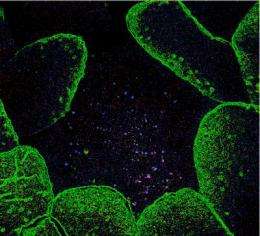
This is a color-enhanced tissue section from a healthy mouse that displays the presence of commensal bacteria (Alcaligenes species, purple) on the interior of a Peyer's patch (gut-associated lymphoid tissue) and overlaying intestinal epithelial cells (green). Credit: Gregory Sonnenberg, Ph.D.; David Artis, Ph.D., Perelman School of Medicine University of Pennsylvania; Science
The healthy human intestine is colonized with over 100 trillion beneficial, or commensal, bacteria of many different species. In healthy people, these bacteria are limited to the intestinal tissues and have a number of helpful properties, including aiding in the digestion of food and promoting a healthy immune system.
However, when it comes to commensal bacteria, location is key. While commensal bacteria in the intestine provide positive effects, several chronic human diseases, including HIV/AIDS, inflammatory bowel disease, viral hepatitis, and obesity are associated with the spread of these intestinal commensal bacteria to the blood stream and other peripheral tissues, which can cause chronic inflammation. 'Good bugs' that promote normal health can 'turn bad' if found in the wrong location.
In earlier work, researchers from the Perelman School of Medicine at the University of Pennsylvania found that barrier surfaces -- the skin, gut, lung are guarded by immune cells and limit the inner body's exposure to viruses, bacteria, and parasites, as well as allergens and pollutants. But, how immune cells play a role in limiting the location of commensal bacteria to intestinal and other barrier sites remains unclear.
Now, David Artis, PhD, associate professor of Microbiology, and Gregory F. Sonnenberg, PhD, a postdoctoral researcher in the Artis lab, have identified that immune cells, called innate lymphoid cells, are resident in the intestinal tissues of healthy humans, mice, and non-human primates, and are critical in limiting the location of commensal bacteria. If the innate lymphoid cells are depleted in mice, commensal bacteria move to peripheral tissues and promote inflammation. The research appears this week in Science.
Remarkably, the commensal bacteria that were found in peripheral tissues were all members of a group called Alcaligenes, indicating that the immune system may have developed highly selective pathways to regulate containment of different groups of commensal bacteria.
"A fundamental question that has puzzled researchers for many years is how did the human body evolve to accommodate all these commensal bacteria and keep them in their correct locations?," asks Artis. "The indication from these studies is that the body may have many different pathways to limit the spread of commensal bacteria and these pathways may be tailored to specific types of bacteria."
Supporting experiments in animal models, Alcaligenes-specific immune responses were associated with patients with Crohn's disease or progressive hepatitis C virus infection, two debilitating human diseases linked to the spread of commensal bacteria to systemic tissues.
"The identification of systemic Alcaligenes-specific immune responses in these patient populations suggests that, coupled with other groups of bacteria, the spread of Alcaligenes to tissues outside the intestine may be contributing to chronic inflammation and disease progression," suggests Sonnenberg.
Innate immune cells may become impaired in chronic human diseases, resulting in the spread of Alcaligenes bacteria and pathologic inflammation, which may represent a novel pathway to target in human disease, say the investigators.
"Although it's still early days for this line of research, these findings suggest that targeting innate lymphoid cell responses or directly targeting specific groups of commensal bacteria may be useful in the treatment of some chronic inflammatory diseases," adds Artis.
Journal reference:
Science
Provided by
University of Pennsylvania School of Medicine
-
Inner weapons against allergies: Gut bacteria control allergic diseases
Mar 25, 2012 |
not rated yet |
0
-
Friend or Foe? Scientists Determine How the Intestine Keeps Us Safe From Microbial Invaders
Feb 21, 2007 |
not rated yet |
0
-
Biodiversity loss may cause increase in allergies and asthma
May 07, 2012 |
not rated yet |
0
-
DNA of good bacteria drives intestinal response to infection
Oct 02, 2008 |
not rated yet |
0
-
Researchers investigate cellular mechanisms leading to immune response in airway epithelium
Nov 23, 2010 |
not rated yet |
0
-
Motion perception revisited: High Phi effect challenges established motion perception assumptions
Apr 23, 2013 |
3 / 5 (2) |
2
-
Anything you can do I can do better: Neuromolecular foundations of the superiority illusion (Update)
Apr 02, 2013 |
4.5 / 5 (11) |
5
-
The visual system as economist: Neural resource allocation in visual adaptation
Mar 30, 2013 |
5 / 5 (2) |
9
-
Separate lives: Neuronal and organismal lifespans decoupled
Mar 27, 2013 |
4.9 / 5 (8) |
0
-
Sizing things up: The evolutionary neurobiology of scale invariance
Feb 28, 2013 |
4.8 / 5 (10) |
14
-
Pressure-volume curve: Elastic Recoil Pressure don't make sense
May 18, 2013
-
If you became brain-dead, would you want them to pull the plug?
May 17, 2013
-
MRI bill question
May 15, 2013
-
Ratio of Hydrogen of Oxygen in Dessicated Animal Protein
May 13, 2013
-
Alcohol and acetaminophen
May 13, 2013
-
Marie Curie's leukemia
May 13, 2013
- More from Physics Forums - Medical Sciences
More news stories
Computational tool translates complex data into simplified 2-dimensional images
In their quest to learn more about the variability of cells between and within tissues, biomedical scientists have devised tools capable of simultaneously measuring dozens of characteristics of individual ...
Medical research
13 hours ago |
5 / 5 (3) |
0
|
Now we know why old scizophrenia medicine works on antibiotics-resistant bacteria
In 2008 researchers from the University of Southern Denmark showed that the drug thioridazine, which has previously been used to treat schizophrenia, is also a powerful weapon against antibiotic-resistant bacteria such as ...
Medical research
May 17, 2013 |
4 / 5 (4) |
0
|
SUMO wrestling cells reveal new protective mechanism target for stroke
Scientists investigating the interaction of a group of proteins in the brain responsible for protecting nerve cells from damage have identified a new target that could increase cell survival.
Medical research
May 17, 2013 |
5 / 5 (1) |
0
How serotonin receptors can shape drug effects, from LSD to migraine medication
New findings by researchers carrying out experiments at the U.S. Department of Energy Office of Science's Advanced Photon Source (APS) help explain why some drugs that interact with two kinds of human serotonin ...
Medical research
May 17, 2013 |
4 / 5 (1) |
0
|
Preventing blood poisoning
Peptide molecules derived from the body's natural immune system can help boost the body's defence against life-threatening blood poisoning, joint University research has uncovered.
Medical research
May 17, 2013 |
4 / 5 (1) |
0
|
New theory on genesis of osteoarthritis comes with successful therapy in mice
Scientists at Johns Hopkins have turned their view of osteoarthritis (OA) inside out. Literally. Instead of seeing the painful degenerative disease as a problem primarily of the cartilage that cushions joints, ...
Researchers identify a potential new risk for sleep apnea: Asthma
Researchers at the University of Wisconsin have identified a potential new risk factor for obstructive sleep apnea: asthma. Using data from the National Institutes of Health (Heart, Lung, and Blood Institute)-funded Wisconsin ...
Study finds that sleep apnea and Alzheimer's are linked
A new study looking at sleep-disordered breathing (SDB) and markers for Alzheimer's disease (AD) risk in cerebrospinal fluid (CSF) and neuroimaging adds to the growing body of research linking the two.
'Gap' for HIV vaccine efforts after latest setback
The hunt for an HIV vaccine has gobbled up $8 billion in the past decade, and the failure of the most recent efficacy trial has delivered yet another setback to 26 years of efforts.
Ginger compounds may be effective in treating asthma symptoms
Gourmands and foodies everywhere have long recognized ginger as a great way to add a little peppery zing to both sweet and savory dishes; now, a study from researchers at Columbia University shows purified components of the ...
Alzheimer's leaves bilingual victims stranded in Canada
The devastating effect of Alzheimer's disease on bilingual people has been thrown into focus in Canada, where the sudden loss of a second language can leave sufferers feeling like strangers in their own country.
Jun 06, 2012
Rank: not rated yet