Researchers descover melanoma-promoting gene
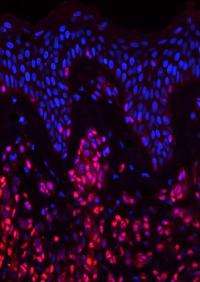
The stem-cell factor Sox10 (red) is active in the tumor tissue of melanoma patients and essential for the development and spread of cancer.
Black skin cancer, also known as melanoma, is particularly aggressive and becoming increasingly common in Switzerland. Despite intensive research, however, there is still no treatment. Researchers from the University of Zurich have now discovered a gene that plays a central role in black skin cancer. Suppressing this gene in mice inhibits the development of melanoma and its proliferation a discovery that could pave the way for new forms of therapy.
Until recently, it was assumed that a tumor was composed of many equivalent cells that all multiply malignantly and can thus contribute towards tumor growth. According to a more recent hypothesis, however, a tumor might also consist of malignant cancer stem cells and other less aggressive tumor cells. Normally, stem cells are responsible for the formation of organs. Cancer stem cells can divide in a very similar way and develop into other tumor cells to form the tumor. Efficient tumor therapy thus primarily needs to fight cancer stem cells. Consequently, a team of stem-cell researchers from the University of Zurich headed by Professor Sommer decided to find out whether mechanisms that are important for normal stem cells also play a role in cancer stem cells.
Melanoma cells are rogue skin-pigment cells formed by so-called neural crest stem cells during embryonic development. Professor Sommers group teamed up with dermatologists and pathologists to investigate whether cells with characteristics of these specific stem cells are present in human tumor tissue. This was indeed the case, as we were able to prove based on numerous biopsies performed on melanoma patients, says Sommer. In particular, one gene that effectively controls the stem-cell program was highly active in all the tumor tissue studied. This gene, which is known as Sox10, is essential for cell division and the survival of stem cells.
The next step for the Zurich researchers was to test how Sox10 works in human melanoma cells. They determined that the gene also controls a stem-cell program in cancer cells and is necessary for cell division. In order to corroborate these findings in a living organism, the researchers ultimately used a mouse which carried similar genetic mutations to those found in human melanoma and thus developed black skin cancer spontaneously. Astonishingly, the suppression of Sox10 in this animal model completely inhibited the formation and spread of cancer.
Our research demonstrates that a tumor could probably be treated by attacking its stem cells, concludes Sommer. The results also illustrate that such studies can primarily be successful through the close collaboration and conscious use of synergies between basic researchers and clinicians.
Provided by
University of Zurich
-
Cell senescence does not stop tumor growth
Jan 19, 2012 |
not rated yet |
0
-
Cancer stem cell vaccine in development shows antitumor effect
Apr 02, 2012 |
not rated yet |
0
-
New role for Vascular Endothelial Growth Factor in regulating skin cancer stem cells
Oct 19, 2011 |
not rated yet |
0
-
Herceptin targets breast cancer stem cells
Jul 09, 2008 |
not rated yet |
0
-
Study identifies gene critical to development and spread of lung cancer
Apr 24, 2012 |
not rated yet |
0
-
Motion perception revisited: High Phi effect challenges established motion perception assumptions
Apr 23, 2013 |
3 / 5 (2) |
2
-
Anything you can do I can do better: Neuromolecular foundations of the superiority illusion (Update)
Apr 02, 2013 |
4.5 / 5 (11) |
5
-
The visual system as economist: Neural resource allocation in visual adaptation
Mar 30, 2013 |
5 / 5 (2) |
9
-
Separate lives: Neuronal and organismal lifespans decoupled
Mar 27, 2013 |
4.9 / 5 (8) |
0
-
Sizing things up: The evolutionary neurobiology of scale invariance
Feb 28, 2013 |
4.8 / 5 (10) |
14
-
Pressure-volume curve: Elastic Recoil Pressure don't make sense
May 18, 2013
-
If you became brain-dead, would you want them to pull the plug?
May 17, 2013
-
MRI bill question
May 15, 2013
-
Ratio of Hydrogen of Oxygen in Dessicated Animal Protein
May 13, 2013
-
Alcohol and acetaminophen
May 13, 2013
-
Marie Curie's leukemia
May 13, 2013
- More from Physics Forums - Medical Sciences
More news stories
New smartphone application improves colonoscopy preparation
The use of a smartphone application significantly improves patients' preparation for a colonoscopy, according to new research presented today at Digestive Disease Week (DDW). The preparation process, which begins days in ...
Cancer
5 hours ago |
not rated yet |
0
Research examines new methods for managing digestive health
Research presented at Digestive Disease Week (DDW) explores new methods for managing digestive health through diet and lifestyle.
Cancer
5 hours ago |
not rated yet |
0
New colonoscope provides ground-breaking view of colon
A ground-breaking advance in colonoscopy technology signals the future of colorectal care, according to research presented today at Digestive Disease Week(DDW). Additional research focuses on optimizing the minimal withdrawal ...
Cancer
20 hours ago |
5 / 5 (2) |
0
ASCO: combo antibody therapy effective for melanoma
(HealthDay)—Concurrent use of two immune checkpoint antibodies—ipilimumab and nivolumab—may be effective for the treatment of advanced melanoma, according to a proof-of-principal study presented in ...
Cancer
May 17, 2013 |
not rated yet |
0
Risk factors ID'd for poor cutaneous cell CA outcomes
(HealthDay)—The risks of metastasis and death associated with cutaneous squamous cell carcinoma (CSCC) are low, but significant, and risk factors for poor outcome include tumor diameter, invasion beyond ...
Cancer
May 17, 2013 |
not rated yet |
0
|
Consuming coffee linked to lower risk of detrimental liver disease, study finds
Regular consumption of coffee is associated with a reduced risk of primary sclerosing cholangitis (PSC), an autoimmune liver disease, Mayo Clinic research shows. The findings were being presented at the Digestive Disease ...
Ketamine shows significant therapeutic benefit in people with treatment-resistant depression
Patients with treatment-resistant major depression saw dramatic improvement in their illness after treatment with ketamine, an anesthetic, according to the largest ketamine clinical trial to-date led by researchers from the ...
New research identifies practice changes to improve value and quality of GI procedures
There are significant cost and risk factors associated with two procedures commonly used to diagnose or treat gastrointestinal problems, according to research presented at Digestive Disease Week (DDW).
New research identifies risks, interventions for children's GI health
An increasing number of U.S. children are experiencing gastrointestinal issues that require interventions to resolve, according to research presented at Digestive Disease Week (DDW).
US psychiatry gets makeover in new manual
The latest makeover to a massive psychiatric tome honored by some, reviled by others and even called the "Bible" of mental disorders is being released Saturday with a host of new changes.
New case of SARS-like virus in Saudi: ministry
A new case of the deadly coronavirus has been detected in Saudi Arabia where 15 people have already died after contracting it, the health ministry announced on Saturday on its Internet website.