'Stoned' gene key to maintaining normal brain function
July 6, 2012 in Medical research

'Stoned' gene key to maintaining normal brain function

Dr Stephen Royle: “This research is another step towards fully understanding the complexities of the human brain.”

(Medical Xpress) -- Scientists at the University of Liverpool have found that a protein produced by a gene identified in fruitflies, is responsible for communication between nerve cells in the brain.

The ‘stoned’ gene was discovered in fruitflies by scientists in the 1970s. When this gene was mutated, the flies had problems walking and flying, giving rise to the term ‘stoned’ gene. The same gene was found in mammals some years later, but until now scientists have not known precisely what this gene is responsible for and why it causes problems with physical functions when it mutates.

‘Packets of chemicals’

Scientists at Liverpool have found that the protein the gene expresses in mammals, called stonin2, is responsible for retrieving ‘packets’ of chemicals that in the brain release in order to communicate with each other.  The inability of the gene to express this protein in the fruitfly study, suggests why the insect appeared not to be able to walk or fly normally.

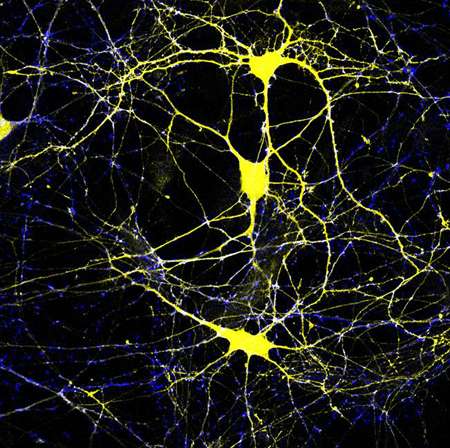
The team used advanced techniques to inactivate stonin2 for short and long periods of time in animal cells grown in the laboratory. The cells used where from an area of the brain associated with learning and memory.  They showed that without stonin2 the nerve cells could not retrieve the ‘packets’ needed to transport the chemicals required for communications between nerve cells.

Dr Stephen Royle, from the University’s Institute of Translational Medicine, explains: “Nerve cells in the brain communicate by releasing ‘packets’ of chemicals.  These ‘packets’ must be retrieved and refilled with chemicals so that they can be used once again. This recycling programme is very important for nerve cells to keep communicating with each other. 

“We have shown that a protein called stonin 2 is needed for the packets to be retrieved. There is currently no evidence to suggest that the gene which expresses this is mutated in human disease, but any failure in its function would be disastrous.  The research is another step towards fully understanding the complexities of the human .”

The research is published in the journal, Current Biology.

More information: www.cell.com/curre… 2(12)00635-5

Journal reference: Current Biology search and more info website

Provided by University of Liverpool search and more info website

4 /5 (3 votes)  

Rank 4 /5 (3 votes)
Related Stories
Relevant PhysicsForums posts

More news stories

Study reveals new mechanism for estrogen suppression of liver lipid synthesis

By discovering the new mechanism by which estrogen suppresses lipid synthesis in the liver, UC Irvine endocrinologists have revealed a potential new approach toward treating certain liver diseases.

Medical research created 9 hours ago | popularity not rated yet | comments 0 | with audio podcast

MRI-based measurement helps predict vascular disease in the brain

Aortic arch pulse wave velocity, a measure of arterial stiffness, is a strong independent predictor of disease of the vessels that supply blood to the brain, according to a new study published in the June issue the journal ...

Medical research created 9 hours ago | popularity not rated yet | comments 0

Antibiotics: A new understanding of sulfonamide nervous system side effects

Since the discovery of Prontosil in 1932, sulfonamide antibiotics have been used to combat a wide spectrum of bacterial infections, from acne to chlamydia and pneumonia. However, their side effects can include serious neurological ...

Medical research created 11 hours ago | popularity not rated yet | comments 0 | with audio podcast

Scientists discover molecule triggers sensation of itch

Scientists at the National Institutes of Health report they have discovered in mouse studies that a small molecule released in the spinal cord triggers a process that is later experienced in the brain as ...

Medical research created 11 hours ago | popularity 5 / 5 (2) | comments 0 | with audio podcast

Discarded immune cells induce the relocation of stem cells

Spanish researchers have discovered that the daily clearance of neutrophils from the body stimulates the release of hematopoietic stem cells from the bone marrow into the bloodstream, according to a report published today ...

Medical research created 13 hours ago | popularity 5 / 5 (2) | comments 0


Controlling mood through the motions of mitochondria

(Medical Xpress)—Regulating the distribution of power in neurons is done by a system that makes the national electric grid look simple by comparison. Each neuron has several thousand mitochondria confined ...

Motion quotient: IQ predicted by ability to filter motion (w/ video)

A brief visual task can predict IQ, according to a new study. This surprisingly simple exercise measures the brain's unconscious ability to filter out visual movement. The study shows that individuals whose ...

Multiple research teams unable to confirm high-profile Alzheimer's study

Teams of highly respected Alzheimer's researchers failed to replicate what appeared to be breakthrough results for the treatment of this brain disease when they were published last year in the journal Science.

ACP issues recommendations for management of high blood glucose in hospitalized patients

High blood glucose is associated with poor outcomes in hospitalized patients, and use of intensive insulin therapy (IIT) to control hyperglycemia is a common practice in hospitals. But the recent evidence does not show a ...

Researchers find common childhood asthma unconnected to allergens or inflammation

Little is known about why asthma develops, how it constricts the airway or why response to treatments varies between patients. Now, a team of researchers at Weill Cornell Medical College, Columbia University Medical Center ...

Diabetes' genetic underpinnings can vary based on ethnic background, studies say

Ethnic background plays a surprisingly large role in how diabetes develops on a cellular level, according to two new studies led by researchers at the Stanford University School of Medicine.