Common antifungal drug decreases tumor growth and shows promise as cancer therapy
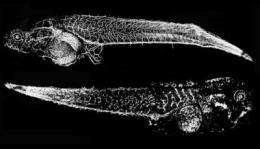
This image shows a frog tadpole with normal blood vessel development (fluorescing, top) and a frog tadpole with blood vessel development that was disrupted by the common antifungal medication, thiabendazole (bottom). New research published by Cha et. al. reveals that thiabendazole slows tumor growth and shows promise as a chemotherapy for cancer. Credit: Hye Ji Cha, The University of Texas at Austin
An inexpensive antifungal drug, thiabendazole, slows tumor growth and shows promise as a chemotherapy for cancer. Scientists in the College of Natural Sciences at The University of Texas at Austin made this discovery by exploiting the evolutionary relatedness of yeast, frogs, mice and humans.
Thiabendazole is an FDA-approved, generic drug taken orally that has been in clinical use for 40 years as an antifungal. It is not currently used for cancer therapy.
Hye Ji Cha, Edward Marcotte, John Wallingford and colleagues found that the drug destroys newly established blood vessels, making it a "vascular disrupting agent." Their research was published in the journal PLOS Biology.
Inhibiting blood vessel, or vascular, growth can be an important chemotherapeutic tool because it starves tumors. Tumors induce new blood vessel formation to feed their out-of-control growth.
In trials using mice, the researchers found that thiabendazole decreased blood vessel growth in fibrosarcoma tumors by more than a half. Fibrosarcomas are cancers of the connective tissue, and they are generally heavily vascularized with blood vessels.
The drug also slowed tumor growth.
"This is very exciting to us, because in a way we stumbled into discovering the first human-approved vascular disrupting agent," said Marcotte, professor of chemistry. "Our research suggests that thiabendazole could probably be used clinically in combination with other chemotherapies."
This video is not supported by your browser at this time.
Blood vessel development in tadpoles with and without the common antifungal drug thiabendazole shows how the drug is a "vascular disrupting agent." Credit: Hye Ji Cha, The University of Texas at Austin
The scientists' discovery is a culmination of research that crosses disciplines and organisms.In a previous study, Marcotte and his colleagues found genes in single-celled yeast that are shared with vertebrates by virtue of their shared evolutionary history. In yeasts, which have no blood vessels, the genes are responsible for responding to various stresses to the cells. In vertebrates, the genes have been repurposed to regulate vein and artery growth, or angiogenesis.
"We reasoned that by analyzing this particular set of genes, we might be able to identify drugs that target the yeast pathway that also act as angiogenesis inhibitors suitable for chemotherapy," said Marcotte.
Turns out they were right.
Cha, a graduate student in cell and molecular biology at the university, searched for a molecule that would inhibit the action of those yeast genes. She found that thiabendazole did the trick.
She then tested the drug in developing frog embryos. These are fast growing vertebrates in which scientists can watch blood vessel growth in living animals.
Cha found that frog embryos grown in water with the drug either didn't grow blood vessels or grew blood vessels that were then dissolved away by the drug. Interestingly, when the drug was removed, the embryos' blood vessels grew back.
Cha then tested the drug on human blood vessel cells growing in Petri dishes, finding that the drug also inhibited their growth. Finally, she tested the drug on fibrosarcoma tumors in mice and found that it reduced blood vessel growth in the tumors as well as slowed the tumors' growth.
"We didn't set out to find a vascular disrupting agent, but that's where we ended up," said Wallingford, associate professor of developmental biology and Cha's graduate advisor with Marcotte. "This is an exciting example of the power of curiosity-driven research and the insights that can come from blending disciplines in biology."
The scientists' goal is now to move the drug into clinical trials with humans. They are talking with clinical oncologists about next steps.
"We hope the clinical trials will be easier because it is already approved by the FDA for human use," said Marcotte.
Journal reference:
PLoS Biology
Provided by
University of Texas at Austin
-
Scientists find new genes for cancer, other diseases in plants, yeast and worms
Apr 13, 2010 |
not rated yet |
0
-
Antifungal drug stops blood vessel growth
Apr 27, 2007 |
not rated yet |
0
-
Common transplant drug inhibits breast cancer growth, study shows
May 26, 2011 |
not rated yet |
0
-
Researchers identify genetic markers that predict efficacy of novel cancer drug
May 29, 2008 |
not rated yet |
0
-
How chemotherapy drugs block blood vessel growth, slow cancer spread
Jan 22, 2009 |
not rated yet |
0
-
Motion perception revisited: High Phi effect challenges established motion perception assumptions
Apr 23, 2013 |
3 / 5 (2) |
2
-
Anything you can do I can do better: Neuromolecular foundations of the superiority illusion (Update)
Apr 02, 2013 |
4.5 / 5 (11) |
5
-
The visual system as economist: Neural resource allocation in visual adaptation
Mar 30, 2013 |
5 / 5 (2) |
9
-
Separate lives: Neuronal and organismal lifespans decoupled
Mar 27, 2013 |
4.9 / 5 (8) |
0
-
Sizing things up: The evolutionary neurobiology of scale invariance
Feb 28, 2013 |
4.8 / 5 (10) |
14
-
How can there be villous adenoma in colon, if there are no villi there
12 hours ago
-
How can there be a term called "intestinal metaplasia" of stomach
May 21, 2013
-
Pressure-volume curve: Elastic Recoil Pressure don't make sense
May 18, 2013
-
If you became brain-dead, would you want them to pull the plug?
May 17, 2013
-
MRI bill question
May 15, 2013
-
Ratio of Hydrogen of Oxygen in Dessicated Animal Protein
May 13, 2013
- More from Physics Forums - Medical Sciences
More news stories
American cancer society celebrates 100 years of progress
(HealthDay)—The American Cancer Society, which is celebrating on Wednesday a century of fighting a disease once viewed as a death sentence, is making a pledge to put itself out of business.
Cancer
2 hours ago |
not rated yet |
0
CT detects twice as many lung cancers as X-ray at initial screening exam
National Lung Screening Trial (NLST) investigators also conclude that the 20 percent reduction in lung cancer mortality with low-dose computed tomography (LDCT) versus chest X-ray (CXR) screening previously reported in the ...
Cancer
2 hours ago |
not rated yet |
0
Research offers promising new approach to treatment of lung cancer
Researchers have developed a new drug delivery system that allows inhalation of chemotherapeutic drugs to help treat lung cancer, and in laboratory and animal tests it appears to reduce the systemic damage ...
Cancer
5 hours ago |
not rated yet |
0
|
Study details genes that control whether tumors adapt or die when faced with p53 activating drugs
When turned on, the gene p53 turns off cancer. However, when existing drugs boost p53, only a few tumors die – the rest resist the challenge. A study published in the journal Cell Reports shows how: tumors that live even i ...
Cancer
6 hours ago |
not rated yet |
0
|
Small increase in cancer risk following CT scans in childhood and adolescence
Study leader, Professor John Mathews from the University of Melbourne said this small increase in cancer risk must be weighed against the undoubted benefits from CT scans in diagnosing and monitoring disease.
Cancer
10 hours ago |
not rated yet |
0
Calorie information in fast food restaurants used by 40 percent of 9-18 year olds when making food choices
A new study published online today (Thursday) in the Journal of Public Health has found that of young people who visited fast food or chain restaurants in the U.S. in 2010, girls and youth who were obese were more likely ...
Having both migraines, depression may mean smaller brain
(HealthDay)—Migraines and depression can each cause a great deal of suffering, but new research indicates the combination of the two may be linked to something else entirely—a smaller brain.
Slowing the aging process—only with antibiotics
Swiss scientists reveal the mechanism responsible for aging hidden deep within mitochondria—and dramatically slow it down in worms by administering antibiotics to the young.
Brain can be trained in compassion, study shows
Until now, little was scientifically known about the human potential to cultivate compassion—the emotional state of caring for people who are suffering in a way that motivates altruistic behavior.
Researchers complete largest genetic sequencing study of human disease
Researchers from Queen Mary, University of London have led the largest sequencing study of human disease to date, investigating the genetic basis of six autoimmune diseases.
Experts favor US approval of Merck sleeping pill (Update)
An independent panel of experts on Wednesday recommended US approval of a new Merck sleeping pill called suvorexant, but expressed concerns over the highest dosage and risks of drowsy daytime driving.