September 17, 2012 feature
Memory vs. Math: Same brain areas show inverse responses to recall and arithmetic
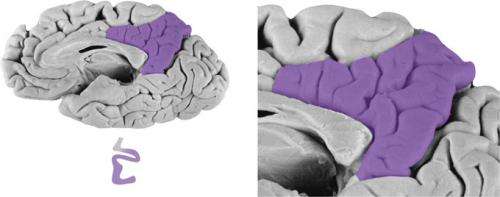
(Medical Xpress)—Scientists have historically relied on neuroimaging – but not electrophysiological – data when studying the human default mode network (DMN), a group of brain regions with lower activity during externally-directed tasks and higher activity if tasks require internal focus. Recently, however, researchers at Stanford University School of Medicine recorded electrical activity directly from a core DMN component known as the posteromedial cortex (PMC) during both internally- and externally-directed waking states – specifically, autobiographical memory and arithmetic calculation, respectively. The data they recorded showed an inverse relationship – namely, the degree activation during memory retrieval predicted the degree of suppression during arithmetic calculation – which they say provides important anatomical and temporal details about DMN function at the neural population level.
Drs. Josef Parvizi, Brett L. Foster, and Mohammad Dastjerdi faced a range of challenges when recording intracranially from the human posteromedial cortex. "A key challenge in specifically studying the electrical activity of this region is that unlike much of the brains outer cerebral cortex, the posteromedial cortex is not superficially visible," Foster tells Medical Xpress. Rather, he illustrates, it is part of the cerebral cortex that is hidden from view, which wraps over into the middle space between the left and right brain hemispheres "like the inner walls of a glacier crevasse."
This is a two-fold problem, he continues. "Not only does this hidden location make it very difficult to record this regions electrical activity from outside the skull on the scalp – a common technique – but also, even if one gets the opportunity to record more closely from inside the skull, one still needs to access this hidden cortex within the narrow space between the two hemispheres." Importantly, the ability to do so in the human brain only arises out of a unique clinical opportunity, where neurosurgeons have diligently placed electrodes onto the cortical walls of this inter-hemispheric space to monitor epileptic seizure activity as part of surgical planning. "The findings reported in our study are all derived from this unique opportunity, which allowed for direct recordings of electrical neural activity from the posteromedial cortex."
The team also encountered challenges in reliably differentiating between internally- and externally-directed neural activity. "Although it's not immediately obvious, an important challenge here is actually making sure that you're in the right location, and that you're looking at the right activity patterns," Foster explains. "These factors are essential for making consistent and reliable observations. More specifically, an important part of our study was reconstructing accurate 3D models of the brain anatomy and the relative position of recording electrodes, for each individual participant, to precisely know the location of observed neural activity." These 3D brain models were used to confirm the recording location on the posteromedial cortex.
"Once we confirm that we're recording electrical activity from the posteromedial cortex, we then focus particularly on high-frequency activity – that is, between 50 and 200 cycles per second." In the electrical signals recorded, this pattern reflects the collective activities of many thousands of closely packed neurons firing together and with this recording precision, the researchers can sensitively compare changes in electrical activity, for the same population of neurons within the posteromedial cortex, between states of internal versus external focus. "To our surprise," Foster notes, "these electrical responses were not simply different – they were completely inverted. We were initially skeptical, but with every new data set we analyzed the same result kept popping out. Finally," Foster adds, "our paper also shows that recording sites less than 1 cm outside of the posteromedial cortex did not show this pattern of activity – adding to the importance of our anatomical precision."
The scientists leveraged a range of insights, innovations and techniques to address these challenges. "As I've mentioned, a key innovation of our study was the use of intracranial direct brain recordings, in conjunction with precise brain visualization and analysis techniques, to investigate a rather unique but understudied brain region." Although a number of brain imaging studies exist for the posteromedial cortex, there is very limited electrophysiological data on this region in humans.
"A simpler, yet important, conceptual insight was the serious consideration given to decreases in neural activity," says Foster. Brain function is often discussed only in terms of cooperative and complementary patterns of neural activation – but like a growing number of neuroscientists, the researchers think it might be more appropriate to be talking about competitive brain processes, where some brain regions show increased activity, while others are actively shutdown and suppressed during cognition. "It might be more of an ongoing battle, rather than a shared harmony, for cognitive resources in the brain."
Medical Xpress asked Foster to discuss how the ability to temporally correlate electrophysiological and imaging data might impact neuroscience, and in particular the study of neural correlates of intention, motivation, perception, and behavioral response. "This question relates to a number of hot topics in neuroscience at present. To focus on what I think are the important threads, there is a real emphasis now towards identifying how subtle variations in behavior for each repetition of the same task relates to possible variations in neural response – which is, simply, a greater emphasis on brain-behavior correlations. As an example, in our study the duration of neural suppression in the posteromedial cortex was different for each trial. This might seem like an inconsistency, but each trial had a slightly different reaction time correlated with the duration of suppression."
According to Foster, this highlights the benefits of using techniques that allow researchers to assess changes in neural activity at the timescales at which cognition and behavior occur – a high temporal resolution not achievable with other techniques, including fMRI. That being said, imaging methods like fMRI provide a much clearer global picture of the spatial distribution of responses across the brain. "Therefore," Foster points out, "one important contribution of the electrophysiological intracranial recordings we perform is that we can go to these putative hot spot regions and perform similar experiments to unpack the dynamic time course of activation not seen with imaging techniques. Often this means having the precision to separate neural responses that otherwise had looked to be overlapping in time and location, but were not. When combined together, this information allows us not only to identify important regions involved in higher cognitive processes, but importantly to reveal the dynamic neural events which influence subtle changes in decision making, perception and action."
Foster describes other innovations that might be developed and applied to the current experimental design. "We're interested to see how far the switching of activity between internal versus external modes generalizes, as we know this is a simplistic dichotomy that needs refinement. In other words, what other kinds of tasks produce these contrasting increases and decreases in activity? By adapting the task we employed in this study to other types of materials and stimuli, we can more accurately figure out the defining factors in flipping the activity of posteromedial cortex." For example, Foster adds, they could consider replacing internal/external with past/present information processing and investigate the best way to conceptualize this cognitive dichotomy.
"In terms of next steps in our research," Foster continues, "we're interested characterizing the activity in other brain regions preceding the engagement of posteromedial cortex." In so doing, they hope to identify the determining mechanism(s) that switch the posteromedial cortex between activation and suppression states during certain cognitive processes. "This interest is based on our observation of fixed delays – typically greater than 400 milliseconds – before the posteromedial cortex responds.
Foster sees other applications in other areas of research potentially benefitting from their results. "As our findings relate more directly to cognitive neuroscience, the data will be of immediate interest to other investigators in the fields of autobiographical memory, numerical cognition, and those interested specifically in the function of the posteromedial cortex. One particular finding of note regarding memory research was our observation of equal levels of activity in the posteromedial cortex for both events that did and did not happen – that is, true or false as judged by the participant." To the researchers, this suggests a synthesizing role for the posteromedial cortex in attempting to put together and simulate the autobiographical event in question even if it didn't occur in one's past.
"This property more generally relates to work in other brain regions involved in memory, suggesting that memory is not just about retrieving the past, but also about envisioning and planning for the future. In turn," Foster concludes, "clinical failure of these functions can produce serious cognitive deficits. Indeed, the posteromedial cortex is a key location, among others, of brain pathology in Alzheimer's disease, where individuals have degraded autobiographical memory recall and future planning."
More information: Neural populations in human posteromedial cortex display opposing responses during memory and numerical processing, PNAS September 4, 2012, doi:10.1073/pnas.1206580109
Copyright 2012 Medical Xpress
All rights reserved. This material may not be published, broadcast, rewritten or redistributed in whole or part without the express written permission of PhysOrg.com.


