Study: Statins may stem tumor growth
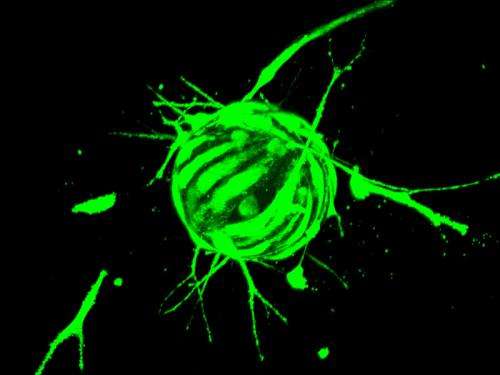
(Medical Xpress)—One of the world's top selling drugs potentially also acts against the growth of new lymphatic vessels, with potential implications for cancer therapy. This surprising finding was brought forward by Swiss researchers with their newly developed three-dimensional cell culture system.
Researchers at the Institute of Pharmaceutical Sciences at ETH Zurich and the University of California Berkeley have made an unexpected discovery. Their search for novel pharmaceuticals that might prevent the generation of tumour metastases and transplant rejection identified a well-known drug class: the statins. These cholesterol-lowering compounds are standardly used to treat patients with cardiovascular disease to prevent the progression of atherosclerosis. Statins are among the most widely prescribed drugs worldwide.
Scientists led by Michael Detmar, Professor at the ETH Zurich Institute of Pharmaceutical Sciences, made this discovery with a newly developed cell culture system that allows compound screening for modulators of lymphatic vessel expansion. Lymphatic vessel growth is a contributing factor to the dissemination of tumour cells in cancer patients and the rejection of transplanted organs by the recipient's immune system. For their screening system, the researchers coated lymphatic endothelial cells from human skin onto microscopic micro carrier beads consisting of a natural polymer and encapsulated them in a tumour environment mimicking hydrogel. When stimulated with growth factors, the lymphatic endothelial cells started to build so-called sprouts, the first step for the formation of new lymphatic vessels.
Automated cell culture in 3D
To distinguish it from common cell culture methods, which consist of a two-dimensional cell layer in a plane cell culture dish, the researchers called their micro carrier bead system a three-dimensional system that enabled them to test over 1000 small chemical compounds.
"We were able to screen such a high number of substances because we succeeded in automating this process", explains Postdoc Martin Schulz, the first author of the respective study published in the science journal "PNAS". For this work, the researchers utilised an automated screening microscope at the Light Microscopy Centre of ETH Zurich. This approach resulted in over 100'000 high-resolution images of the cell-coated micro beads that visualise the development of sprouts. The sprout number was determined by an algorithm developed by ETH-researcher Felix Reisen from the group of Gisbert Schneider, Professor of Computer-Assisted Drug Design at the Institute of Pharmaceutical Sciences. "Manual analysis would allow a throughput of maybe ten compounds, but impossibly 1000", Schulz states.
System might allow reduction of animal experiments
By utilizing known substances that inhibit lymphatic vessel growth, the researchers demonstrated that the results of their 3D-system are in closer agreement with animal experiments than commonly used cell culture test systems. "Our system thereby offers a better predictability", concludes Michael Detmar. "And in contrast to animal experiments, we are able to directly assess the response in human cells", adds Martin Schulz. The researchers are convinced that the number of animal experiments can be reduced with such a 3D-system, in particular with regard to the pharmacological testing of large numbers of chemical substances.
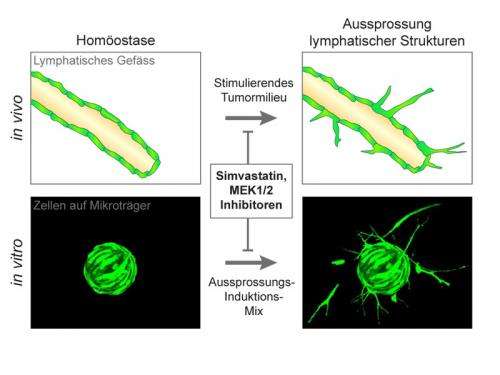
The so-called screening of over 1000 substances resulted in around 30 compounds that inhibit lymphatic vessel growth. Among several identified pharmaceuticals that were not known to convey this effect, two were investigated in more detail. One of the two – as earlier mentioned – belongs to the drug class of statins. Subsequently, the researchers confirmed the inhibitory effect of statins also in mice.
No suitable medicine available
The researchers consider it possible that statins in the future might not only be administered to patients with cardiovascular disease, but also to cancer patients. Many cancers spread over the body via lymphatic vessels, as has been known for some time – also based on research in the group of Michael Detmar among others. Some tumours are known to secrete mediators that induce the growth of lymphatic vessels towards the tumour. Therefore, clinical oncology has an interest in drugs that inhibit this growth. "So far, there are no reliable treatments available in the clinics", elaborates Detmar.
"In the future, one might imagine to treat high risk cancer patients with statins to prevent developing tumours from metastasizing, even before the cancer diagnosis", says Detmar. Because of their extensive medical evaluation and market approval for other diseases, these drugs would require repurposing by the regulatory authorities for the application as inhibitors of lymphatic vessel growth. This process would be significantly easier than the approval of a new drug.
Fewer tumours after statin treatment
The assumption that the development and progression of tumours might be impeded by statins is supported by a study published 5 weeks ago by researchers at the University Hospital Zurich that the ETH-researchers did not contribute to. There, cancer malignancies of over 100 patients that received a donor heart within the last 20 years were investigated. Patients under continuous statin treatment developed cancer less frequently and had an improved prognosis compared to patients without statins.
Potentially, statins might also be indicated after organ transplantation to reduce graft rejection in future. It is known that immune cells which are mediating organ rejection are transported via lymphatic vessels, and there are studies indicating that graft rejection can be reduced if the growth of lymphatic vessels is inhibited. However, according to Detmar, it is imperative to first investigate whether the commonly applied statin dosages are sufficient to reduce growth of lymphatic vessels in humans.
More information: Schulz MMP, Reisen F, Zgraggen S, Fischer S, Yuen D, Kang GJ, Chen L, Schneider G, Detmar M: Phenotype-based high-content chemical library screening identifies statins as inhibitors of in vivo lymphangiogenesis. Proceedings of the National Academy of Sciences 2012, in press.
Fröhlich GM et al.: Statins and the Risk of Cancer After Heart Transplantation. Circulation 2012, 126: 440-447. DOI: 10.1161/circulationaha.111.081059


