Human neural stem cells study offers new hope for children with fatal brain diseases
October 10, 2012 in Medical research
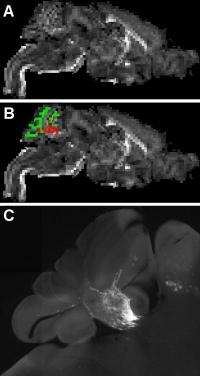
A. This is a high-field MRI scan of the entire brain of a mouse that received the transplant of human stem cells (HuCNS-SCs; spinal cord is at lower left and the front of the brain is far right) B. The red color identifies regions in white matter where the MRI signal predicted that stem cells made new myelin. Green areas predicted no myelin. C. An analysis for human myelin was done in the region of the brain seen on the MRI in red and green in panel B. Regions in white confirmed that myelin was present where predicted by the MRI signal in panel B. Credit: Oregon Health & Science University Doernbecher Children's Hospital
Physician-scientists at Oregon Health & Science University Doernbecher Children's Hospital have demonstrated for the first time that banked human neural stem cells—HuCNS-SCs, a proprietary product of StemCells Inc.—can survive and make functional myelin in mice with severe symptoms of myelin loss. Myelin is the critical fatty insulation, or sheath, surrounding new nerve fibers and is essential for normal brain function.
This is a very important finding in terms of advancing stem cell therapy to patients, the investigators report, because in most cases, patients are not diagnosed with a myelin disease until they begin to show symptoms. The research is published online in the journal Science Translational Medicine.
Myelin disorders are a common, extremely disabling, often fatal type of brain disease found in children and adults. They include cerebral palsy in children born prematurely as well as multiple sclerosis, among others.
Using advanced MRI technology, researchers at OHSU Doernbecher Children's Hospital also recently recognized the importance of healthy brain white matter at all stages of life and showed that a major part of memory decline in aging occurs due to widespread changes in the white matter, which results in damaged myelin and progressive senility (Annals of Neurology, September 2011).
In this breakthrough study, Stephen A. Back, M.D., Ph.D., senior author and clinician-scientist in the Papé Family Pediatric Research Institute at OHSU Doernbecher Children's Hospital, used a transgenic mouse model (Shiverer-immunodeficient) that develops progressive neurological deterioration because it is unable to make a key protein required to make normal myelin. Although this mouse has been widely investigated, prior to this study, true human brain-derived stem cells had not been tested for their potential to make new myelin in animals that were already deteriorating neurologically.
"Typically, newborn mice have been studied by other investigators because stem cells survive very well in the newborn brain. We, in fact, found that the stem cells preferentially matured into myelin-forming cells as opposed to other types of brain cells in both newborn mice and older mice. The brain-derived stem cells appeared to be picking up on cues in the white matter that instructed the cells to become myelin-forming cells," explained Back.
Although Back, in collaboration with investigators at StemCells Inc., had achieved success implanting stem cells in presymptomatic newborn animals, it was unclear whether the cells would survive after transplant into older animals that were already declining in health. Back and his colleagues put these cells to the test by transplanting them in animals that were declining neurologically and found that the stem cells were able to effectively survive and make functional myelin.
The study also is important because the research team was able to confirm by MRI that new myelin had been made by the stem cells within weeks after the transplant. Until now, it was unclear whether stem cell-derived myelin could be detected without major modifications to the stem cells, such as filling them with special dyes or iron particles that can be detected by the MRI.
These studies were particularly challenging, Back explained, because the mice were too sick to survive in the MRI scanner. Fortunately, OHSU is home to a leading national center for ultra-high field MRI scanners that were used to detect the myelin made by normal, unmodified stem cells.
"This is an important advance because it provides proof of principle that MRI can be used to track the transplants as myelin is being made. We actually confirmed that the MRI signal in the white matter was coming from human myelin made by the stem cells," Back said.
In a study conducted by clinical researchers at the University of California San Francisco and published in the same online issue of Science Translational Medicine (Gupta et. al), the human neural stem cells were also tested in a small number of patients with a rare childhood myelin disorder where the MRI was detecting signals from the brain consistent with myelin formation. Before MRI, there wasn't a way to confirm new myelin without a brain biopsy or an autopsy. The USCF researchers report the study results strongly support that the MRI findings in the patients were due to new myelin.
"These findings provide us with much greater confidence that going forward, a wide variety of myelin disorders might be candidates for therapy. Of course, each condition varies in terms of severity, how fast it progresses and the degree of brain injury it causes. This must all be taken into consideration as neurologists and stem cell biologist work to make further advances for these challenging brain disorders," Back said.
Journal reference:
Science Translational Medicine
Annals of Neurology
Provided by
Oregon Health & Science University
-
Neurologically impaired mice improve after receiving human stem cells
Jun 04, 2008 |
not rated yet |
0
-
Precision with stem cells a step forward for treating MS, other diseases
Oct 13, 2011 |
not rated yet |
0
-
First use of high-field MRI in developing brain reveals previously undetectable injuries
Nov 07, 2011 |
not rated yet |
0
-
Hope for infant brain injuries like cerebral palsy as well as multiple sclerosis
Jun 27, 2011 |
not rated yet |
0
-
Hopes for reversing age-associated effects in MS patients
Jan 06, 2012 |
not rated yet |
0
-
Motion perception revisited: High Phi effect challenges established motion perception assumptions
Apr 23, 2013 |
3 / 5 (2) |
2
-
Anything you can do I can do better: Neuromolecular foundations of the superiority illusion (Update)
Apr 02, 2013 |
4.5 / 5 (11) |
5
-
The visual system as economist: Neural resource allocation in visual adaptation
Mar 30, 2013 |
5 / 5 (2) |
9
-
Separate lives: Neuronal and organismal lifespans decoupled
Mar 27, 2013 |
4.9 / 5 (8) |
0
-
Sizing things up: The evolutionary neurobiology of scale invariance
Feb 28, 2013 |
4.8 / 5 (10) |
14
-
Pressure-volume curve: Elastic Recoil Pressure don't make sense
20 hours ago
-
If you became brain-dead, would you want them to pull the plug?
May 17, 2013
-
MRI bill question
May 15, 2013
-
Ratio of Hydrogen of Oxygen in Dessicated Animal Protein
May 13, 2013
-
Alcohol and acetaminophen
May 13, 2013
-
Marie Curie's leukemia
May 13, 2013
- More from Physics Forums - Medical Sciences
More news stories
Now we know why old scizophrenia medicine works on antibiotics-resistant bacteria
In 2008 researchers from the University of Southern Denmark showed that the drug thioridazine, which has previously been used to treat schizophrenia, is also a powerful weapon against antibiotic-resistant bacteria such as ...
Medical research
May 17, 2013 |
3.7 / 5 (3) |
0
|
SUMO wrestling cells reveal new protective mechanism target for stroke
Scientists investigating the interaction of a group of proteins in the brain responsible for protecting nerve cells from damage have identified a new target that could increase cell survival.
Medical research
May 17, 2013 |
5 / 5 (1) |
0
How serotonin receptors can shape drug effects, from LSD to migraine medication
New findings by researchers carrying out experiments at the U.S. Department of Energy Office of Science's Advanced Photon Source (APS) help explain why some drugs that interact with two kinds of human serotonin ...
Medical research
May 17, 2013 |
not rated yet |
0
|
Preventing blood poisoning
Peptide molecules derived from the body's natural immune system can help boost the body's defence against life-threatening blood poisoning, joint University research has uncovered.
Medical research
May 17, 2013 |
4 / 5 (1) |
0
|
New mechanism to prevent type 2 diabetes in obese individuals
A new Montréal study conducted by Dr. May Faraj, associate research professor at the Université de Montréal and invited scientist at the IRCM, along with her research team and medical collaborators, shows ...
Medical research
May 17, 2013 |
not rated yet |
0
|
New research identifies risks, interventions for children's GI health
An increasing number of U.S. children are experiencing gastrointestinal issues that require interventions to resolve, according to research presented at Digestive Disease Week (DDW).
US psychiatry gets makeover in new manual
The latest makeover to a massive psychiatric tome honored by some, reviled by others and even called the "Bible" of mental disorders is being released Saturday with a host of new changes.
New case of SARS-like virus in Saudi: ministry
A new case of the deadly coronavirus has been detected in Saudi Arabia where 15 people have already died after contracting it, the health ministry announced on Saturday on its Internet website.
AIDS science at 30: 'Cure' now part of lexicon
Big names in medicine are set to give an upbeat assessment of the war on AIDS on Tuesday, 30 years after French researchers identified the virus that causes the disease.
For combat veterans suffering from post-traumatic stress disorder, 'fear circuitry' in the brain never rests
Chronic trauma can inflict lasting damage to brain regions associated with fear and anxiety. Previous imaging studies of people with post-traumatic stress disorder, or PTSD, have shown that these brain regions can over-or ...
New colonoscope provides ground-breaking view of colon
A ground-breaking advance in colonoscopy technology signals the future of colorectal care, according to research presented today at Digestive Disease Week(DDW). Additional research focuses on optimizing the minimal withdrawal ...