How defects in a signaling protein sabotage the immune system in multiple, seemingly contradictory ways
November 21, 2012 in Immunology

Immunology: Making sense of contradictions

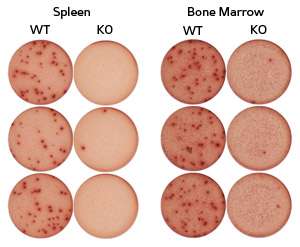
TACI-deficient mice (KO) produce far fewer antibody-secreting plasma cells in response to an immune challenge relative to normal, wild-type (WT) animals. Credit: 2012 A*STAR Bioprocessing Technology Institute

The antibody response to immune threats is managed by cells known as B lymphocytes. The differentiation and function of B cells are tightly regulated to ensure a prompt response to confirmed dangers, such as viruses or bacteria, and also to prevent the emergence of harmful autoimmune responses that can damage healthy tissues in the body.

Many express a protein called TACI on their surface, but its specific function has remained ambiguous. "Human patients with TACI manifest two seemingly opposing conditions—immunodeficiency as well as autoimmunity," says Kong-Peng Lam, a researcher at the A*STAR Bioprocessing Technology Institute. By exploring the roots of these contradictory effects, Lam and his team have provided an explanation.

Much of the antibody response is marshaled at sites known as germinal centers (GCs), where so-called 'follicular helper T (Tfh) cells' essentially 'train' GC B cells to respond to infectious threats. Lam and co-workers examined mice that lack TACI, and found that these mice generated considerably greater numbers of both Tfh and GC B cells. A pathway driven by a signaling protein called BAFF plays a major role in driving GC B ; the researchers determined that this pathway is hyperactive in TACI-deficient mice, and proposed a model wherein TACI normally sequesters excess BAFF to limit cellular expansion of GCs.

In spite of the increased GC B cells, TACI-deficient mice generally failed to mount an efficient antibody response against an immune challenge. Upon closer examination, Lam and co-workers found that these animals had fewer (see image), the class of B lymphocytes that secretes , and determined that TACI acts as a 'survival factor' that enables these cells to flourish.

Although these two effects would seem to counteract each other, the researchers' proposed model links these physiological changes with the unusual immune defects observed in human patients. Lam notes that B cell selection in the GC also entails elimination of harmful B cells that recognize host antigens. "Absence of TACI increases the population of GC B cells, and this probably has the follow-on effect of reducing the stringency of the selection process, such that autoimmunity may arise," he says.

Thus, while the drop in the number of plasma cells would result in overall immunodeficiency, the 'quality' of surviving plasma cells would also drop. "The few antibody-secreting cells that manage to survive may be autoreactive," says Lam, "and this explains the two seemingly opposing conditions that are found in TACI-deficient patients."

More information: Ou, X., Xu, S. & Lam, K.-P. Deficiency in TNFRSF13B (TACI) expands T-follicular helper and germinal center B cells via increased ICOS-ligand expression but impairs plasma cell survival. Proceedings of the National Academy of Sciences 109, 15401–15406 (2012). www.pnas.org/conte… 109.abstract

Journal reference: Proceedings of the National Academy of Sciences search and more info website

Provided by Agency for Science, Technology and Research (A*STAR), Singapore search and more info website

not rated yet  

Rank not rated yet
Related Stories
Relevant PhysicsForums posts

More news stories

Stem-cell-based strategy boosts immune system in mice

Raising hopes for cell-based therapies, UC San Francisco researchers have created the first functioning human thymus tissue from embryonic stem cells in the laboratory. The researchers showed that, in mice, ...

Immunology created May 16, 2013 | popularity 4.8 / 5 (5) | comments 0 | with audio podcast

Resistance to visceral leishmaniasis: New mechanisms involved

Researchers from CNRS, Université Toulouse III - Paul Sabatier and IRD have elucidated new molecular mechanisms involved in resistance to visceral leishmaniasis, a serious parasitic infection. They have shown that dectin-1 ...

Immunology created May 16, 2013 | popularity not rated yet | comments 0

Women's immune systems remain younger for longer

Women's immune systems age more slowly than men's, suggests research in BioMed Central's open access journal Immunity & Ageing. The slower decline in a woman's immune system may contribute to women living longer than men. ...

Immunology created May 14, 2013 | popularity not rated yet | comments 0

Newly described type of immune cell and T cells share similar path to maturity, according to new study

(Medical Xpress)—Labs around the world, and a core group at Penn, have been studying recently described populations of immune cells called innate lymphoid cells (ILCs). Some researchers liken them to foot soldiers that ...

Immunology created May 14, 2013 | popularity 5 / 5 (3) | comments 0 | with audio podcast

Not all cytokine-producing cells start out the same way, study finds

(Medical Xpress)—Cytokines are molecules produced by immune cells that induce the migration of other cells to sites of infection or injury, promote the production of anti-microbial agents, and signal the production of inflammatory ...

Immunology created May 13, 2013 | popularity 5 / 5 (1) | comments 0 | with audio podcast


New theory on genesis of osteoarthritis comes with successful therapy in mice

Scientists at Johns Hopkins have turned their view of osteoarthritis (OA) inside out. Literally. Instead of seeing the painful degenerative disease as a problem primarily of the cartilage that cushions joints, ...

Computational tool translates complex data into simplified 2-dimensional images

In their quest to learn more about the variability of cells between and within tissues, biomedical scientists have devised tools capable of simultaneously measuring dozens of characteristics of individual ...

Researchers identify a potential new risk for sleep apnea: Asthma

Researchers at the University of Wisconsin have identified a potential new risk factor for obstructive sleep apnea: asthma. Using data from the National Institutes of Health (Heart, Lung, and Blood Institute)-funded Wisconsin ...

Study finds that sleep apnea and Alzheimer's are linked

A new study looking at sleep-disordered breathing (SDB) and markers for Alzheimer's disease (AD) risk in cerebrospinal fluid (CSF) and neuroimaging adds to the growing body of research linking the two.

'Gap' for HIV vaccine efforts after latest setback

The hunt for an HIV vaccine has gobbled up $8 billion in the past decade, and the failure of the most recent efficacy trial has delivered yet another setback to 26 years of efforts.

Ginger compounds may be effective in treating asthma symptoms

Gourmands and foodies everywhere have long recognized ginger as a great way to add a little peppery zing to both sweet and savory dishes; now, a study from researchers at Columbia University shows purified components of the ...