Musical duets lock brains as well as rhythms
November 29, 2012 in Neuroscience

Musical duets lock brains as well as rhythms

Enlarge

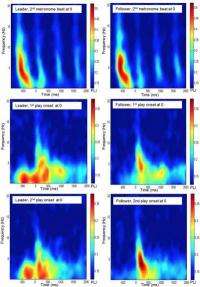
Time-frequency diagrams of the grand average of the phase locking index, averaged across frontal electrodes for leaders and followers during preparatory tempo setting and around coordinated play onsets. Credit: Max Plank Institute, Sänger et al.

Researchers from the Max Planck Institute for Human Development in Berlin have shown that synchronization emerges between brains when making music together, and even when musicians play different voices. In a study published November 29th in Frontiers in Neuroscience, Johanna Sänger and her team used electrodes to record the brain waves of guitarists while they played different voices of the same duet. The results point to brain synchronicity that cannot be explained away by similitudes in external stimulation but can be attributed to a more profound interpersonal coordination.

Scientists working with Ulman Lindenberger at the Max Planck Institute in Berlin already discovered synchronous between musicians playing the same piece in 2009. The current study goes one step further by examining the brain activity of guitar players performing a piece of music with two different parts. Their aim was to find out whether musicians' brains would synchronize if the two guitarists were not playing exactly the same notes, but instead played different voices of the same song.

To test their hypothesis, the psychologists arranged 32 experienced in duet pairs, and recorded electrical activity in different brain regions of each musician. They were then asked to play a sequence from the "Sonata in G Major" by Christian Gottlieb Scheidler a total of 60 times, and the duet partners were given slightly different tasks: each musician had to play a different voice, and one of the two was responsible for ensuring that they started at the same time and held the same tempo. Thus, one person took the lead and the other followed.

The duet's brain activities showed coordinated brain oscillations, even when playing different voices of the same duet. Called phase coherence, this suggests a direct for interpersonal coordination.

"When people coordinate their own actions, small networks between brain regions are formed. But we also observed similar network properties between the brains of the individual players, especially when mutual coordination is very important; for example at the joint onset of a ," says Johanna Sänger. The difference between leader and follower was also reflected in the results of the measurement of captured by electrodes: "In the player taking the lead, the internal synchronization of an individual's brain waves was stronger and, importantly, was present already before the duet started to play," says Johanna Sänger. "This could be a reflection of the leading player's decision to begin playing at a certain moment in time," she added.

The current data indicate that synchronization between individuals occurs in associated with social cognition and music production. And such interbrain networks are expected to occur not only while performing music. "We think that different people's also synchronise when people mutually coordinate their actions in other ways, such as during sport, or when they communicate with one another," Sänger says.

More information: Johanna Sänger, Viktor Müller and Ulman Lindenberger, Intra- and interbrain synchronization and network properties when playing guitar in duets. Frontiers in Human Neuroscience, 2012, doi: 10.3389/fnhum.2012.00312

Journal reference: Frontiers in Human Neuroscience search and more info website

Provided by Frontiers

not rated yet  

Filter


Move the slider to adjust rank threshold, so that you can hide some of the comments.


Display comments: newest first

Tausch
Nov 29, 2012

Rank: not rated yet
Kudos.
Twins performing the same task at separate times and places will show the same brain wave oscillations as when performing the same task together?
Rank not rated yet
Related Stories
Relevant PhysicsForums posts

More news stories

New neuron formation could increase capacity for new learning, at the expense of old memories

New research presented today shows that formation of new neurons in the hippocampus - a brain region known for its importance in learning and remembering - could cause forgetting of old memories by causing a reorganization ...

Neuroscience created May 24, 2013 | popularity 4 / 5 (4) | comments 0

Help at hand for people with schizophrenia

How can healthy people who hear voices help schizophrenics? Finding the answer for this is at the centre of research conducted at the University of Bergen.

Neuroscience created May 24, 2013 | popularity 4 / 5 (2) | comments 2

Japanese research organizations contribute to Human Brain Project

One of the major frontiers of modern science is a comprehensive understanding of the human brain and its functions to guide the development of new technologies in information and communication. In a major announcement for ...

Neuroscience created May 24, 2013 | popularity 3.7 / 5 (3) | comments 0

Controlling mood through the motions of mitochondria

(Medical Xpress)—Regulating the distribution of power in neurons is done by a system that makes the national electric grid look simple by comparison. Each neuron has several thousand mitochondria confined ...

Neuroscience created May 23, 2013 | popularity 4.9 / 5 (10) | comments 0 | with audio podcast report

Brain uses internal 'average voice' prototype to identify who is talking

(Medical Xpress)—The human brain is able to identify individuals' voices by comparing them against an internal 'average voice' prototype, according to neuroscientists.

Neuroscience created May 23, 2013 | popularity 3.7 / 5 (3) | comments 3 | with audio podcast


First drug to improve heart failure mortality in over a decade

Coenzyme Q10 decreases all cause mortality by half, according to the results of a multicentre randomised double blind trial presented today at Heart Failure 2013 congress. It is the first drug to improve heart failure mortality ...

Seniors more likely to crash when driving with pet, study finds

(HealthDay)—Animals make great companions for senior citizens, but elderly people who always drive with a pet in the car are far more likely to crash than those who never drive with a pet, researchers have ...

Heart failure accelerates male 'menopause'

Heart failure accelerates the aging process and brings on early andropausal syndrome (AS), according to research presented today at the Heart Failure Congress 2013. AS, also referred to as male 'menopause', was four times ...

Death highest in heart failure patients admitted in January, on Friday, and overnight

Mortality and length of stay are highest in heart failure patients admitted in January, on Friday, and overnight, according to research presented today at the Heart Failure Congress 2013. The analysis of nearly 1 million ...

Feds fight morning-after pill age ruling in NY

(AP)—Department of Justice lawyers have again asked a federal appeals court in New York to delay lifting age restrictions and prescription requirements on an emergency contraceptive popularly known as the morning-after ...

New immune system discovered

(Medical Xpress)—A research team, led by Jeremy Barr, a biology post-doctoral fellow, unveils a new immune system that protects humans and animals from infection.