Learning to control brain activity improves visual sensitivity
December 4, 2012 in Neuroscience

Learning to control brain activity improves visual sensitivity

Enlarge

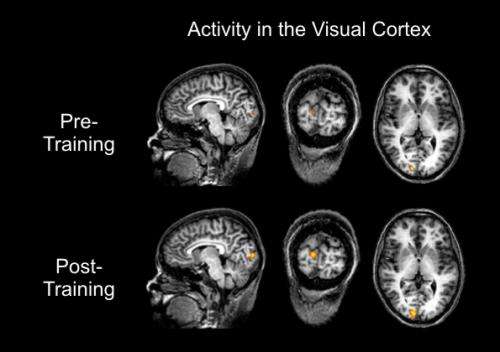
Functional MRI scan shows how the brain changes through neurofeedback training. The top panel shows brain activity in the visual cortex before neurofeedback training. The bottom panel shows brain activity in the visual cortex after the participant has learned to control activity in this area through neurofeedback training. Credit: F. Scharnowski

Training human volunteers to control their own brain activity in precise areas of the brain can enhance fundamental aspects of their visual sensitivity, according to a new study. This non-invasive 'neurofeedback' approach could one day be used to improve brain function in patients with abnormal patterns of activity, for example stroke patients.

Researchers at the Wellcome Trust Centre for Neuroimaging at UCL used non-invasive, real-time brain imaging that enabled participants to watch their own brain activity on a screen, a technique known as neurofeedback. During the training phase, they were asked to try and increase activity in the area of the brain that processes visual information, the , by imagining images and observing how their brains responded.

After the training phase, the participants' was tested using a new task that required them to detect very subtle changes in the contrast of an image. When they were asked to repeat this task whilst clamping brain activity in the visual cortex at high levels, they found that those who had successfully learned to control their brain activity could improve their ability to detect even very small changes in contrast.

This improved performance was only observed when participants were exercising control of their brain activity.

Lead author Dr Frank Scharnowski, who is now based at the University of Geneva, explains: "We've shown that we can train people to manipulate their own brain activity and improve their , without surgery and without drugs."

In the past, researchers have used recordings of electrical activity in the brain to train people to get better at various tasks, including decreased reaction times, altered emotional responses and even enhanced musical performance. In this study, the researchers used functional (fMRI) to provide the volunteers with real-time feedback on . The advantage of this technique is that you can see exactly where in the brain the training is having an effect, so you can target the training to particular brain areas that are responsible for specific tasks.

"The next step is to test this approach in the clinic to see whether we can offer any benefit to patients, for example to stroke patients who may have problems with perception, even though there is no damage to their vision," adds Dr Scharnowski.

More information: F. Scharnowski et al. Improving visual perception through neurofeedback. Journal of Neuroscience, 2012. [Epub ahead of print].

Journal reference: Journal of Neuroscience search and more info website

Provided by Wellcome Trust search and more info website

5 /5 (5 votes)  

Filter


Move the slider to adjust rank threshold, so that you can hide some of the comments.


Display comments: newest first

Tausch
Dec 05, 2012

Rank: not rated yet
...even enhanced musical performance.

Kudos.
The acoustical analogy to the entire (visual) set up is...
piano tuning.
Or, if you will, "enhanced acoustical performance".

Don't take my word or claim for it. Test subjects who make a living from this neurofeedback.

The advantage of this technique is that you can see exactly where in the brain the training is having an effect, so you can target the training to particular brain areas that are responsible for specific tasks.


If this is true, then you can 'alter' forms of Synesthesia - 'displacing' the 'lateralization' of 'function'.
That depends if you label synesthesia a disability.

And whether lateralization of function universally holds.

Rank 5 /5 (5 votes)
Relevant PhysicsForums posts

More news stories

For combat veterans suffering from post-traumatic stress disorder, 'fear circuitry' in the brain never rests

Chronic trauma can inflict lasting damage to brain regions associated with fear and anxiety. Previous imaging studies of people with post-traumatic stress disorder, or PTSD, have shown that these brain regions can over-or ...

Neuroscience created May 18, 2013 | popularity 5 / 5 (1) | comments 0 | with audio podcast

Temporal processing in the olfactory system

The neural machinery underlying our olfactory sense continues to be an enigma for neuroscience. A recent review in Neuron seeks to expand traditional ideas about how neurons in the olfactory bulb might encode information about ...

Neuroscience created May 17, 2013 | popularity 4 / 5 (1) | comments 0 | with audio podcast report

Melon focus headband turns to Kickstarter for rollout plans

(Medical Xpress)—What if the quality of your work depends more on your focus on the piano keys or canvas or laptop than your musical or painting or computing skills? If target users can be convinced, they ...

Neuroscience created May 17, 2013 | popularity 3.7 / 5 (3) | comments 0 | with audio podcast weblog

Deep brain stimulation: A fix when the drugs don't work

Neurological disorders can have a devastating impact on the lives of sufferers and their families.

Neuroscience created May 17, 2013 | popularity 5 / 5 (1) | comments 0 | with audio podcast

Brain makes call on which ear is used for cell phone

If you're a left-brain thinker, chances are you use your right hand to hold your cell phone up to your right ear, according to a newly published study from Henry Ford Hospital in Detroit.

Neuroscience created May 16, 2013 | popularity 2 / 5 (2) | comments 0 | with audio podcast


Researchers identify a potential new risk for sleep apnea: Asthma

Researchers at the University of Wisconsin have identified a potential new risk factor for obstructive sleep apnea: asthma. Using data from the National Institutes of Health (Heart, Lung, and Blood Institute)-funded Wisconsin ...

Study finds that sleep apnea and Alzheimer's are linked

A new study looking at sleep-disordered breathing (SDB) and markers for Alzheimer's disease (AD) risk in cerebrospinal fluid (CSF) and neuroimaging adds to the growing body of research linking the two.

Ginger compounds may be effective in treating asthma symptoms

Gourmands and foodies everywhere have long recognized ginger as a great way to add a little peppery zing to both sweet and savory dishes; now, a study from researchers at Columbia University shows purified components of the ...

Computational tool translates complex data into simplified 2-dimensional images

In their quest to learn more about the variability of cells between and within tissues, biomedical scientists have devised tools capable of simultaneously measuring dozens of characteristics of individual ...

New theory on genesis of osteoarthritis comes with successful therapy in mice

Scientists at Johns Hopkins have turned their view of osteoarthritis (OA) inside out. Literally. Instead of seeing the painful degenerative disease as a problem primarily of the cartilage that cushions joints, ...

'Gap' for HIV vaccine efforts after latest setback

The hunt for an HIV vaccine has gobbled up $8 billion in the past decade, and the failure of the most recent efficacy trial has delivered yet another setback to 26 years of efforts.