New technique to deliver stem cell therapy may help damaged eyes regain their sight
December 5, 2012 in Medical research
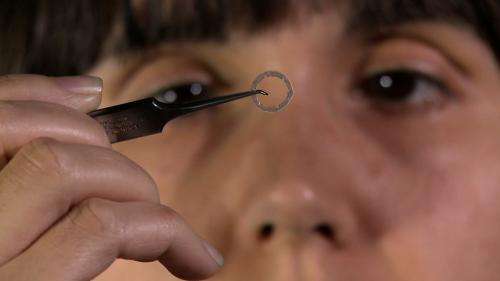
EPSRC Fellow, Dr. Ílida Ortega Asencio, examines a disc of biodegradable material which can be fixed over the cornea. The disc, developed by Dr. Ortega and her colleagues from the University of Sheffields Faculty of Engineering, is loaded with stem cells which, when the disc is grafted to the eye, will multiply, allowing the body to heal the eye naturally. The aim is to effect the natural repair of eyes damaged by accident or disease, enabling millions of people across the world to retain or even regain - their sight. Credit: GovEd Communications
In research published in the journal Acta Biomaterialia, researchers from the University of Sheffield describe a new method for producing membranes to help in the grafting of stem cells onto the eye, mimicking structural features of the eye itself. The technology has been designed to treat damage to the cornea, the transparent layer on the front of the eye, which is one of the major causes of blindness in the world.
Using a combination of techniques known as microstereolithography and electrospinning, the researchers are able to make a disc of biodegradable material which can be fixed over the cornea. The disc is loaded with stem cells which then multiply, allowing the body to heal the eye naturally.
"The disc has an outer ring containing pockets into which stem cells taken from the patient's healthy eye can be placed," explains EPSRC Fellow, Dr Ílida Ortega Asencio, from Sheffield's Faculty of Engineering. "The material across the centre of the disc is thinner than the ring, so it will biodegrade more quickly allowing the stem cells to proliferate across the surface of the eye to repair the cornea."
This video is not supported by your browser at this time.
University of Sheffield film of Dr Ílida Ortega Ascencio explaining how the disc works
A key feature of the disc is that it contains niches or pockets to house and protect the stem cells, mirroring niches found around the rim of a healthy cornea. Standard treatments for corneal blindness are corneal transplants or grafting stem cells onto the eye using donor human amniotic membrane as a temporary carrier to deliver these cells to the eye. For some patients, the treatment can fail after a few years as the repaired eyes do not retain these stem cells, which are required to carry out on-going repair of the cornea. Without this constant repair, thick white scar tissue forms across the cornea causing partial or complete sight loss. The researchers have designed the small pockets they have built into the membrane to help cells to group together and act as a useful reservoir of daughter cells so that a healthy population of stem cells can be retained in the eye."Laboratory tests have shown that the membranes will support cell growth, so the next stage is to trial this in patients in India, working with our colleagues in the LV Prasad Eye Institute in Hyderabad," says Professor Sheila MacNeil. "One advantage of our design is that we have made the disc from materials already in use as biodegradable sutures in the eye so we know they won't cause a problem in the body. This means that, subject to the necessary safety studies and approval from Indian Regulatory Authorities, we should be able to move to early stage clinical trials fairly quickly."
This video is not supported by your browser at this time.
Wellcome Trust film giving the background to the project
Treating corneal blindness is a particularly pressing problem in the developing world, where there are high instances of chemical or accidental damage to the eye but complex treatments such as transplants or amniotic membrane grafts are not available to a large part of the population.The technique has relevance in more developed countries such as the UK and US as well, according to Dr Frederick Claeyssens. "The current treatments for corneal blindness use donor tissue to deliver the cultured cells which means that you need a tissue bank. But not everyone has access to banked tissues and it is impossible to completely eliminate all risks of disease transmission with living human tissue," he says. "By using a synthetic material, it will eliminate some of the risk to patients and be readily available for all surgeons. We also believe that the overall treatment using these discs will not only be better than current treatments, it will be cheaper as well."
More information: 'Combined microfabrication and electrospinning to produce 3D architectures for corneal repair' by Ílida Ortega, Anthony J. Ryan, Pallavi Deshpande, Sheila MacNeil and Frederik Claeyssens is available online pre-publication in the next issue of Acta Biomaterialia: dx.doi.org/10.1016… .2012.10.039
Journal reference:
Acta Biomaterialia
Provided by
University of Sheffield
-
The role of stem cells in renewing the cornea
Oct 02, 2008 |
not rated yet |
0
-
Bone marrow stem cells may cure eye disease
May 10, 2007 |
not rated yet |
0
-
New cells found that could help save people's sight
Nov 08, 2012 |
not rated yet |
0
-
Two patients in Scotland get stem cell transplants to treat blindness
May 22, 2012 |
not rated yet |
0
-
Eye research paves way for more successful cornea transplants
Jul 06, 2012 |
not rated yet |
0
-
Motion perception revisited: High Phi effect challenges established motion perception assumptions
Apr 23, 2013 |
3 / 5 (2) |
2
-
Anything you can do I can do better: Neuromolecular foundations of the superiority illusion (Update)
Apr 02, 2013 |
4.5 / 5 (11) |
5
-
The visual system as economist: Neural resource allocation in visual adaptation
Mar 30, 2013 |
5 / 5 (2) |
9
-
Separate lives: Neuronal and organismal lifespans decoupled
Mar 27, 2013 |
4.9 / 5 (8) |
0
-
Sizing things up: The evolutionary neurobiology of scale invariance
Feb 28, 2013 |
4.8 / 5 (10) |
14
-
How can there be a term called "intestinal metaplasia" of stomach
1 hour ago
-
Pressure-volume curve: Elastic Recoil Pressure don't make sense
May 18, 2013
-
If you became brain-dead, would you want them to pull the plug?
May 17, 2013
-
MRI bill question
May 15, 2013
-
Ratio of Hydrogen of Oxygen in Dessicated Animal Protein
May 13, 2013
-
Alcohol and acetaminophen
May 13, 2013
- More from Physics Forums - Medical Sciences
More news stories
Study suggests new source of kidneys for transplant
Nearly 20 percent of kidneys that are recovered from deceased donors in the U.S. are refused for transplant due to factors ranging from scarring in small blood vessels of the kidney's filtering units to the organ going too ...
Medical research
16 hours ago |
5 / 5 (2) |
0
|
Discovery of circadian clock in mice hair reveals period of time when damage from radiotherapy can be quickly repaired
Discovering that mouse hair has a circadian clock - a 24-hour cycle of growth followed by restorative repair - researchers suspect that hair loss in humans from toxic cancer radiotherapy and chemotherapy ...
Medical research
16 hours ago |
5 / 5 (2) |
1
|
Do salamanders hold the solution to regeneration?
Salamanders' immune systems are key to their remarkable ability to regrow limbs, and could also underpin their ability to regenerate spinal cords, brain tissue and even parts of their hearts, scientists have ...
Medical research
17 hours ago |
4.9 / 5 (7) |
3
|
New study finds blind people have the potential to use their 'inner bat' to locate objects
New research from the University of Southampton has shown that blind and visually impaired people have the potential to use echolocation, similar to that used by bats and dolphins, to determine the location of an object.
Medical research
20 hours ago |
not rated yet |
1
|
Germ-fighting vaccine system makes great strides in delivery
A novel vaccine study from South Dakota State University (SDSU) will headline the groundbreaking research that will be unveiled at the American Association of Pharmaceutical Scientists' (AAPS) National Biotechnology Conference ...
Medical research
20 hours ago |
not rated yet |
0
Sugar injections for knee arthritis may ease pain
(HealthDay)—Injections of a sugar solution appear to help relieve knee pain and stiffness related to osteoarthritis, a new study suggests.
Anti-CD47 antibody may offer new route to successful cancer vaccination
(Medical Xpress)—Scientists at the School of Medicine have shown that their previously identified therapeutic approach to fight cancer via immune cells called macrophages also prompts the disease-fighting killer T cells ...
Evaluating a new way to open clogged arteries
Over the past few decades, scientists have developed many devices that can reopen clogged arteries, including angioplasty balloons and metallic stents. While generally effective, each of these treatments ...
Losing weight may ease chronic heartburn
(HealthDay)—Obese and overweight men and women who suffer from heartburn often report relief when they lose weight, a new study shows.
Primary care docs should play role in kids' dental health, experts say
(HealthDay)—When it comes to the care of your children's teeth, dentists aren't the only experts who can help.
Study identifies superior hypertension treatment, efficacy between sexes
(Medical Xpress)—In a recent subgroup analysis of the largest blood pressure treatment trial in history, University of Alabama at Birmingham (UAB) researchers found that women and men react the same to ...