A light switch inside the brain
January 18, 2013 in Neuroscience
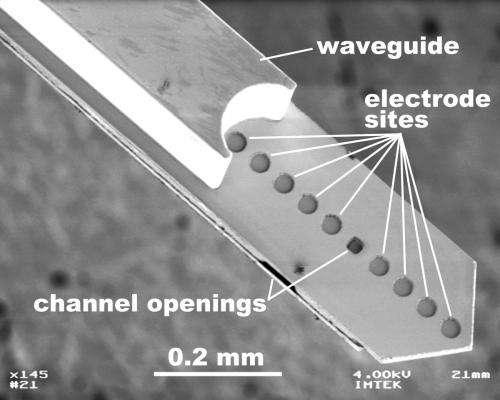
The polymer-based neural probe with platinum electrodes for the measurement of electrical signals, an injection channel for fluids (rectangular openings), and a waveguide for optical stimulation. Credit: IMTEK/University of Freiburg
Activating and deactivating individual nerve cells in the brain is something many neuroscientists wish they could do, as it would help them to better understand how the brain works.
Scientists in Freiburg and Basel, Switzerland, have developed an implant that is able to genetically modify specific nerve cells, control them with light stimuli, and measure their electrical activity all at the same time. This novel 3-in-1 tool paves the way for completely new experiments in neurobiology, also at Freiburg's new Cluster of Excellence BrainLinks-BrainTools.
Birthe Rubehn and her colleagues from the Department of Microsystems Engineering (IMTEK) and the Bernstein Center of the University of Freiburg as well as the Friedrich Miescher Institute for Biomedical Research in Basel describe the prototype of their implant in the journal Lab on a Chip. They report that initial experiments in which they implanted prototypes into mice were successful: The team was able to influence the activity of nerve cells in the brain in a controlled manner by means of laser light pulses.
The team used an innovative genetic technique that brings nerve cells to change their activity by shining light of different colors onto them. In optogenetics, genes from certain species of algae are inserted into the genome of another organism, for instance a mouse. The genes lead to the inclusion of light-sensitive pores for electrically charged particles into a nerve cell's membrane. These additional openings allow neuroscientists to control the cells' electrical activity.
However, only the new implant from Freiburg and Basel makes this principle actually practicable. The device, at its tip only a quarter of a millimeter wide and a tenth of a millimeter thick, was constructed on the basis of polymers, special plastics whose safety for implantation into the nervous system has been proven. Contrary to probes developed so far, it is capable of injecting the substances necessary for genetic modification, emitting light for the stimulation of the nerve cells, and measuring the effect through various electrical contacts all at once. Besides optimizing the technique for serial production, the scientists want to develop a second version whose injection channel dissolves over time, reducing the implant's size even further.
More information: Rubehn B., Wolff S.B.E., Tovote P., Lüthi A. and Stieglitz T. (2013): A polymer-based neural microimplant for optogenetic applications: design and first in vivo study. Lab on a Chip, DOI: 10.1039/C2LC40874K
Journal reference:
Lab on a Chip
Provided by Albert-Ludwigs-Universität Freiburg
-
Astrocytes: More than just glue
Aug 07, 2012 |
not rated yet |
0
-
Stimulating brain cells with light
Oct 26, 2012 |
not rated yet |
0
-
Milestone in the regeneration of brain cells
Aug 20, 2007 |
not rated yet |
0
-
Lighting up nerves could help people with eye condition Retinitis Pigmentosa
Jan 28, 2010 |
not rated yet |
0
-
Controlling movements with light
Jul 20, 2011 |
not rated yet |
0
-
Motion perception revisited: High Phi effect challenges established motion perception assumptions
Apr 23, 2013 |
3 / 5 (2) |
2
-
Anything you can do I can do better: Neuromolecular foundations of the superiority illusion (Update)
Apr 02, 2013 |
4.5 / 5 (11) |
5
-
The visual system as economist: Neural resource allocation in visual adaptation
Mar 30, 2013 |
5 / 5 (2) |
9
-
Separate lives: Neuronal and organismal lifespans decoupled
Mar 27, 2013 |
4.9 / 5 (8) |
0
-
Sizing things up: The evolutionary neurobiology of scale invariance
Feb 28, 2013 |
4.8 / 5 (10) |
14
-
Why is zone 1 in liver more prone to ischemic injury?
May 23, 2013
-
How can there be villous adenoma in colon, if there are no villi there
May 22, 2013
-
How can there be a term called "intestinal metaplasia" of stomach
May 21, 2013
-
Pressure-volume curve: Elastic Recoil Pressure don't make sense
May 18, 2013
-
If you became brain-dead, would you want them to pull the plug?
May 17, 2013
-
MRI bill question
May 15, 2013
- More from Physics Forums - Medical Sciences
More news stories
New neuron formation could increase capacity for new learning, at the expense of old memories
New research presented today shows that formation of new neurons in the hippocampus - a brain region known for its importance in learning and remembering - could cause forgetting of old memories by causing a reorganization ...
Neuroscience
May 24, 2013 |
4 / 5 (4) |
0
Help at hand for people with schizophrenia
How can healthy people who hear voices help schizophrenics? Finding the answer for this is at the centre of research conducted at the University of Bergen.
Neuroscience
May 24, 2013 |
4 / 5 (2) |
2
Japanese research organizations contribute to Human Brain Project
One of the major frontiers of modern science is a comprehensive understanding of the human brain and its functions to guide the development of new technologies in information and communication. In a major announcement for ...
Neuroscience
May 24, 2013 |
3.7 / 5 (3) |
0
Controlling mood through the motions of mitochondria
(Medical Xpress)—Regulating the distribution of power in neurons is done by a system that makes the national electric grid look simple by comparison. Each neuron has several thousand mitochondria confined ...
Neuroscience
May 23, 2013 |
4.9 / 5 (10) |
0
|
Brain uses internal 'average voice' prototype to identify who is talking
(Medical Xpress)—The human brain is able to identify individuals' voices by comparing them against an internal 'average voice' prototype, according to neuroscientists.
Neuroscience
May 23, 2013 |
3.7 / 5 (3) |
3
|
First drug to improve heart failure mortality in over a decade
Coenzyme Q10 decreases all cause mortality by half, according to the results of a multicentre randomised double blind trial presented today at Heart Failure 2013 congress. It is the first drug to improve heart failure mortality ...
Seniors more likely to crash when driving with pet, study finds
(HealthDay)—Animals make great companions for senior citizens, but elderly people who always drive with a pet in the car are far more likely to crash than those who never drive with a pet, researchers have ...
Heart failure accelerates male 'menopause'
Heart failure accelerates the aging process and brings on early andropausal syndrome (AS), according to research presented today at the Heart Failure Congress 2013. AS, also referred to as male 'menopause', was four times ...
Death highest in heart failure patients admitted in January, on Friday, and overnight
Mortality and length of stay are highest in heart failure patients admitted in January, on Friday, and overnight, according to research presented today at the Heart Failure Congress 2013. The analysis of nearly 1 million ...
Feds fight morning-after pill age ruling in NY
(AP)—Department of Justice lawyers have again asked a federal appeals court in New York to delay lifting age restrictions and prescription requirements on an emergency contraceptive popularly known as the morning-after ...
New immune system discovered
(Medical Xpress)—A research team, led by Jeremy Barr, a biology post-doctoral fellow, unveils a new immune system that protects humans and animals from infection.
Jan 20, 2013
Rank: not rated yet