Researchers use hydrogel to repair cartilage
January 11, 2013
by Bob Yirka
in Medical research
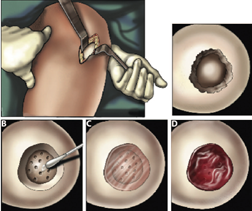
This is an illustration of the cartilage repair surgical procedure. A mini-incision exposes the cartilage defect (top left-hand panel), and any dead tissue is removed from the edges. (B) The adhesive is then applied to the base and walls of the defect, followed by microfracture. (C) Lastly, the hydrogel solution is injected into the defect. (D) Bleeding from the microfracture holes is trapped in and around the hydrogel. Credit: Science Translational Medicine/AAAS
(Medical Xpress)—Researchers in the US have created a type of hydrogel that has proven to be effective in treating patients with damaged cartilage. The gel, the team writes, in their paper published in the journal Science Translational Medicine, thickens when exposed to light, providing a lattice platform for the development of new cell growth.
Cartilage is the pliable material that sits between bones that connect at the joints – its job is to serve as a buffer or cushion. Injuries to cartilage or simple wear and tear can result in perforations that allow bones to rub against one another causing difficulty in moving and pain. Sadly, cartilage doesn't generally repair itself the way other body parts do because it doesn't have a blood source. For that reason, doctors must intercede if a patient is to recover.
The traditional approach to repairing damaged cartilage is a procedure called microfracturing – doctors drill holes in the bone near the cartilage releasing blood and stem cells into the damaged area, promoting new cell growth. Unfortunately for such patients, the procedure doesn't fully restore cartilage to its former state and quite often leads to the formation of scar tissue. Because of this, many patients who experience cartilage damage, particularly in the knee, wind up with an artificial joint instead of repaired cartilage.
In this new approach, the researchers developed a hydrogel that when exposed to light, thickens into a Jell-O like substance with a crisscross lattice pattern. To make use of it, doctors first perform the standard microfracturing procedure. Once that's finished, they apply the gel to the holes in the cartilage, then finish by bathing it in light to cause it to thicken. The gel provides a platform for the stem cells to grow into cartilage cells, allowing for rejuvenation. Over time, the gel dissolves, leaving behind new cartilage.
To test how well the gel works, the team performed just the microfracturing procedure on one group of patients, and the combined procedure on another. They found that those that had received the gel had on average 86 percent closure of the perforations, whereas those that underwent just the microfracturing showed the normal 64 percent – a dramatic improvement, especially considering that those patients that received the gel also reported much less pain.
Because the number of patients in the study was small, more testing will have to be done to see just how effective the gel really is, of course. Thus far though, the results have been positive enough to suggest that the gel will likely become a standard treatment for cartilage repair in the very near future.
More information: Human Cartilage Repair with a Photoreactive Adhesive-Hydrogel Composite, Sci Transl Med 9 January 2013: Vol. 5, Issue 167, p. 167ra6 DOI: 10.1126/scitranslmed.3004838
ABSTRACT
Surgical options for cartilage resurfacing may be significantly improved by advances and application of biomaterials that direct tissue repair. A poly(ethylene glycol) diacrylate (PEGDA) hydrogel was designed to support cartilage matrix production, with easy surgical application. A model in vitro system demonstrated deposition of cartilage-specific extracellular matrix in the hydrogel biomaterial and stimulation of adjacent cartilage tissue development by mesenchymal stem cells. For translation to the joint environment, a chondroitin sulfate adhesive was applied to covalently bond and adhere the hydrogel to cartilage and bone tissue in articular defects. After preclinical testing in a caprine model, a pilot clinical study was initiated where the biomaterials system was combined with standard microfracture surgery in 15 patients with focal cartilage defects on the medial femoral condyle. Control patients were treated with microfracture alone. Magnetic resonance imaging showed that treated patients achieved significantly higher levels of tissue fill compared to controls. Magnetic resonance spin-spin relaxation times (T2) showed decreasing water content and increased tissue organization over time. Treated patients had less pain compared with controls, whereas knee function [International Knee Documentation Committee (IKDC)] scores increased to similar levels between the groups over the 6 months evaluated. No major adverse events were observed over the study period. With further clinical testing, this practical biomaterials strategy has the potential to improve the treatment of articular cartilage defects.
Journal reference:
Science Translational Medicine
© 2013 Medical Xpress
-
Tissue engineered scaffolding allows reproduction of cartilage tissue
May 09, 2007 |
not rated yet |
0
-
Growing cartilage -- no easy task
Feb 01, 2010 |
not rated yet |
0
-
Stem cells offer cartilage repair hope for arthritis sufferers
Apr 11, 2008 |
not rated yet |
0
-
Cartilage repair gel gives injuries a sporting chance
Mar 08, 2012 |
not rated yet |
0
-
Research team finds compound that can spur cartilage growth
Apr 06, 2012 |
not rated yet |
0
-
Motion perception revisited: High Phi effect challenges established motion perception assumptions
Apr 23, 2013 |
3 / 5 (2) |
2
-
Anything you can do I can do better: Neuromolecular foundations of the superiority illusion (Update)
Apr 02, 2013 |
4.5 / 5 (11) |
5
-
The visual system as economist: Neural resource allocation in visual adaptation
Mar 30, 2013 |
5 / 5 (2) |
9
-
Separate lives: Neuronal and organismal lifespans decoupled
Mar 27, 2013 |
4.9 / 5 (8) |
0
-
Sizing things up: The evolutionary neurobiology of scale invariance
Feb 28, 2013 |
4.8 / 5 (10) |
14
-
Why is zone 1 in liver more prone to ischemic injury?
May 23, 2013
-
How can there be villous adenoma in colon, if there are no villi there
May 22, 2013
-
How can there be a term called "intestinal metaplasia" of stomach
May 21, 2013
-
Pressure-volume curve: Elastic Recoil Pressure don't make sense
May 18, 2013
-
If you became brain-dead, would you want them to pull the plug?
May 17, 2013
-
MRI bill question
May 15, 2013
- More from Physics Forums - Medical Sciences
More news stories
Study reveals new mechanism for estrogen suppression of liver lipid synthesis
By discovering the new mechanism by which estrogen suppresses lipid synthesis in the liver, UC Irvine endocrinologists have revealed a potential new approach toward treating certain liver diseases.
Medical research
May 23, 2013 |
5 / 5 (1) |
0
|
MRI-based measurement helps predict vascular disease in the brain
Aortic arch pulse wave velocity, a measure of arterial stiffness, is a strong independent predictor of disease of the vessels that supply blood to the brain, according to a new study published in the June issue the journal ...
Medical research
May 23, 2013 |
not rated yet |
0
Antibiotics: A new understanding of sulfonamide nervous system side effects
Since the discovery of Prontosil in 1932, sulfonamide antibiotics have been used to combat a wide spectrum of bacterial infections, from acne to chlamydia and pneumonia. However, their side effects can include serious neurological ...
Medical research
May 23, 2013 |
3 / 5 (1) |
0
|
Scientists discover molecule triggers sensation of itch
Scientists at the National Institutes of Health report they have discovered in mouse studies that a small molecule released in the spinal cord triggers a process that is later experienced in the brain as ...
Medical research
May 23, 2013 |
5 / 5 (3) |
0
|
Discarded immune cells induce the relocation of stem cells
Spanish researchers have discovered that the daily clearance of neutrophils from the body stimulates the release of hematopoietic stem cells from the bone marrow into the bloodstream, according to a report published today ...
Medical research
May 23, 2013 |
5 / 5 (2) |
0
First drug to improve heart failure mortality in over a decade
Coenzyme Q10 decreases all cause mortality by half, according to the results of a multicentre randomised double blind trial presented today at Heart Failure 2013 congress. It is the first drug to improve heart failure mortality ...
Seniors more likely to crash when driving with pet, study finds
(HealthDay)—Animals make great companions for senior citizens, but elderly people who always drive with a pet in the car are far more likely to crash than those who never drive with a pet, researchers have ...
Heart failure accelerates male 'menopause'
Heart failure accelerates the aging process and brings on early andropausal syndrome (AS), according to research presented today at the Heart Failure Congress 2013. AS, also referred to as male 'menopause', was four times ...
Death highest in heart failure patients admitted in January, on Friday, and overnight
Mortality and length of stay are highest in heart failure patients admitted in January, on Friday, and overnight, according to research presented today at the Heart Failure Congress 2013. The analysis of nearly 1 million ...
Feds fight morning-after pill age ruling in NY
(AP)—Department of Justice lawyers have again asked a federal appeals court in New York to delay lifting age restrictions and prescription requirements on an emergency contraceptive popularly known as the morning-after ...
New immune system discovered
(Medical Xpress)—A research team, led by Jeremy Barr, a biology post-doctoral fellow, unveils a new immune system that protects humans and animals from infection.
Jan 11, 2013
Rank: not rated yet