Possible role for Huntington's gene discovered
January 16, 2013 by Anne Trafton in Genetics
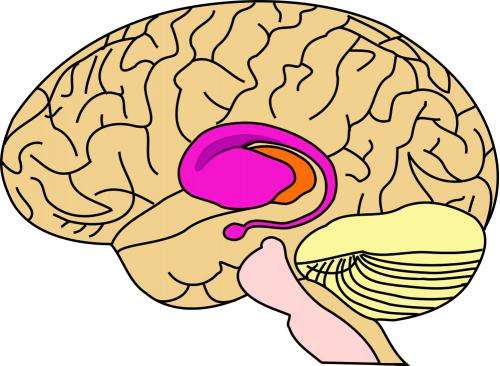
The gene that causes Huntington's disease does most of its damage in the basal ganglia, shown in pink. The basal ganglia are responsible for many functions, including voluntary motor control and habit formation. Credit: U.S. Food and Drug Administration
About 20 years ago, scientists discovered the gene that causes Huntington's disease, a fatal neurodegenerative disorder that affects about 30,000 Americans. The mutant form of the gene has many extra DNA repeats in the middle of the gene, but scientists have yet to determine how that extra length produces Huntington's symptoms.
In a new step toward answering that question, MIT biological engineers have found that the protein encoded by this mutant gene alters patterns of chemical modifications of DNA. This type of modification, known as methylation, controls whether genes are turned on or off at any given time.
The mutant form of this protein, dubbed "huntingtin," appears to specifically target genes involved in brain cell function. Disruptions in the expression of these genes could account for the neurodegenerative symptoms seen in Huntington's disease, including early changes in cognition, says Ernest Fraenkel, an associate professor of biological engineering at MIT.
Fraenkel's lab is now investigating the details of how methylation might drive those symptoms, with an eye toward developing potential new treatments. "One could imagine that if we can figure out, in more mechanistic detail, what's causing these changes in methylation, we might be able to block this process and restore normal levels of transcription early on in the patients," says Fraenkel, senior author of a paper describing the findings in this week's issue of the Proceedings of the National Academy of Sciences.
Unexpected patterns
DNA methylation has a major impact on genetic expression: Genes that are methylated at particular sites are usually dormant, because the methyl groups deny access to the proteins needed to copy DNA's instructions and carry them to the rest of the cell. For a long time, scientists believed that DNA methylation patterns changed during embryonic development and then remained constant in adulthood. However, DNA methylation is emerging as important to a wide range of normal cell activity.
In the new study, the MIT team measured changes in methylation patterns during early stages of Huntington's disease in cells derived from a brain region called the striatum in mouse embryos. This region, where planning of movement occurs, is severely affected by Huntington's disease.
"We're very interested in the earliest phases, because that's when there's the most hope that you could either slow down or stop progression of the disease, and allow people to live healthy lives much longer," Fraenkel says. "By the time there is much more severe neurodegeneration, it's unlikely that you're going to be able to reverse the damage."
Fraenkel and Ng were surprised to find a dramatic difference in methylation patterns between cells with normal and mutant forms of the huntingtin protein. Some genomic sites gained methylation, while others lost it. Many of the affected sites were in regions that regulate the expression of nearby genes necessary for neuron growth and survival.
Turning genes off and on
After observing the changing methylation patterns, the MIT team identified many proteins that tend to bind to the DNA sites where those changes take place. These proteins include Sox2 and others known to regulate genes involved in neuronal activity, including growth of the neurons.
The new findings go a long way toward explaining how the extra DNA repeats in the mutant form of the huntingtin gene might bring about disease, says Mark Mehler, a professor of neurology at the Albert Einstein College of Medicine. "People have not had a good sense, until this paper, of what these repeats might be doing," says Mehler, who was not part of the research team. "What this study has done is demonstrated a mechanism by which expanded repeats can alter gene expression."
The researchers are now studying whether huntingtin affects other modifications of DNA and histones, the proteins around which DNA is wound. Together, these might cause genes to be turned on or off inappropriately, Fraenkel says.
The researchers are also working with mouse models at different stages of Huntington's disease to track how the methylation patterns change as the disease progresses. "That also gives us an opportunity to do interventions and test whether affecting particular proteins influences the progression of the disease," Fraenkel says.
Journal reference:
Proceedings of the National Academy of Sciences
Provided by
Massachusetts Institute of Technology
This story is republished courtesy of MIT News (web.mit.edu/newsoffice/), a popular site that covers news about MIT research, innovation and teaching.
-
Controlling patterns of DNA methylation
Oct 28, 2011 |
not rated yet |
0
-
New insights into why humans are more susceptible to cancer and other diseases
Aug 23, 2012 |
not rated yet |
0
-
Scientists tackle Huntington's disease by targeting mutant gene
Nov 06, 2012 |
not rated yet |
0
-
Gene packaging tells story of cancer development
Dec 04, 2008 |
not rated yet |
0
-
Epigenetics alters genes in rheumatoid arthritis
Jul 03, 2012 |
not rated yet |
0
-
Motion perception revisited: High Phi effect challenges established motion perception assumptions
Apr 23, 2013 |
3 / 5 (2) |
2
-
Anything you can do I can do better: Neuromolecular foundations of the superiority illusion (Update)
Apr 02, 2013 |
4.5 / 5 (11) |
5
-
The visual system as economist: Neural resource allocation in visual adaptation
Mar 30, 2013 |
5 / 5 (2) |
9
-
Separate lives: Neuronal and organismal lifespans decoupled
Mar 27, 2013 |
4.9 / 5 (8) |
0
-
Sizing things up: The evolutionary neurobiology of scale invariance
Feb 28, 2013 |
4.8 / 5 (10) |
14
-
Classical and Quantum Mechanics via Lie algebras
Apr 15, 2011
- More from Physics Forums - Independent Research
More news stories
Researchers develop model for better testing, targeting of malignant peripheral nerve sheath tumors
University of Minnesota Medical School researchers from the Masonic Cancer Center, University of Minnesota, in partnership with the University's Brain Tumor Program, have developed a new mouse model of malignant peripheral ...
Genetics
May 20, 2013 |
5 / 5 (1) |
0
|
Researchers identify new circadian clock component
Northwestern University scientists have shown a gene involved in neurodegenerative disease also plays a critical role in the proper function of the circadian clock.
Genetics
May 16, 2013 |
3 / 5 (1) |
1
|
Returning genetic incidental findings without patient consent violates basic rights, experts say
Informed consent is the backbone of patient care. Genetic testing has long required patient consent and patients have had a "right not to know" the results. However, as 21st century medicine now begins to use the tools of ...
Genetics
May 16, 2013 |
5 / 5 (1) |
3
|
Ethicists provide framework supporting new recommendations on reporting incidental findings in gene sequencing
In a paper published in Science Express, a group of experts led by bioethicists in the Center for Medical Ethics and Health Policy at Baylor College of Medicine provide a framework for the new American College of Medical Geneti ...
Genetics
May 16, 2013 |
not rated yet |
0
Experts urge caution over use of new genetic sequencing techniques
The use of genome-wide analysis (GWA), where the entirety of an individual's DNA is examined to look for the genomic mutations or variants which can cause health problems is a massively useful technology for diagnosing disease. ...
Genetics
May 16, 2013 |
not rated yet |
0
If you can remember it, you can remember it wrong
(Medical Xpress)—Native peoples in regions where cameras are uncommon sometimes react with caution when their picture is taken. The fear that something must have been stolen from them to create the photo ...
B vitamins could delay dementia
(Medical Xpress)—Despite spending billions of dollars on research and development, drug companies have been unable to come up with effective treatments for dementia and Alzheimer's Disease (AD). Now, A. ...
New sleeping pill poised to hit US markets
An experimental sleeping pill from US drug company Merck is effective at helping people fall and stay asleep, according to reviewers at the US Food and Drug Administration, which could soon approve the new drug.
Reducing caloric intake delays nerve cell loss
Activating an enzyme known to play a role in the anti-aging benefits of calorie restriction delays the loss of brain cells and preserves cognitive function in mice, according to a study published in the May ...
Insight into the dazzling impact of insulin in cells
Australian scientists have charted the path of insulin action in cells in precise detail like never before. This provides a comprehensive blueprint for understanding what goes wrong in diabetes.
Antidepressant reduces stress-induced heart condition
A drug commonly used to treat depression and anxiety may improve a stress-related heart condition in people with stable coronary heart disease, according to researchers at Duke Medicine.