Chili peppers spark discovery: WSU effort to fix injured brains with new nerve cells funded
February 4, 2013 in Medical research

Chili peppers spark discovery

Enlarge

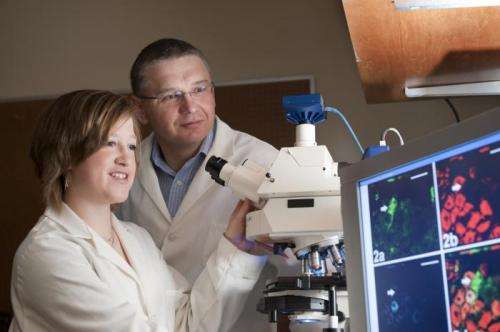
Cutline and credit: Washington State University neuroscientist Krzysztof Czaja and student Rachel Wanty look at images of nerve cells that he has found can be grown outside the brain. Czaja has an NFL grant to see if the cells can treat concussions and other brain injuries. Credit: Photo by Robert Hubner, Washington State University photo services. (Credit it as you wish; no restrictions on photo use.)

As research efforts go, this one is high risk. Which is to say, it could easily fail.

And it's high reward. Meaning it could provide some relief to concussions and subsequent health effects seen in athletes, soldiers and other head-injury victims.

The National Football League thinks enough of the work that its charitable arm has given Krzysztof Czaja (pronounced K-shish-toff Chai-uh), a Washington State University neuroscientist, $100,000 to keep looking.

Five years ago, Czaja and WSU colleagues discovered by accident that a nerve center just outside the brain can recover from damage by inducing developing stem cells to become functional , or neurons. Now he is looking for the substances that get the process going.

"Our idea is to trigger the cells and then plant them in a new, injured environment so they start to develop and seek connections," Czaja says.

The grant is one of 15 that NFL Charities awarded last year to support sports-related medical research, mostly in the prevention and treatment of concussions. Mounting concerns over football-related have led to congressional hearings, research linking injuries to long-term like dementia, and lawsuits from former players. The league has instituted rule changes to make the game safer, but still had 170 concussions this season, according to the Watch database of FRONTLINE and .

Czaja's work grows out of experiments in which he and colleagues killed neurons in rats' nodose ganglia, a sort of brain outside the brain. They used capsaicin, the active component of , but at doses thousands of times more potent than Tabasco sauce. The goal was to see if the damage to the nodose ganglia neurons affects curbing the desire to eat.

Usually, the rats are euthanized soon after the experiment. But when Czaja learned that one group of rats was in good condition six months later, he thought to see what the ganglia looked like.

"What I found is that we actually got more neurons than less," he said.

The damage, he said, was "like a double-edged sword. It's damaging the nervous system but it's also inducing a cascade of events to fix it." Before this discovery, decades of neuroscientific thinking held that new neurons can only be formed inside the brain, putting them off limits to harvesting, let alone experimentation.

If Czaja can find the chemical agent stimulating the creation of new neurons, doctors could in theory use it to produce new neurons and graft them to damaged areas of the brain. Because they are from the patient, doctors might avoid autoimmune problems and both the ethical questions and technical challenges surrounding human embryonic .

"I think that our nervous system is much more plastic and much more capable and powerful than we think, than we imagine," said Czaja. "That's just unleashing this potential. And the beauty of our model is that this is something on the periphery we can use to fix the central nervous system."

Provided by Washington State University search and more info website

5 /5 (3 votes)  

Filter


Move the slider to adjust rank threshold, so that you can hide some of the comments.


Display comments: newest first

wealthychef
Feb 04, 2013

Rank: not rated yet
Help for stroke survivors?
Rank 5 /5 (3 votes)
Relevant PhysicsForums posts

More news stories

Study reveals new mechanism for estrogen suppression of liver lipid synthesis

By discovering the new mechanism by which estrogen suppresses lipid synthesis in the liver, UC Irvine endocrinologists have revealed a potential new approach toward treating certain liver diseases.

Medical research created May 23, 2013 | popularity not rated yet | comments 0 | with audio podcast

MRI-based measurement helps predict vascular disease in the brain

Aortic arch pulse wave velocity, a measure of arterial stiffness, is a strong independent predictor of disease of the vessels that supply blood to the brain, according to a new study published in the June issue the journal ...

Medical research created May 23, 2013 | popularity not rated yet | comments 0

Antibiotics: A new understanding of sulfonamide nervous system side effects

Since the discovery of Prontosil in 1932, sulfonamide antibiotics have been used to combat a wide spectrum of bacterial infections, from acne to chlamydia and pneumonia. However, their side effects can include serious neurological ...

Medical research created May 23, 2013 | popularity not rated yet | comments 0 | with audio podcast

Scientists discover molecule triggers sensation of itch

Scientists at the National Institutes of Health report they have discovered in mouse studies that a small molecule released in the spinal cord triggers a process that is later experienced in the brain as ...

Medical research created May 23, 2013 | popularity 5 / 5 (3) | comments 0 | with audio podcast

Discarded immune cells induce the relocation of stem cells

Spanish researchers have discovered that the daily clearance of neutrophils from the body stimulates the release of hematopoietic stem cells from the bone marrow into the bloodstream, according to a report published today ...

Medical research created May 23, 2013 | popularity 5 / 5 (2) | comments 0


Researchers identify first drug targets in childhood genetic tumor disorder

Two mutations central to the development of infantile myofibromatosis (IM)—a disorder characterized by multiple tumors involving the skin, bone, and soft tissue—may provide new therapeutic targets, according to researchers ...

Engineered cytomegalovirus protects monkeys from HIV equivalent

(Medical Xpress)—A new study by researchers in the US has shown that an ancient virus can be modified to help in the fight against the simian immunodeficiency virus SIV, which is the equivalent in monkeys ...

Driving and hands-free talking lead to spike in errors, study shows

Talking on a hands-free device while behind the wheel can lead to a sharp increase in errors that could imperil other drivers on the road, according to new research from the University of Alberta.

Hormone levels may provide key to understanding psychological disorders in women

Women at a particular stage in their monthly menstrual cycle may be more vulnerable to some of the psychological side-effects associated with stressful experiences, according to a study from UCL.

Going live: Immune cell activation in multiple sclerosis

Biological processes are generally based on events at the molecular and cellular level. To understand what happens in the course of infections, diseases or normal bodily functions, scientists would need to ...

Pollen count apps for smartphones are nothing to sneeze at

Kate O'Reilly's spring allergy survival kit includes the usual stuff - nasal sprays, allergy pills and a box of tissues. This season, she's added a new weapon to her line of defense: an app on her smartphone.