Scientists develop new therapeutics that could accelerate wound healing
(Medical Xpress)—In "before" and "after" photos from advertisements for wound-healing ointments, bandages and antibiotic creams, we see an injury transformed from an inflamed red gash to smooth and flawless skin.
What we don't appreciate is the vital role that our own natural biomolecules play in the healing process, including their contribution to the growth of new cells and the development of new blood vessels that provide nutrients to those cells.
Now, UCLA researchers led by Heather Maynard, a professor of chemistry and biochemistry and a member of UCLA's California NanoSystems Institute, are working to take advantage of our body's ability to heal itself by developing new bio-mimicking therapeutics that could be used to treat skin wounds.
Among the key players involved in natural wound-healing is a signaling molecule known as basic fibroblast growth factor, or bFGF, which is secreted by our cells to trigger processes that are involved in healing, as well as embryonic development, tissue regeneration, bone regeneration, the development and maintenance of the nervous system, and stem cell renewal.
bFGF has been widely investigated as a tool doctors could potentially use to promote or accelerate these processes, but its instability outside the body has been a significant hurdle to its widespread use, Maynard said.
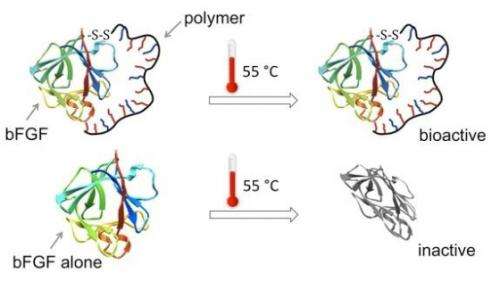
Now, Maynard and her team have discovered how to stabilize bFGF based on the principle of mimicry. Relying on the growth factor's ability to bind heparin—a naturally occurring complex sugar found on the surface of our cells—the team synthesized a polymer that mimics the structure of heparin. When attached to bFGF, the new polymer makes the protein stable to the many stresses that normally inactivate it, rendering it a more suitable candidate for medical applications.
The research is published Feb. 17 in the online edition of the journal Nature Chemistry and will appear in an upcoming print edition of the journal.
UCLA co-authors of the research include graduate students Thi Nguyen and Caitlin Decker, former postdocs Dr. Sung-Hye Kim and Dr. Darice Wong, and Joseph Loo, professor of chemistry and biochemistry.
The research was federally funded by the National Institutes of Health and the National Science Foundation.
Our ability to heal from wounds is essential to our survival. When those natural healing processes are compromised, serious wounds can lead to infection and other health problems. People with diabetes, for example, can have wounds that heal very slowly. The resulting chronic wounds are debilitating and can lead to loss of limbs or even death. Yet, despite the need for wound dressings that can stimulate the body to heal wounds, very few are curative.
"This very important clinical need is the motivation behind our research," Maynard said.
The importance of fibroblast growth factor was recognized in 1973, when biologist Hugo Armelin discovered that this previously unknown chemical, extracted from the pituitary gland, successfully caused cells to divide. Since then, researchers have applied fibroblast growth factor to wounds such as foot ulcers resulting from diabetes, but the treatments have not been very effective. What scientists now recognize, Maynard said, is that these growth factors typically lose their activity quickly in storage.
Knowing that other key biomolecules have been stabilized before with the help of polymers, Maynard and her team developed a strategy to maintain bFGF activity by taking advantage of its known structure and binding capabilities. Their new polymer, p(SS-co-PEGMA), mimics heparin's natural ability to stabilize the growth factor.
After showing that p(SS-co-PEGMA) was non-toxic to human cells important in wound healing, they used it to conjugate bFGF and demonstrated that they could keep the growth factor active outside of the body for extended periods of time, even after it is exposed to heat, cold, enzymes that would normally break it down, and acidic conditions like those found in the wound injury setting. Moreover, they showed that this bound bFGF functions just like normal bFGF to trigger the same signaling pathways involved in the healing process.
The advance is an important step in the use of growth factors for therapy. The ability to stabilize bFGF means that it can be potentially stored, shipped and made available for use by doctors and patients when needed any time and anywhere, Maynard said.
The group is testing their new material with dermatologists Dr. Lloyd Miller, an associate professor of dermatology at Johns Hopkins University, and Dr. Jenny Kim, an associate professor of clinical medicine and dermatology at the David Geffen School of Medicine at UCLA, a member of the CNSI, and chief of dermatology for the Veterans Affairs Greater Los Angeles Healthcare System. The group is also researching ways to stabilize other proteins involved in wound healing and ways to make bFGF more active.
"This stable bFGF–polymer conjugate may also be useful in diseases other than wound healing—for example, vocal chord repair, cardiac repair and bone regeneration," Maynard said. "More generally, we think that this idea of making polymers that mimic natural stabilizers is useful in a wide range of fields."


