Misregulated genes may have big autism role
March 21, 2013 by David Orenstein in Genetics
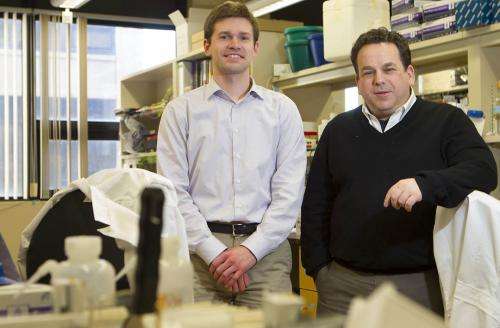
Matthew Schewede, left, and Eric Morrow, Brown University, demonstrated the value of studying rare forms of autism. Research is done not only for the patients who have rare conditions, but also because doing so can inform research about other forms of autism. Credit: Michael Cohea/Brown University
A new study finds that two genes individually associated with rare autism-related disorders are also jointly linked to more general forms of autism. The finding suggests a new genetic pathway to investigate in general autism research.
The genes encode the proteins NHE6 and NHE9, which are responsible for biochemical exchanges in the endosomes of cells. Mutations in the NHE6 gene are a direct cause of Christianson Syndrome, while mutations in the NHE9 gene lead to a severe form of autism with epilepsy. In the new study, a statistical analysis published online this week in the journal Molecular Psychiatry, Brown University researchers and their colleagues found a specific pattern of misregulation of those two genes—NHE9 is up-regulated and NHE6 is down-regulated—in the brains of children with autism compared to the brains of non-autistic children.
"These genes play a role, not just in the rare forms of autism but also in the generalized pathology of autism," said Dr. Eric Morrow, professor of biology and professor of psychiatry and human behavior at Brown University, the paper's senior author. "In autism I think people get overwhelmed because there are hundreds of different genes. One of the important things is to find points of convergence where there are events that might be common across different forms."
The new study suggests that misregulation of NHE6 and NHE9 is one such event.
The research is based on a statistical analysis of messenger RNA samples from a bank of brain tissue donated posthumously by some children who had autism and some who did not. Messenger RNA is a key molecular player in the process of gene expression, making it an indicator of how gene expression was regulated in the cerebral cortex of each of the children.
Guided by Morrow, who studies autism genomics and sees autism patients at the E.P. Bradley Hospital in East Providence, lead author Matthew Schewede spent the summer of 2012 poring over the raw data, which was made available from a 2011 study led by co-author Daniel Geschwind and Irinia Voineagu of the University of California–Los Angeles.
Schwede, who studied statistics as an undergraduate at Harvard, is now a second-year student in the Warren Alpert Medical School. His classes are a block away from Morrow's lab, making the collaboration easy.
"We kind of stumbled on this," Schwede said. "At first we were just identifying what was up- and down-regulated in autism cerebral cortex in this data set."
But Schwede's findings about the NHE genes caught Morrow's attention in particular, because Morrow has been studying the NHE6 and NHE9 genes and the rare autism forms they cause.
"When we realized that some genes of interest for our lab were altered in the cerebral cortex, we focused the analysis on these genes in particular and how they were related to other processes," Schwede said.
Schwede made a second key finding: a strong and significant correlation between the misregulation of the NHE genes and the down-regulation of synapse genes, which is known to occur in autism.
Schwede's purely statistical analysis does not explain the physiology of how up-regulation of NHE9 and down-regulation NHE6 would affect synapse formation or general autism, but Morrow's biology group has a clear next step: to observe the neural and behavioral effects in the lab of misregulation of those genes in various experimental systems.
"That's a hypothesis that we can take to the mouse," Morrow said. "When we knock out these genes, how do the synapses change?"
The statistical results point out the value of studying rare forms of autism, not only for the sake the patients who have those conditions, Morrow said, but also because doing so can inform research about other forms of autism.
"We argue that it's relevant but sometimes, in fairness, we wonder about that," Morrow said. "A study like this really conveys strongly that that's a fair argument."
Journal reference:
Molecular Psychiatry
Provided by
Brown University
-
Autism speaks through gene expression
Feb 01, 2013 |
not rated yet |
0
-
Autism blurs distinctions between brain regions
Jun 03, 2011 |
not rated yet |
0
-
A world first: The discovery of a common genetic cause of autism and epilepsy
Apr 08, 2011 |
not rated yet |
0
-
From 'Refrigerator Mothers' to untangling the genetic roots of autism
Mar 07, 2012 |
not rated yet |
0
-
Study characterizes epigenetic signatures of autism in brain tissue
Nov 07, 2011 |
not rated yet |
0
-
Motion perception revisited: High Phi effect challenges established motion perception assumptions
Apr 23, 2013 |
3 / 5 (2) |
2
-
Anything you can do I can do better: Neuromolecular foundations of the superiority illusion (Update)
Apr 02, 2013 |
4.5 / 5 (11) |
5
-
The visual system as economist: Neural resource allocation in visual adaptation
Mar 30, 2013 |
5 / 5 (2) |
9
-
Separate lives: Neuronal and organismal lifespans decoupled
Mar 27, 2013 |
4.9 / 5 (8) |
0
-
Sizing things up: The evolutionary neurobiology of scale invariance
Feb 28, 2013 |
4.8 / 5 (10) |
14
-
Classical and Quantum Mechanics via Lie algebras
Apr 15, 2011
- More from Physics Forums - Independent Research
More news stories
Researchers identify new circadian clock component
Northwestern University scientists have shown a gene involved in neurodegenerative disease also plays a critical role in the proper function of the circadian clock.
Genetics
May 16, 2013 |
not rated yet |
0
|
Returning genetic incidental findings without patient consent violates basic rights, experts say
Informed consent is the backbone of patient care. Genetic testing has long required patient consent and patients have had a "right not to know" the results. However, as 21st century medicine now begins to use the tools of ...
Genetics
May 16, 2013 |
5 / 5 (1) |
3
|
Ethicists provide framework supporting new recommendations on reporting incidental findings in gene sequencing
In a paper published in Science Express, a group of experts led by bioethicists in the Center for Medical Ethics and Health Policy at Baylor College of Medicine provide a framework for the new American College of Medical Geneti ...
Genetics
May 16, 2013 |
not rated yet |
0
Experts urge caution over use of new genetic sequencing techniques
The use of genome-wide analysis (GWA), where the entirety of an individual's DNA is examined to look for the genomic mutations or variants which can cause health problems is a massively useful technology for diagnosing disease. ...
Genetics
May 16, 2013 |
not rated yet |
0
Collecting DNA for human rights: How to help while safeguarding privacy
DNA databases might help identify victims of crime and human trafficking, but how do we safeguard the personal privacy of innocent victims and family members? A new report online May 15 in the Cell Press journal Trends in ...
Genetics
May 15, 2013 |
not rated yet |
0
Consuming coffee linked to lower risk of detrimental liver disease, study finds
Regular consumption of coffee is associated with a reduced risk of primary sclerosing cholangitis (PSC), an autoimmune liver disease, Mayo Clinic research shows. The findings were being presented at the Digestive Disease ...
Ketamine shows significant therapeutic benefit in people with treatment-resistant depression
Patients with treatment-resistant major depression saw dramatic improvement in their illness after treatment with ketamine, an anesthetic, according to the largest ketamine clinical trial to-date led by researchers from the ...
Research examines new methods for managing digestive health
Research presented at Digestive Disease Week (DDW) explores new methods for managing digestive health through diet and lifestyle.
New smartphone application improves colonoscopy preparation
The use of a smartphone application significantly improves patients' preparation for a colonoscopy, according to new research presented today at Digestive Disease Week (DDW). The preparation process, which begins days in ...
New research identifies practice changes to improve value and quality of GI procedures
There are significant cost and risk factors associated with two procedures commonly used to diagnose or treat gastrointestinal problems, according to research presented at Digestive Disease Week (DDW).
New research identifies risks, interventions for children's GI health
An increasing number of U.S. children are experiencing gastrointestinal issues that require interventions to resolve, according to research presented at Digestive Disease Week (DDW).