Brain rhythm associated with learning also linked to running speed, study shows
June 27, 2011 By Kim DeRose in Neuroscience
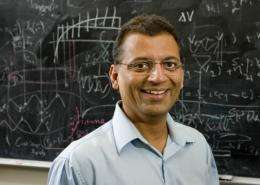
Mayank Mehta
(Medical Xpress) -- Rhythms in the brain that are associated with learning become stronger as the body moves faster, UCLA neurophysicists report in a new study.
The research team, led by professor Mayank Mehta, used specialized microelectrodes to monitor an electrical signal known as the gamma rhythm in the brains of mice. This signal is typically produced in a brain region called the hippocampus, which is critical for learning and memory, during periods of concentration and learning.
The researchers found that the strength of the gamma rhythm grew substantially as running speed increased, bringing scientists a step closer to understanding the brain functions essential for learning and navigation.
"The gamma rhythm is known to be controlled by attention and learning, but we find it is also governed by how fast you are running," said Mehta, an associate professor of physics and astronomy, neurology, and neurobiology and the senior author of the study. "This research provides an interesting link between the world of learning and the world of speed."
The study is published today in PLoS ONE, a peer-reviewed online publication of the Public Library of Science.
The 'language of the brain'
How does the brain learn? The hippocampus is thought to rapidly and temporarily record facts and events as they are experienced, said Mehta, who also directs the Keck Center for Neurophysics at UCLA. During subsequent sleep, these temporary memories are thought to be consolidated to other brain regions for storage. If the hippocampus is damaged, it becomes very difficult to learn new things.
Understanding how the brain learns may one day help treat conditions such as Alzheimer's disease, dementia, and epilepsy that specifically target the hippocampus, Mehta said.
"Deciphering the language of the brain is one of the biggest challenges that human beings face," he said. "If we can learn to interpret these brain oscillations, it may be possible to successfully intervene in cases ranging from learning disorders to post-traumatic stress, or even to mitigate the effects of cognitive decline with aging."
The brain contains billions of neurons, specialized cells that transmit electrical and chemical signals. Neurons in the hippocampus encode spatial position information where one is in space through spikes, the sharp pulses that constitute the "syllables" of their language, Mehta said.
"You can imagine the brain as a large orchestra; the gamma rhythm is a continuously playing violin, punctuated by neuronal spikes similar to the beats of a drum" said Zhiping Chen, a fourth-year UCLA physics graduate student in Mehta's laboratory and lead author of the study.
The brain signals are a combination of multiple rhythms and neuron spikes from many different brain regions, each hinting at the language of the neurons, Mehta said. The challenge is to combine this vast amount of data to reveal the language of the brain and relate it to behavior.
"The biophysical laws that govern a single neuron are fairly well known," Mehta said. "What is not known is how those billions of neurons interact with one another and form the mind."
Tackling such interdisciplinary questions requires a diverse team of scientists and engineers. Members of Mehta's group have backgrounds in physics, mathematics, engineering, neurobiology, psychology and medicine, among other disciplines.
"We hope to explore the connection between psychology and neuroscience. Studying how the individual brain cells interact can explain how consciousness arises," said Chen.
The experiment
"The hippocampus is critical for navigation," Chen said. "Cells in the hippocampus encode position information, but to navigate, it is not enough to know where you are; you must also know how fast you are going. We concluded there must be a separate brain signal that encodes this speed information."
The experiment was performed by measuring electrical signals from hundreds of neurons using microwires 20 times thinner than a human hair, Mehta said. Nearly a hundred gigabytes of data was collected every day, enough to fill the Library of Congress every two months.
Analysis of this vast and complex data yielded an unexpected result: The gamma rhythm, a fast signal that occurs while concentrating or learning, gradually grew stronger as the mice moved faster.
"It is rare to find a relationship that is so clear," Chen said. "When we first saw the results, we were surprised and excited."
Does this mean movement or exercise could influence the learning process? Mehta said it is too early to tell.
"With these new results, we are asking questions which we never imagined," he said.
The study also verifies recent assertions that the gamma rhythm, which oscillates between 30 and 120 times every second, can be divided into slow and fast signals that originate from separate parts of the brain, Mehta said.
"Surprisingly, the two signals become increasingly separated in time with increasing speed," he said.
Additional co-authors of the study include Bert Sakmann, Nobel laureate and director of the Max Planck Florida Institute; Evgeny Resnik, a graduate student at the Max Planck Institute for Medical Research; and James McFarland, a postdoctoral researcher in the UCLA Department of Physics.
This research is funded by the National Science Foundation and the National Institute of Health, as well as the Whitehall Foundation and the W.M. Keck Foundation. Mehta and Chen are members of the newly established Integrative center for Learning and Memory at UCLA. Mehta is also a member of the Royal Norwegian Academy of Sciences.
From outer to inner space
Mehta began his career as a theoretical physicist interested in probing the nature of space-time. He was challenging long accepted ideas in the field before even finishing graduate school at the Indian Institute of Science.
Grappling with the mathematical complexities of universes with more than six dimensions, Mehta became fascinated by how learning occurs and what things the brain will absorb or learn most readily.
Mehta's previous research has shown that the hippocampal circuit rapidly evolves with learning and that brain rhythms are crucial for this process. The question now becomes: What is the relationship between activity in the hippocampus and behavior?
"It is amazing that we can understand things that are absolutely unnecessary for our survival," Mehta said. "The brain is a very complex place, and our intuition about the mind is not enough to understand the brain. If we can first determine the rules of the brain, they will likely point in a direction that we have never imagined."
Provided by
University of California Los Angeles
-
Learning keeps brain healthy: study
Mar 02, 2010 |
not rated yet |
0
-
Study: Theta rhythm reduces seizure rate
Jun 20, 2006 |
not rated yet |
0
-
Discovery of cell linked to learning and memory
May 14, 2008 |
not rated yet |
0
-
Neuroscientists pinpoint brain site for rapid learning
Oct 23, 2006 |
not rated yet |
0
-
Memory mission explores new territory in neuroscience
Nov 21, 2008 |
not rated yet |
0
-
Limits to growth: Scientists identify key metastasis-enabling enzyme
May 22, 2012 |
5 / 5 (3) |
0
-
Seeing is as seeing does: Spatially-structured retinal input in early development of cortical maps
Apr 26, 2012 |
5 / 5 (4) |
1
-
Dreamless nights: Brain activity during nonrapid eye movement sleep
Apr 09, 2012 |
4.4 / 5 (12) |
0
-
Take your time: Neurobiology sheds light on the superiority of spaced vs. massed learning
Mar 28, 2012 |
4.5 / 5 (21) |
3
-
Your brain on 'shrooms: fMRI elucidates neural correlates of psilocybin psychedelic state
Feb 29, 2012 |
4.9 / 5 (42) |
45
-
A question about drug tolerance
21 hours ago
-
Poor nutrition leading to overeating?
May 23, 2012
-
Math and dyslexia?
May 21, 2012
-
portable metabolism meter?
May 21, 2012
-
Rare medical conditions on 20/20 tonight
May 18, 2012
-
"Good" Cholesterol in Doubt
May 17, 2012
- More from Physics Forums - Medical Sciences
More news stories
Persistent sensory experience is good for aging brain
Despite a long-held scientific belief that much of the wiring of the brain is fixed by the time of adolescence, a new study shows that changes in sensory experience can cause massive rewiring of the brain, even as one ages. ...
Neuroscience
3 hours ago |
not rated yet |
0
Boundary stops molecule right where it needs to be
A molecule responsible for the proper formation of a key portion of the nervous system finds its way to the proper place not because it is actively recruited, but instead because it can't go anywhere else.
Neuroscience
3 hours ago |
not rated yet |
0
|
Locating ground zero: How the brain's emergency workers find the disaster area
Like emergency workers rushing to a disaster scene, cells called microglia speed to places where the brain has been injured, to contain the damage by 'eating up' any cellular debris and dead or dying neurons. ...
Neuroscience
3 hours ago |
5 / 5 (2) |
0
|
Genetic 'reset switch' enables signaling pathway to induce multiple developmental outcomes for olfactory neurons
Within the nervous system, a handful of signaling pathways modulate development of a cornucopia of different neuronal subtypes. Even small alterations in neuron differentiation pathways can disrupt subsequent ...
Neuroscience
7 hours ago |
not rated yet |
0
The auditory cortex adapts agilely with concentration
The birth of sensory perception on the human cerebral cortex is yet to be fully explained. The different areas on the cortex function in cooperation, and no perception is the outcome of only one area working alone. In his ...
Neuroscience
8 hours ago |
not rated yet |
0
Amino acid consumption associated with how fast cancer cells divide
For almost a century, researchers have known that cancer cells have peculiar appetites, devouring glucose in ways that normal cells do not. But glucose uptake may tell only part of cancer's metabolic story. Researchers from ...
Cyber exercise partners help you go the distance: Motivation gains can double
A new study testing the benefits of a virtual exercise partner shows the presence of a moderately more capable cycling partner can significantly boost the motivation by as much as 100 percent ...
Childhood cancer scars survivors later in life
Scars left behind by childhood cancer treatments are more than skin-deep. The increased risk of disfigurement and persistent hair loss caused by childhood cancer and treatment are associated with emotional distress and reduced ...
Low vitamin D in diet increases stroke risk in Japanese-Americans
Japanese-American men who did not eat foods rich in vitamin D had a higher risk of stroke later in life, according to results of a 34-year study reported in Stroke, an American Heart Association journal.
Doctors group warns EU health care access shrinking
Access to health care is declining in Europe, and Greece in particular faces a humanitarian crisis as it cuts health and social spending, aid group Doctors of the World warned Thursday.
Scotland sets minimum price for booze
Scotland on Thursday became the first part of Britain to introduce a minimum price for alcohol in an attempt to change its unhealthy relationship with booze.
Jun 27, 2011
Rank: not rated yet
Jun 27, 2011
Rank: not rated yet
Jun 27, 2011
Rank: not rated yet
"learning process"?
Of course, for sake of brevity, the article has to fall short.
The surprise is the researchers' extreme broad approach:
"The question now becomes: What is the relationship between activity in the hippocampus and behavior?"
One might just as well ask:
What is the relationship between the inhabitants' activity in single city to the behavior of a single individual.
Orchestra? Fine.
Single out a single instrument. Obviously you feel the median for all instruments is air.
Obviously you feel the median for all brains is "that [which] transmit electrical and chemical signals"(neurons).
Your approach is leading you astray. Fourier Transformations are taking place. Simply take your pick where, how, when, what, and how much. Find "a single instrument". Where it is in the "score sheet"? Does the 'instrument' 'carry' the 'melody'? Have you adequately define the 'melody'?
Where is your map?
Jun 28, 2011
Rank: 5 / 5 (1)
This is a PLoS ONE publication. This is a free, online resource http://www.plosone.org
Really worth bookmarking for the amateur science buff
Jun 29, 2011
Rank: not rated yet
Jun 29, 2011
Rank: 5 / 5 (1)
..."Finally, we show that adult mice dark-reared from birth also exhibit normal distribution of aromatase and ERs throughout V1, suggesting that the implementation and maintenance of estrogen-associated circuits is independent of visual experience."
You see? Forget perceptual learning. A function of experience.
The mind blowing corollary:
Replace the word "visual" with "auditory" and you are half way into your theory of the origins of human language.
"...dark-reared from birth..."????
The conditions are synonymous to embryonic and fetal neurological development implemented in the womb.
Neuroscience keeps starting in the middle of the melody. (Life after birth) Then asks: What's the tune? No one is willing to walk backwards, viewing where they have been, backtracking till conception. There where the solutions to neuroscience come into view.
Jun 29, 2011
Rank: not rated yet