Playing music alters the processing of multiple sensory stimuli in the brain
November 24, 2011 in Neuroscience
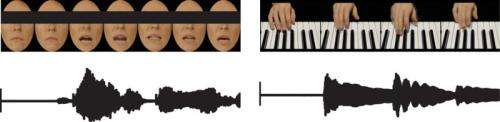
A segment of the audiovisual speech (left) and music (right) stimulus. © HweeLing Lee/MPI for Biological Cybernetics
(Medical Xpress) -- Over the years pianists develop a particularly acute sense of the temporal correlation between the movements of the piano keys and the sound of the notes played. However, they are no better than non-musicians at assessing the synchronicity of lip movements and speech.
This was discovered by researchers from the Max Planck Institute for Biological Cybernetics in a comparative study on the simultaneous brain processing of stimuli from different senses by musicians and non-musicians. The researchers also used functional magnetic resonance imaging in their study to map the areas of the brain active during this process. According to their findings, in pianists, the perception of asynchronous music and hand movements triggers increased error signals in a circuit involving the cerebellum, premotor and associative areas of the brain, which is refined by piano practicing. The study shows that our sensorimotor experience influences the way in which the brain temporally links signals from different senses during perception.
In a world full of stimuli which affect all senses, the human brain constantly has to link the impressions we perceive in a way that makes sense. We learn through experience, for example, that the synchronous events that arise in a busy bar setting, such as the lip movements of a particular person and the sound of a certain voice, belong together. HweeLing Lee and research group leader Uta Noppeney from the Max Planck Institute for Biological Cybernetics in Tübingen study how the brain integrates stimuli from several senses and how the circuits in the brain change as a result of learning. In their latest study, they examined how well 18 amateur pianists were able to perceive the temporal coincidence between finger movements on the piano keys and a piece of piano music and between lip movements and spoken sentences as compared with 19 non-musicians. For this study, we availed of the fact that the pianists specifically train in an activity, in which several sensory stimuli, that is visual and auditory information, movement and the striking of the piano keys, have to be connected, explains Uta Noppeney.
During the experiment, the finger or mouth movements were advanced or delayed in relation to the sounds heard at intervals of up to 360 milliseconds. The study participants were requested to specify when asked whether the events were synchronous or asynchronous. Using the same film and sound material and the same participants, the experiments were then repeated using functional magnetic resonance imaging (fMRI). In this case, the subjects remained passive and the machine recorded the areas of the brain that became active during the automatic perception of the synchronous and asynchronous signals.
The experiments revealed that the pianists were significantly more accurate than the non-musicians in assessing whether the finger movements on the piano and the sounds heard coincided temporally or not. The window for the temporal integration of the stimuli in the pianists is clearly narrower than in non-musicians, says HweeLing Lee. However, the same differences were not observed in the experiments involving spoken sentences and lip movements both groups recorded similar performances here. In principle, asynchronicity in language and music activates the same areas in the brain. However, the fMRI scans showed that, in the experiment with the pianists, asynchronous music triggered a stronger signal in a circuit involving the left cerebellum, a premotor and associative region in the cerebral cortex than in the non-musicians.
The processing of stimuli in the brains of the pianists points to a context-specific mechanism: as a result of their piano practice, a forward model involving the cerebellum and premotor cerebral cortex is programmed in the circuit which enables the individual to make far more precise predictions about the correct temporal sequence of the visual and auditory signals, explains Uta Noppeney. An asynchronous stimulus triggers prediction error signal. The researchers see this as an important indication of how the brain can generally react in a flexible way to sensorimotor experience. Whether pianists would perform equally well in the assessment of violin music and whether more intensive music playing would influence language processing in the brain remain open questions. For the next stage in the study of the processing of multiple sensory stimuli in the brain, we will have to train the participants in a specific way so that we can investigate the effects in greater detail, says Uta Noppeney.
More information: HweeLing Lee, Uta Noppeney, Long-term music training tunes how the brain temporally binds signals from multiple senses, PNAS, doi: 10.1073/pnas.1115267108
Journal reference:
Proceedings of the National Academy of Sciences
Provided by
Max-Planck-Gesellschaft
-
Training and experience can affect brain organization, research shows
Nov 04, 2007 |
not rated yet |
0
-
The improvising brain: Getting to the neural roots of the musical riff
Feb 06, 2009 |
not rated yet |
0
-
Musical skill reflects working memory capacity in addition to practice time
Jul 08, 2010 |
not rated yet |
0
-
Where the brain combines what's heard and felt
Oct 19, 2005 |
not rated yet |
0
-
Voice cells for voice recognition
Aug 24, 2011 |
not rated yet |
0
-
Motion perception revisited: High Phi effect challenges established motion perception assumptions
Apr 23, 2013 |
3 / 5 (2) |
2
-
Anything you can do I can do better: Neuromolecular foundations of the superiority illusion (Update)
Apr 02, 2013 |
4.5 / 5 (11) |
5
-
The visual system as economist: Neural resource allocation in visual adaptation
Mar 30, 2013 |
5 / 5 (2) |
9
-
Separate lives: Neuronal and organismal lifespans decoupled
Mar 27, 2013 |
4.9 / 5 (8) |
0
-
Sizing things up: The evolutionary neurobiology of scale invariance
Feb 28, 2013 |
4.8 / 5 (10) |
14
-
Why is zone 1 in liver more prone to ischemic injury?
20 hours ago
-
How can there be villous adenoma in colon, if there are no villi there
May 22, 2013
-
How can there be a term called "intestinal metaplasia" of stomach
May 21, 2013
-
Pressure-volume curve: Elastic Recoil Pressure don't make sense
May 18, 2013
-
If you became brain-dead, would you want them to pull the plug?
May 17, 2013
-
MRI bill question
May 15, 2013
- More from Physics Forums - Medical Sciences
More news stories
Controlling mood through the motions of mitochondria
(Medical Xpress)—Regulating the distribution of power in neurons is done by a system that makes the national electric grid look simple by comparison. Each neuron has several thousand mitochondria confined ...
Neuroscience
6 hours ago |
4.8 / 5 (5) |
0
|
Brain uses internal 'average voice' prototype to identify who is talking
(Medical Xpress)—The human brain is able to identify individuals' voices by comparing them against an internal 'average voice' prototype, according to neuroscientists.
Neuroscience
10 hours ago |
1 / 5 (1) |
0
|
Depression common among children with temporal lobe epilepsy
A new study determined that children and adolescents with seizures involving the temporal lobe are likely to have clinically significant behavioral problems and psychiatric illness, especially depression. Findings published ...
Neuroscience
10 hours ago |
not rated yet |
0
The secret lives, and deaths, of neurons
As the human body fine-tunes its neurological wiring, nerve cells often must fix a faulty connection by amputating an axon—the "business end" of the neuron that sends electrical impulses to tissues or other ...
Neuroscience
12 hours ago |
5 / 5 (2) |
0
|
Regenerating spinal cord fibers may be treatment for stroke-related disabilities
A study by researchers at Henry Ford Hospital found "substantial evidence" that a regenerative process involving damaged nerve fibers in the spinal cord could hold the key to better functional recovery by most stroke victims.
Neuroscience
12 hours ago |
not rated yet |
0
|
ACP issues recommendations for management of high blood glucose in hospitalized patients
High blood glucose is associated with poor outcomes in hospitalized patients, and use of intensive insulin therapy (IIT) to control hyperglycemia is a common practice in hospitals. But the recent evidence does not show a ...
Motion quotient: IQ predicted by ability to filter motion (w/ video)
A brief visual task can predict IQ, according to a new study. This surprisingly simple exercise measures the brain's unconscious ability to filter out visual movement. The study shows that individuals whose ...
Multiple research teams unable to confirm high-profile Alzheimer's study
Teams of highly respected Alzheimer's researchers failed to replicate what appeared to be breakthrough results for the treatment of this brain disease when they were published last year in the journal Science.
Scientists discover molecule triggers sensation of itch
Scientists at the National Institutes of Health report they have discovered in mouse studies that a small molecule released in the spinal cord triggers a process that is later experienced in the brain as ...
Researchers find common childhood asthma unconnected to allergens or inflammation
Little is known about why asthma develops, how it constricts the airway or why response to treatments varies between patients. Now, a team of researchers at Weill Cornell Medical College, Columbia University Medical Center ...
Type 2 diabetes progresses faster in kids, study finds
(HealthDay)—Type 2 diabetes is more aggressive in children than adults, with signs of serious complications seen just a few years after diagnosis, new research finds.
Nov 24, 2011
Rank: not rated yet
Nov 24, 2011
Rank: not rated yet
Nov 26, 2011
Rank: not rated yet
I tend to hear music out of thin air, especially in the presence of any sort of rhythm, it can be an off-balance washing machine, my mind builds a symphony around it without any help from me.....idk....odd, but amusing.
Nov 28, 2011
Rank: not rated yet
Nov 28, 2011
Rank: not rated yet