Scientists strengthen memory by stimulating key site in brain
February 8, 2012 in Neuroscience

Study: Electric boost helps brain to learn better (AP)

Enlarge

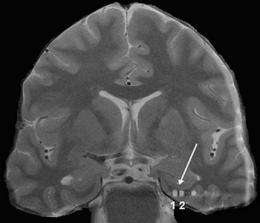
This undated image provided by the Fried Lab/UCLA shows a brain MRI with an arrow showing where researchers applied deep-brain stimulation during tests on learning. A painless bit of electrical current applied to the brain helped some people play a video game, and someday it might help Alzheimer's disease patients remember what they've learned, a small study suggests. The game-players had to learn where particular stores were in a virtual city. They recalled the locations better if they'd learned them while current was supplied by tiny electrodes buried in their brains. That strategy may someday help people with early Alzheimer's hang on to many kinds of memory, suggested Dr. Itzhak Fried, a neurosurgeon at the University of California, Los Angeles. But "this is obviously a preliminary result,'' he cautioned. (UCLA, Fried Lab)

Ever gone to the movies and forgotten where you parked the car? New UCLA research may one day help you improve your memory.

UCLA neuroscientists have demonstrated that they can strengthen in human patients by stimulating a critical junction in the brain. Published in the Feb. 9 edition of the , the finding could lead to a new method for boosting memory in patients with early Alzheimer's disease.

The UCLA team focused on a brain site called the . Considered the doorway to the hippocampus, which helps form and store memories, the entorhinal cortex plays a crucial role in transforming daily experience into .

"The entorhinal cortex is the golden gate to the brain's memory mainframe," explained senior author Dr. Itzhak Fried, professor of neurosurgery at the David Geffen School of Medicine at UCLA. "Every visual and sensory experience that we eventually commit to memory funnels through that doorway to the hippocampus. Our must send signals through this hub in order to form memories that we can later consciously recall."

Fried and his colleagues followed seven who already had electrodes implanted in their brains to pinpoint the origin of their seizures. The researchers monitored the electrodes to record as memories were being formed.

Using a video game featuring a taxi cab, virtual passengers and a cyber city, the researchers tested whether deep-brain stimulation of the entorhinal cortex or the hippocampus altered recall. Patients played the role of cab drivers who picked up passengers and traveled across town to deliver them to one of six requested shops.

"When we stimulated the in the patients' entorhinal cortex during learning, they later recognized landmarks and navigated the routes more quickly," said Fried. "They even learned to take shortcuts, reflecting improved .

"Critically, it was the stimulation at the gateway into the hippocampus – and not the hippocampus itself – that proved effective," he added.

The use of stimulation only during the learning phase suggests that patients need not undergo continuous stimulation to boost their memory, but only when they are trying to learn important information, Fried noted. This may lead the way to neuro-prosthetic devices that can switch on during specific stages of information processing or daily tasks.

Six million Americans and 30 million people worldwide are newly diagnosed with Alzheimer's disease each year. The progressive disorder is the sixth leading cause of death in the United States and the fifth leading cause of death for those aged 65 and older.

"Losing our ability to remember recent events and form new memories is one of the most dreaded afflictions of the human condition," said Fried. "Our preliminary results provide evidence supporting a possible mechanism for enhancing memory, particularly as people age or suffer from early dementia. At the same time, we studied a small sample of patients, so our results should be interpreted with caution."

Future studies will determine whether can enhance other types of recall, such as verbal and autobiographical memories. No adverse effects of the stimulation were reported by the seven patients.

Fried's coauthors included first author Nanthia Suthana, as well as Dr. Zulfi Haneef, Dr. John Stern, Roy Mukamel, Eric Behnke and Barbara Knowlton, all of UCLA. The research was supported by grants from the National Institute of Neurological Disorders and Stroke and the Dana Foundation.

Provided by University of California - Los Angeles

4.8 /5 (13 votes)  

Filter


Move the slider to adjust rank threshold, so that you can hide some of the comments.


Display comments: newest first

BrainGuy
Feb 08, 2012

Rank: not rated yet
Understandably, you get funding by either claiming gains for people with neurodegenerative disorders or strategic gains on the battlefield. I can't help but think, however, how this could revolutionize education. Targeted DBS, coupled with AR enhanced visuals of educational information (e.g. a virtual 3D tour of the circulatory system) would offer unforgettable and unparalleled understanding.
Rank 4.8 /5 (13 votes)
Related Stories
Relevant PhysicsForums posts

More news stories

For combat veterans suffering from post-traumatic stress disorder, 'fear circuitry' in the brain never rests

Chronic trauma can inflict lasting damage to brain regions associated with fear and anxiety. Previous imaging studies of people with post-traumatic stress disorder, or PTSD, have shown that these brain regions can over-or ...

Neuroscience created 13 hours ago | popularity 5 / 5 (1) | comments 0 | with audio podcast

Temporal processing in the olfactory system

The neural machinery underlying our olfactory sense continues to be an enigma for neuroscience. A recent review in Neuron seeks to expand traditional ideas about how neurons in the olfactory bulb might encode information about ...

Neuroscience created May 17, 2013 | popularity not rated yet | comments 0 | with audio podcast report

Melon focus headband turns to Kickstarter for rollout plans

(Medical Xpress)—What if the quality of your work depends more on your focus on the piano keys or canvas or laptop than your musical or painting or computing skills? If target users can be convinced, they ...

Neuroscience created May 17, 2013 | popularity 3.7 / 5 (3) | comments 0 | with audio podcast weblog

Deep brain stimulation: A fix when the drugs don't work

Neurological disorders can have a devastating impact on the lives of sufferers and their families.

Neuroscience created May 17, 2013 | popularity 5 / 5 (1) | comments 0 | with audio podcast

Brain makes call on which ear is used for cell phone

If you're a left-brain thinker, chances are you use your right hand to hold your cell phone up to your right ear, according to a newly published study from Henry Ford Hospital in Detroit.

Neuroscience created May 16, 2013 | popularity 2 / 5 (2) | comments 0 | with audio podcast


New research identifies risks, interventions for children's GI health

An increasing number of U.S. children are experiencing gastrointestinal issues that require interventions to resolve, according to research presented at Digestive Disease Week (DDW).

US psychiatry gets makeover in new manual

The latest makeover to a massive psychiatric tome honored by some, reviled by others and even called the "Bible" of mental disorders is being released Saturday with a host of new changes.

New case of SARS-like virus in Saudi: ministry

A new case of the deadly coronavirus has been detected in Saudi Arabia where 15 people have already died after contracting it, the health ministry announced on Saturday on its Internet website.

AIDS science at 30: 'Cure' now part of lexicon

Big names in medicine are set to give an upbeat assessment of the war on AIDS on Tuesday, 30 years after French researchers identified the virus that causes the disease.

New colonoscope provides ground-breaking view of colon

A ground-breaking advance in colonoscopy technology signals the future of colorectal care, according to research presented today at Digestive Disease Week(DDW). Additional research focuses on optimizing the minimal withdrawal ...

Now we know why old scizophrenia medicine works on antibiotics-resistant bacteria

In 2008 researchers from the University of Southern Denmark showed that the drug thioridazine, which has previously been used to treat schizophrenia, is also a powerful weapon against antibiotic-resistant bacteria such as ...