Long-distance training teaches proper technique for asthma test
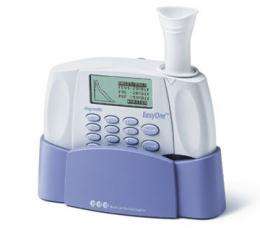
(Medical Xpress) -- Virtual, long-distance training can teach primary-care professionals the proper technique for performing a lung-function test, a University of Washington-led study has shown. The breathing test, called spirometry, is important in accurately diagnosing asthma in patients over age 5, and also in seeing if a chosen treatment is appropriate.
Dr. James Stout, UW professor of pediatrics and health services, heads the team that designed the long-distance training program. Their goal is to try to improve the care of patients with asthma or chronic obstructive pulmonary disease. Stout is a researcher at the UW Child Health Institute, which studies access, cost-effectiveness, quality, and outcomes of healthcare for children.
Asthma and chronic obstructive pulmonary disease are common medical problems, especially among low-income and minority populations. These groups have more severe cases of these lung diseases and a greater number of hospitalizations because of their illness.
“My view is that anyone with either of these diagnoses deserves the test as part of their overall assessment,” Stout said, who also is a pediatrician at the Odessa Brown Children’s Clinic, a satellite of Seattle Children’s Hospital located in the Central District.
He pointed to other studies revealing that up to 65 percent of general pediatricians do not use spirometry in routine asthma care. Even when spirometry is performed in primary-care doctor’s offices, many of the tests don’t meet American Thoracic Society quality standards, research has indicated.
Usually sprirometry is taught hands-on, with an experienced provider demonstrating how it’s done, letting trainees try it and interpret the results, and then coaching the trainees until they consistently perform it correctly.
However, in-person training is inconvenient for some providers to obtain. Practicing primary-care providers in rural areas have long travel distances to teaching sites, and those working in physician shortage areas or in safety-net practices for vulnerable populations are reluctant to spare time from their patients.
Stout and his group devised a multi-media online training that primary-care professionals in pediatrics, family medicine and internal medicine, as well as their support staff, typically nurses and medical assistants, can take in their offices. The webinar training is followed by several weeks of on-going coaching. Healthcare professionals can hook-up one brand of spirometers to a secure system that transmits the results, without any information that identifies the patient, to experts who check for problems in the healthcare professional’s technique.
The healthcare professionals can also mail results, without any information identifying the patient, to the expert team for a similar reading on their abilities. The coaches then advise on how to better master the test procedure and give tips on how to encourage the patient to take in enough air, breathe long and hard, and make several tries.
Spirometry training can be put to use in other ways in primary-care practices. For example, it could be performed as part of a smoking cessation program. Patients may then be motivated to continue to abstain from tobacco as they watch their lung function get better over time.
A paper recently published in Academic Pediatrics evaluating the training for health professionals shows that it translates to better asthma care for patients. His team has since refined the approach and delivered it to more than 250 practices in a score of states. Ongoing technical improvements, Stout said, has made the training more user-friendly.
“The program we deliver now, Spirometry 360, is both shorter and better than the one we tested in the trial,” Stout said.
Does the online education in spirometry translate to better health for asthma patients? As part of Stout’s research team, Dr. Rita Mangione-Smith, professor of pediatrics, Division of General Pediatrics, has been leading a study to see if the online training improves health outcomes for children with asthma. The preliminary findings are positive; final results should be available later this year. Mangione-Smith is also a scientist at the Seattle Children’s Research Institute.
“Even though traditionally these types of hands-on skills are taught in person,” Stout said, “our team has proven that this procedure can be learned successfully over long distance and that this training improved asthma care in the pediatric practices we studied.”
This latest development in long-distance spirometry training may pave the way for teaching other sophisticated procedures over the miles through advances in learning technology and telecommunications. The University of Washington has licensed this particular approach to remote medical training as Spirometry 360.
The Academic Pediatrics paper evaluating the effectiveness of remote teaching of spirometry is “Learning from a Distance: Spirometry Training in Improving Asthma Care.” In addition to Stout and Mangione-Smith, other UW and Seattle Children’s Research Institute investigators on the study were Drs. Karen Smith, Chuan Zhou, Cam Solomon, and Michelle M. Garrison. Dr. Allen Dozer from New York Medical College in Valhalla was also part of the study team.
An Agency for Healthcare Research and Quality grant funded the study.


