Highways of the brain: High-cost and high-capacity
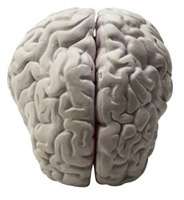
A new study proposes a communication routing strategy for the brain that mimics the American highway system, with the bulk of the traffic leaving the local and feeder neural pathways to spend as much time as possible on the longer, higher-capacity passages through an influential network of hubs, the so-called rich club.
The study, published this week online in the Early Edition of the Proceedings of the National Academy of Sciences, involves researchers from Indiana University and the University Medical Center Utrecht in the Netherlands and advances their earlier findings that showed how select hubs in the brain not only are powerful in their own right but have numerous and strong connections between each other.
The current study characterizes the influential network within the rich club as the "backbone" for global brain communication. A costly network in terms of the energy and space consumed, said Olaf Sporns, professor in the Department of Psychological and Brain Sciences at IU Bloomington, but one with a big pay-off: providing quick and effective communication between billions and billions of brain cells.
"Until now, no one knew how central the brain's rich club really was," Sporns said. "It turns out the rich club is always right in the middle when it comes to how brain regions talk to each other. It absorbs, transforms and disseminates information. This underscores its importance for brain communication."
In earlier work, using diffusion imaging, the researchers found a group of 12 strongly interconnected bihemispheric hub regions, comprising the precuneus, superior frontal and superior parietal cortex, as well as the subcortical hippocampus, putamen and thalamus. Together, these regions form the brain's "rich club." Most of these areas are engaged in a wide range of complex behavioral and cognitive tasks, rather than more specialized processing such as vision and motor control.
For the current study, Martijn van den Heuvel, a professor at the Rudolf Magnus Institute of Neuroscience at University Medical Center Utrecht, used diffusion tensor imaging data for two sets of 40 healthy subjects to map the large-scale connectivity structure of the brain. The cortical sheet was divided into 1,170 regions, and then pathways between the regions were reconstructed and measured. As in the previous study, the rich club nodes were widely distributed and had up to 40 percent more connectivity compared to other areas.
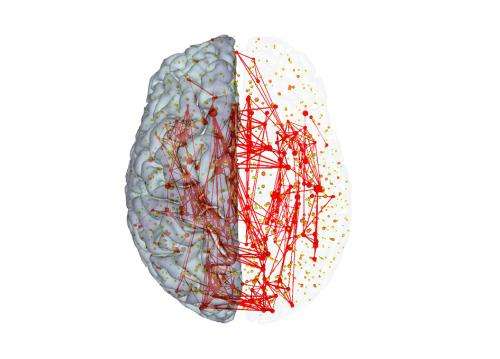
The rich club (in red) and rich club connections are shown here, with a graphical image of the left hemisphere of the human brain superimposed.
The connections measured -- almost 700,000 in total -- were classified in one of three ways: as rich club connections if they connected nodes within the rich club; as feeder connections if they connected a non-rich club node to a rich club node; and as local connections if they connected non-rich club nodes. Rich club connections made up the majority of all long-distance neural pathways. The study also found that connections classified as rich club connections were used more heavily for communication than other feeder and local connections. A path analysis showed that when a minimally short path is traced from one area of the brain to another, it travels through the rich club network 69 percent of the time, even though the network accounts for only 10 percent of the brain.A common pattern in communication paths spanning long distances, Sporns said, was that such paths involved sequences of steps leading across local, feeder, rich club, feeder and back to local connections. In other words, he said, many communication paths first traveled toward the rich club before reaching their destinations.
"It is as if the rich club acts as an attractor for signal traffic in the brain," Sporns said. "It soaks up information which is then integrated and sent back out to the rest of the brain."
Van den Heuvel agreed.
"It's like a big 'neuronal magnet' for communication and information integration in our brains," he said. "Seeking out the rich club may offer a strategy for neurons and brain regions to find short communication paths across the brain, and might provide insight into how our brain manages to be so highly efficient."
From an evolutionary standpoint, it was important for the brain to minimize energy consumption and wiring volume, but if these were the only factors, there would be no rich club because of the extra resources it requires, Sporns said. The rich club is expensive, at least in terms of wiring volume, and perhaps also in terms of metabolic cost. The trade-off for higher cost, Sporns said, is higher performance -- the integration of diverse signals and the ability to select short paths across the network.
"Brain neurons don't have maps; how do they find paths to get in touch? Perhaps the rich club helps with this, offering the brain's neurons and regions a way to communicate efficiently based on a routing strategy that involves the rich club."
People use related strategies to navigate social networks.
"Strangely, neurons may solve their communication problems just like the people to which they belong," Sporns said.
More information: "High-cost, high-capacity backbone for global brain communication" PNAS, 2012.
Journal reference:
Proceedings of the National Academy of Sciences
Provided by
Indiana University
-
Study: A rich club in the human brain
Nov 01, 2011 |
not rated yet |
0
-
Manipulating the Brain Network Could Improve IQ
Jun 10, 2009 |
not rated yet |
0
-
New map IDs the core of the human brain
Jul 01, 2008 |
not rated yet |
0
-
Wiring the brain
Apr 13, 2012 |
not rated yet |
0
-
Scientists study background brain activity
Jun 05, 2007 |
not rated yet |
0
-
Motion perception revisited: High Phi effect challenges established motion perception assumptions
Apr 23, 2013 |
3 / 5 (2) |
2
-
Anything you can do I can do better: Neuromolecular foundations of the superiority illusion (Update)
Apr 02, 2013 |
4.5 / 5 (11) |
5
-
The visual system as economist: Neural resource allocation in visual adaptation
Mar 30, 2013 |
5 / 5 (2) |
9
-
Separate lives: Neuronal and organismal lifespans decoupled
Mar 27, 2013 |
4.9 / 5 (8) |
0
-
Sizing things up: The evolutionary neurobiology of scale invariance
Feb 28, 2013 |
4.8 / 5 (10) |
14
-
Why is zone 1 in liver more prone to ischemic injury?
May 23, 2013
-
How can there be villous adenoma in colon, if there are no villi there
May 22, 2013
-
How can there be a term called "intestinal metaplasia" of stomach
May 21, 2013
-
Pressure-volume curve: Elastic Recoil Pressure don't make sense
May 18, 2013
-
If you became brain-dead, would you want them to pull the plug?
May 17, 2013
-
MRI bill question
May 15, 2013
- More from Physics Forums - Medical Sciences
More news stories
New neuron formation could increase capacity for new learning, at the expense of old memories
New research presented today shows that formation of new neurons in the hippocampus - a brain region known for its importance in learning and remembering - could cause forgetting of old memories by causing a reorganization ...
Neuroscience
22 hours ago |
4 / 5 (4) |
0
Help at hand for people with schizophrenia
How can healthy people who hear voices help schizophrenics? Finding the answer for this is at the centre of research conducted at the University of Bergen.
Neuroscience
23 hours ago |
4 / 5 (2) |
2
Japanese research organizations contribute to Human Brain Project
One of the major frontiers of modern science is a comprehensive understanding of the human brain and its functions to guide the development of new technologies in information and communication. In a major announcement for ...
Neuroscience
23 hours ago |
3.7 / 5 (3) |
0
Controlling mood through the motions of mitochondria
(Medical Xpress)—Regulating the distribution of power in neurons is done by a system that makes the national electric grid look simple by comparison. Each neuron has several thousand mitochondria confined ...
Neuroscience
May 23, 2013 |
4.9 / 5 (9) |
0
|
Brain uses internal 'average voice' prototype to identify who is talking
(Medical Xpress)—The human brain is able to identify individuals' voices by comparing them against an internal 'average voice' prototype, according to neuroscientists.
Neuroscience
May 23, 2013 |
3.7 / 5 (3) |
3
|
Feds fight morning-after pill age ruling in NY
(AP)—Department of Justice lawyers have again asked a federal appeals court in New York to delay lifting age restrictions and prescription requirements on an emergency contraceptive popularly known as the morning-after ...
Heart failure accelerates male 'menopause'
Heart failure accelerates the aging process and brings on early andropausal syndrome (AS), according to research presented today at the Heart Failure Congress 2013. AS, also referred to as male 'menopause', was four times ...
First drug to improve heart failure mortality in over a decade
Coenzyme Q10 decreases all cause mortality by half, according to the results of a multicentre randomised double blind trial presented today at Heart Failure 2013 congress. It is the first drug to improve heart failure mortality ...
Death highest in heart failure patients admitted in January, on Friday, and overnight
Mortality and length of stay are highest in heart failure patients admitted in January, on Friday, and overnight, according to research presented today at the Heart Failure Congress 2013. The analysis of nearly 1 million ...
Engineered cytomegalovirus protects monkeys from HIV equivalent
(Medical Xpress)—A new study by researchers in the US has shown that an ancient virus can be modified to help in the fight against the simian immunodeficiency virus SIV, which is the equivalent in monkeys ...
Researchers identify first drug targets in childhood genetic tumor disorder
Two mutations central to the development of infantile myofibromatosis (IM)—a disorder characterized by multiple tumors involving the skin, bone, and soft tissue—may provide new therapeutic targets, according to researchers ...

Jun 19, 2012
Rank: not rated yet
While it is not the focus of the article, even so, "mimics" is a poor choice of wording here.
Highways evolved from foot paths into today's eight lane behemoths just as the nodal points they connect evolved from clusters of huts into giant megalopoli. These networks evolved from the activity of the human brain itself. So any "mimicry" flows opposite that conjured by this analogy.
Going deeper, human foot trails usually followed animal paths, and the villages, towns, and cites have been devoted to resource gathering/distribution. The human brain evolved from earlier mammalian brains which of course evolved from earlier forms still, reaching back to bacterial communication. Yet evidence of this connectome of all connectomes and interactome of all interactomes remains unremarked and unnoted by the over-specialized, unimaginative minions playing everywhere today at "research".