Langerhans cells migrate to their final destination in multiple waves at different stages of embryonic development
August 29, 2012 in Medical research
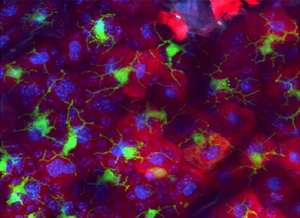
Fluorescence microscopy reveals Langerhans cells (green) in the epidermis (red, with cell nuclei stained blue). © 2004 Jean Davoust/Florent Ginhoux
As our primary interface with the outside world, the skin needs to be able to protect itself against infectious threats. Specialized cells known as Langerhans cells (LCs) (see image) are an essential component of this defense, helping other immune cells to distinguish friend from foe. "These cells play an important role in maintaining tolerance to cutaneous antigen, while simultaneously promoting immune responses against any invading pathogens," explains Florent Ginhoux at the A*STAR Singapore Immunology Network.
LCs are the skin-based counterparts of dendritic cells (DCs), which reside in all tissues. However, LCs and tissue DCs are generated via distinct developmental pathways, and new research from Ginhoux and co-workers has uncovered unexpected complexity in the process by which the adult LC population arises over time.
Unlike DCs, which are generated continuously from bone marrow progenitors prior to their entry in the bloodstream and tissues, LCs are instead replenished by local precursors in the skin. In this sense, LCs are similar to microglia, immune cells residing exclusively in the brain, and Ginhoux suspected the two otherwise-similar cell types might arise from a common embryonic source. "We had previously shown that microglia derive from yolk sac progenitors," he says. "We hypothesized that LCs could be derived from yolk sac progenitors as well."
To test this model, the researchers used a genetic labeling strategy to trace the development of different cells in mouse embryos. Indeed, they confirmed that LCs are generated by precursors in the yolk sac, which migrate to the skin around the tenth day of mouse embryonic development, a process that requires 20 days in full. However, they were surprised to find that these yolk sac-derived cells form less than 10% of the adult LC population.
In fact, further lineage-tracing experiments revealed a later, larger wave of LC formation in the fetal liver, producing cells that migrate to the skin between the thirteenth and seventeenth day of embryonic development. "It was unexpected to find that the fetal liver contribution superseded that of the yolk sac," says Ginhoux. He notes that although both microglia and LCs appear to emerge from common progenitors in the yolk sac, the subsequent formation of the blood-brain barrier would most likely prevent equivalent migration of liver-derived microglial precursors to the brain.
This two-wave developmental process thus appears to be specifically limited to LCs, and Ginhoux and co-workers now hope to determine what, if any, functional value is gained by this stepwise developmental process.
More information: Hoeffel, G., Wang, Y., Greter, M., See, P., Teo, P., et al. Adult Langerhans cells derive predominantly from embryonic fetal liver monocytes with a minor contribution of yolk sac–derived macrophages. Journal of Experimental Medicine 209, 1167–1181 (2012). Article
Journal reference:
Journal of Experimental Medicine
Provided by
Agency for Science, Technology and Research (A*STAR), Singapore
-
Mystery to the origin of long-lived, skin-deep immune cells uncovered
Jun 07, 2012 |
not rated yet |
0
-
Double duty: Versatile immune cells play dual roles in human skin
May 03, 2012 |
not rated yet |
0
-
Scientists discover origin of brain immune cells
Oct 27, 2010 |
not rated yet |
0
-
New path of origin for macrophages
May 02, 2012 |
not rated yet |
0
-
Researchers discover origin of immune cells in the brain
Oct 22, 2010 |
not rated yet |
0
-
Motion perception revisited: High Phi effect challenges established motion perception assumptions
Apr 23, 2013 |
3 / 5 (2) |
2
-
Anything you can do I can do better: Neuromolecular foundations of the superiority illusion (Update)
Apr 02, 2013 |
4.5 / 5 (11) |
5
-
The visual system as economist: Neural resource allocation in visual adaptation
Mar 30, 2013 |
5 / 5 (2) |
9
-
Separate lives: Neuronal and organismal lifespans decoupled
Mar 27, 2013 |
4.9 / 5 (8) |
0
-
Sizing things up: The evolutionary neurobiology of scale invariance
Feb 28, 2013 |
4.8 / 5 (10) |
14
-
Why is zone 1 in liver more prone to ischemic injury?
2 hours ago
-
How can there be villous adenoma in colon, if there are no villi there
23 hours ago
-
How can there be a term called "intestinal metaplasia" of stomach
May 21, 2013
-
Pressure-volume curve: Elastic Recoil Pressure don't make sense
May 18, 2013
-
If you became brain-dead, would you want them to pull the plug?
May 17, 2013
-
MRI bill question
May 15, 2013
- More from Physics Forums - Medical Sciences
More news stories
Baby's life saved with groundbreaking 3-D printed device that restored his breathing
Every day, their baby stopped breathing, his collapsed bronchus blocking the crucial flow of air to his lungs. April and Bryan Gionfriddo watched helplessly, just praying that somehow the dire predictions ...
Medical research
13 hours ago |
5 / 5 (2) |
0
Research shows how immune system peacefully co-exists with 'good' bacteria
The human gut is loaded with commensal bacteria – "good" microbes that, among other functions, help the body digest food. The gastrointestinal tract contains literally trillions of such cells, and yet the ...
Medical research
17 hours ago |
5 / 5 (3) |
0
|
Slowing the aging process—only with antibiotics
Swiss scientists reveal the mechanism responsible for aging hidden deep within mitochondria—and dramatically slow it down in worms by administering antibiotics to the young.
Medical research
17 hours ago |
4.9 / 5 (9) |
1
|
How healthy are you for your age?
On May 22, JoVE will publish details of a technique to measure the health of human genetic material in relation to a patient's age. The method is demonstrated by the laboratory of Dr. Gil Atzmon at New York's Albert Einste ...
Medical research
21 hours ago |
not rated yet |
0
A molecular explanation for age-related fertility decline in women
(Medical Xpress)—Scientists supported by the National Institutes of Health have a new theory as to why a woman's fertility declines after her mid-30s. They also suggest an approach that might help slow ...
Medical research
22 hours ago |
not rated yet |
0
|
US teen birth rate drops to record low
US teen births have dropped to a record low, but the country still has one of the highest rates among developed nations, the US Centers for Disease Control and Prevention said Thursday.
Researchers complete largest genetic sequencing study of human disease
Researchers from Queen Mary, University of London have led the largest sequencing study of human disease to date, investigating the genetic basis of six autoimmune diseases.
Brain can be trained in compassion, study shows
Until now, little was scientifically known about the human potential to cultivate compassion—the emotional state of caring for people who are suffering in a way that motivates altruistic behavior.
Rate of bicycle-related fatalities significantly lower in states with helmet laws
Existing research shows that bicyclists who wear helmets have an 88 percent lower risk of brain injury, but researchers at Boston Children's Hospital found that simply having bicycle helmet laws in place showed a 20 percent ...
Having both migraines, depression may mean smaller brain
(HealthDay)—Migraines and depression can each cause a great deal of suffering, but new research indicates the combination of the two may be linked to something else entirely—a smaller brain.
Novel approach for influenza vaccination shows promise in early animal testing
A new approach for immunizing against influenza elicited a more potent immune response and broader protection than the currently licensed seasonal influenza vaccines when tested in mice and ferrets. The vaccine ...