Immune system kill switch could be target for chemotherapy and infection recovery
December 6, 2012 in Immunology
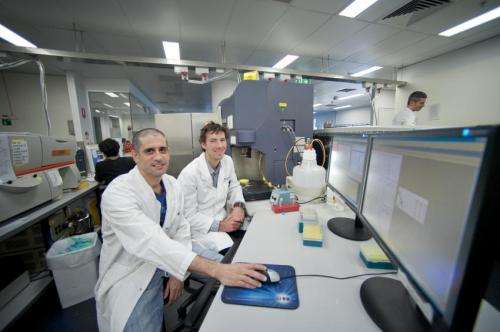
Dr. Seth Masters (right) and Dr. Motti Gerlic were part of a research team from the Walter and Eliza Hall Institute in Melbourne, Australia, that discovered an immune system ‘kill switch’ that destroys blood stem cells when the body is under severe stress, such as that induced by chemotherapy and systemic infections. Credit: Walter and Eliza Hall Institute
Researchers have discovered an immune system 'kill switch' that destroys blood stem cells when the body is under severe stress, such as that induced by chemotherapy and systemic infections.
The discovery could have implications for protecting the blood system during chemotherapy or in diseases associated with overwhelming infection, such as sepsis.
The kill switch is triggered when internal immune cell signals that protect the body from infection go haywire. Dr Seth Masters, Dr Motti Gerlic, Dr Benjamin Kile and Dr Ben Croker from the Walter and Eliza Hall Institute led a research project that found blocking these internal signals, in particular a cell receptor called NLRP1, could stop blood stem cells from self-destructing, preventing death after chemotherapy and boosting recovery from infection. The findings were published today in the journal Immunity.
NLRP1 is part of a family of immune receptors that acts as a protective mechanism, instructing immune and blood stem cells to die because it has 'sensed' infection or severe stress-related damage. However this protective mechanism can go too far, Dr Masters said.
"One theory is that when stem cells are infected with a bacteria or virus, they can effectively pass the infection on to all their blood cell offspring, helping to spread the pathogen throughout the body," Dr Masters said. "So the body has evolved to activate this pathway to kill the infected stem cell, reducing the risk of infection. However, in the case of sepsis, or in a cancer patient who contracts an infection, the NLRP1 receptor inappropriately instructs blood stem cells to die, and too many are killed, until the patient can't recover their immune cells, leaving them at much higher risk of death."
Dr Croker said it is the first time that immune receptor-mediated killing of blood stem cells has been suggested to be a critical factor in sepsis, a severe inflammatory disease that kills one person every few minutes worldwide. "Sepsis is the leading cause of death in critically ill patients, leading to shock, organ failure and death," Dr Croker said. "People with sepsis have very low numbers of immune cells in the blood and the ability of the immune system to recover and immune cells to repopulate the body is strongly linked to the patient's chance of survival," he said.
Most research has focused on the 'cytokine storm' theory of sepsis, which says that an excess of inflammatory signals sent out by immune cells cause the severe symptoms in patients. However Dr Croker said all the clinical trials based on this theory have failed. "Our research provides a different view of the disease, one in which the death of blood stem cells leaves the patient unable to repopulate their red and white blood cells, and therefore unable to recover," he said.
Dr Masters said the research could, in the future, lead to treatments for sepsis. "Therapies for sepsis are non-existent at the moment," Dr Masters said "We are really still just treating the infection, in a situation where most people die not from the infection, but from the body's immune response to it."
The research team is involved in testing inhibitors of this pathway to treat severe infections, and have high hopes for its future use. "It is early days, but we are optimistic that this is a pathway that could help to prevent blood cell death and treat severe cases of sepsis, as well as other conditions where blood stem cells are critically depleted, such as during chemotherapy," he said.
Journal reference:
Immunity
Provided by
Walter and Eliza Hall Institute
-
Inappropriate activation of an immune signaling pathway during infection leaves the body vulnerable to sepsis
Sep 26, 2012 |
not rated yet |
0
-
New research sheds light on how stem cells turn into blood cells
Mar 05, 2009 |
not rated yet |
0
-
'Blueprint' for blocking MMP may unlock new treatments for deadly blood infection
May 18, 2011 |
not rated yet |
0
-
Stem-cell therapy may provide new approach to fight infection
Jul 01, 2010 |
not rated yet |
0
-
Researchers find way to help donor adult blood stem cells overcome transplant rejection
Aug 04, 2011 |
not rated yet |
0
-
Motion perception revisited: High Phi effect challenges established motion perception assumptions
Apr 23, 2013 |
3 / 5 (2) |
2
-
Anything you can do I can do better: Neuromolecular foundations of the superiority illusion (Update)
Apr 02, 2013 |
4.5 / 5 (11) |
5
-
The visual system as economist: Neural resource allocation in visual adaptation
Mar 30, 2013 |
5 / 5 (2) |
9
-
Separate lives: Neuronal and organismal lifespans decoupled
Mar 27, 2013 |
4.9 / 5 (8) |
0
-
Sizing things up: The evolutionary neurobiology of scale invariance
Feb 28, 2013 |
4.8 / 5 (10) |
14
-
Calculating Steam Pressure in Closed Container
1 hour ago
-
Learning curve of Electromagnetism?
6 hours ago
-
thin glass in liquid
7 hours ago
-
How many joules expended for a push up?
10 hours ago
-
force to keep the folding doors
10 hours ago
-
Confusion regarding direction of kinetic friction on inclined plane.
11 hours ago
- More from Physics Forums - Classical Physics
More news stories
Stem-cell-based strategy boosts immune system in mice
Raising hopes for cell-based therapies, UC San Francisco researchers have created the first functioning human thymus tissue from embryonic stem cells in the laboratory. The researchers showed that, in mice, ...
Immunology
May 16, 2013 |
4.8 / 5 (5) |
0
|
Resistance to visceral leishmaniasis: New mechanisms involved
Researchers from CNRS, Université Toulouse III - Paul Sabatier and IRD have elucidated new molecular mechanisms involved in resistance to visceral leishmaniasis, a serious parasitic infection. They have shown that dectin-1 ...
Immunology
May 16, 2013 |
not rated yet |
0
Women's immune systems remain younger for longer
Women's immune systems age more slowly than men's, suggests research in BioMed Central's open access journal Immunity & Ageing. The slower decline in a woman's immune system may contribute to women living longer than men. ...
Immunology
May 14, 2013 |
not rated yet |
0
Newly described type of immune cell and T cells share similar path to maturity, according to new study
(Medical Xpress)—Labs around the world, and a core group at Penn, have been studying recently described populations of immune cells called innate lymphoid cells (ILCs). Some researchers liken them to foot soldiers that ...
Immunology
May 14, 2013 |
5 / 5 (3) |
0
|
Not all cytokine-producing cells start out the same way, study finds
(Medical Xpress)—Cytokines are molecules produced by immune cells that induce the migration of other cells to sites of infection or injury, promote the production of anti-microbial agents, and signal the production of inflammatory ...
Immunology
May 13, 2013 |
5 / 5 (1) |
0
|
New research identifies risks, interventions for children's GI health
An increasing number of U.S. children are experiencing gastrointestinal issues that require interventions to resolve, according to research presented at Digestive Disease Week (DDW).
US psychiatry gets makeover in new manual
The latest makeover to a massive psychiatric tome honored by some, reviled by others and even called the "Bible" of mental disorders is being released Saturday with a host of new changes.
New case of SARS-like virus in Saudi: ministry
A new case of the deadly coronavirus has been detected in Saudi Arabia where 15 people have already died after contracting it, the health ministry announced on Saturday on its Internet website.
AIDS science at 30: 'Cure' now part of lexicon
Big names in medicine are set to give an upbeat assessment of the war on AIDS on Tuesday, 30 years after French researchers identified the virus that causes the disease.
For combat veterans suffering from post-traumatic stress disorder, 'fear circuitry' in the brain never rests
Chronic trauma can inflict lasting damage to brain regions associated with fear and anxiety. Previous imaging studies of people with post-traumatic stress disorder, or PTSD, have shown that these brain regions can over-or ...
New colonoscope provides ground-breaking view of colon
A ground-breaking advance in colonoscopy technology signals the future of colorectal care, according to research presented today at Digestive Disease Week(DDW). Additional research focuses on optimizing the minimal withdrawal ...