Researchers map emotional intelligence in the brain
January 22, 2013 in Neuroscience

Researchers map emotional intelligence in the brain

Enlarge

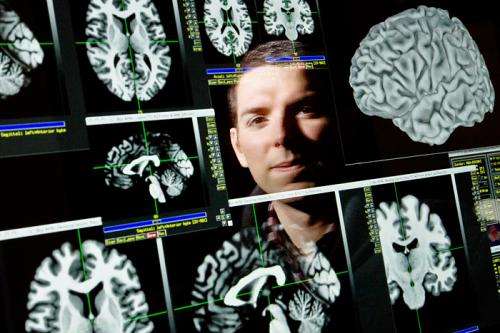
University of Illinois neuroscience professor Aron Barbey led a study that mapped the brain regions associated with emotional intelligence. Credit: L. Brian Stauffer

A new study of 152 Vietnam veterans with combat-related brain injuries offers the first detailed map of the brain regions that contribute to emotional intelligence – the ability to process emotional information and navigate the social world.

The study found significant overlap between general intelligence and , both in terms of behavior and in the brain. Higher scores on general corresponded significantly with higher performance on measures of emotional intelligence, and many of the same brain regions were found to be important to both.

The study appears in the journal Social Cognitive & Affective Neuroscience.

This video is not supported by your browser at this time.

Watch a video about the research.

"This was a remarkable group of patients to study, mainly because it allowed us to determine the degree to which damage to specific brain areas was related to impairment in specific aspects of general and emotional intelligence," said study leader Aron K. Barbey, a professor of neuroscience, of psychology and of speech and hearing science at the Beckman Institute for Advanced Science and Technology at the University of Illinois.

A previous study led by Barbey mapped the neural basis of general intelligence by analyzing how specific brain injuries (in a larger sample of ) impaired performance on tests of fundamental cognitive processes.

In both studies, researchers pooled data from CT scans of participants' brains to produce a collective, three-dimensional map of the cerebral cortex. They divided this composite brain into 3-D units called voxels. They compared the cognitive abilities of patients with damage to a particular voxel or cluster of voxels with those of patients without injuries in those . This allowed the researchers to identify brain areas essential to specific cognitive abilities, and those that contribute significantly to general intelligence, emotional intelligence, or both.

They found that specific regions in the frontal cortex (behind the forehead) and parietal cortex (top of the brain near the back of the skull) were important to both general and emotional intelligence. The frontal cortex is known to be involved in regulating behavior. It also processes feelings of reward and plays a role in attention, planning and memory. The parietal cortex helps integrate sensory information, and contributes to bodily coordination and language processing.

"Historically, has been thought to be distinct from social and emotional intelligence," Barbey said. The most widely used measures of human intelligence focus on tasks such as verbal reasoning or the ability to remember and efficiently manipulate information, he said.

This video is not supported by your browser at this time.

Listen to a podcast of Barbey describing this work.

"Intelligence, to a large extent, does depend on basic cognitive abilities, like attention and perception and memory and language," Barbey said. "But it also depends on interacting with other people. We're fundamentally social beings and our understanding not only involves basic but also involves productively applying those abilities to social situations so that we can navigate the social world and understand others."

The new findings will help scientists and clinicians understand and respond to injuries in their patients, Barbey said, but the results also are of broader interest because they illustrate the interdependence of general and emotional intelligence in the healthy mind.

Journal reference: Social Cognitive and Affective Neuroscience search and more info website

Provided by University of Illinois at Urbana-Champaign search and more info website

4.3 /5 (7 votes)  

Rank 4.3 /5 (7 votes)
Relevant PhysicsForums posts

More news stories

New neuron formation could increase capacity for new learning, at the expense of old memories

New research presented today shows that formation of new neurons in the hippocampus - a brain region known for its importance in learning and remembering - could cause forgetting of old memories by causing a reorganization ...

Neuroscience created 9 hours ago | popularity 3.7 / 5 (3) | comments 0

Help at hand for people with schizophrenia

How can healthy people who hear voices help schizophrenics? Finding the answer for this is at the centre of research conducted at the University of Bergen.

Neuroscience created 9 hours ago | popularity 4 / 5 (2) | comments 2

Japanese research organizations contribute to Human Brain Project

One of the major frontiers of modern science is a comprehensive understanding of the human brain and its functions to guide the development of new technologies in information and communication. In a major announcement for ...

Neuroscience created 9 hours ago | popularity 1 / 5 (1) | comments 0

Controlling mood through the motions of mitochondria

(Medical Xpress)—Regulating the distribution of power in neurons is done by a system that makes the national electric grid look simple by comparison. Each neuron has several thousand mitochondria confined ...

Neuroscience created May 23, 2013 | popularity 4.9 / 5 (9) | comments 0 | with audio podcast report

Brain uses internal 'average voice' prototype to identify who is talking

(Medical Xpress)—The human brain is able to identify individuals' voices by comparing them against an internal 'average voice' prototype, according to neuroscientists.

Neuroscience created May 23, 2013 | popularity 3 / 5 (2) | comments 3 | with audio podcast


Researchers identify first drug targets in childhood genetic tumor disorder

Two mutations central to the development of infantile myofibromatosis (IM)—a disorder characterized by multiple tumors involving the skin, bone, and soft tissue—may provide new therapeutic targets, according to researchers ...

Engineered cytomegalovirus protects monkeys from HIV equivalent

(Medical Xpress)—A new study by researchers in the US has shown that an ancient virus can be modified to help in the fight against the simian immunodeficiency virus SIV, which is the equivalent in monkeys ...

Driving and hands-free talking lead to spike in errors, study shows

Talking on a hands-free device while behind the wheel can lead to a sharp increase in errors that could imperil other drivers on the road, according to new research from the University of Alberta.

Hormone levels may provide key to understanding psychological disorders in women

Women at a particular stage in their monthly menstrual cycle may be more vulnerable to some of the psychological side-effects associated with stressful experiences, according to a study from UCL.

Going live: Immune cell activation in multiple sclerosis

Biological processes are generally based on events at the molecular and cellular level. To understand what happens in the course of infections, diseases or normal bodily functions, scientists would need to ...

Pollen count apps for smartphones are nothing to sneeze at

Kate O'Reilly's spring allergy survival kit includes the usual stuff - nasal sprays, allergy pills and a box of tissues. This season, she's added a new weapon to her line of defense: an app on her smartphone.