Tweaking gene expression to repair lungs
February 25, 2013 in Medical research

Tweaking gene expression to repair lungs

Enlarge

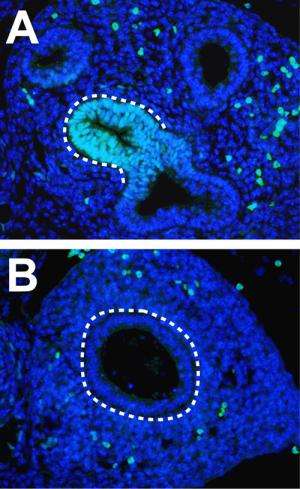
Expression of the important transcription factor Sox2 (green staining and outlined with dashed line) in the airway epithelium of control mouse lung airways (A). Loss of Hdac1/2 expression leads to loss of Sox2 expression in Hdac1/2 double knockout animals (B). Credit: Ed Morrisey, Ph.D., Perelman School of Medicine, University of Pennsylvania.

A healthy lung has some capacity to regenerate itself like the liver. In COPD, these reparative mechanisms fail. HDAC therapies may be useful for COPD, as well as other airway diseases. The levels of HDAC2 expression and its activity are greatly reduced in COPD patients. Decreased HDAC activity may impair the ability of the lung epithelium to regenerate.

such as asthma and (COPD) are on the rise, according to the American Lung Association and the National Institutes of Health.

These ailments are chronic, affect the small airways of the lung, and are thought to involve an injury-repair cycle that leads to the breakdown of normal airway structure and function. For now, drugs for COPD treat only the symptoms.

"A healthy lung has some capacity to regenerate itself like the liver," notes Ed Morrisey, Ph.D., professor of Medicine and Cell and and the scientific director of the Penn Institute for Regenerative Medicine in the Perelman School of Medicine, University of Pennsylvania. "In COPD, these reparative mechanisms fail."

Morrisey is looking at how epigenetics controls lung repair and regeneration. involves chemical modifications to DNA and its supporting proteins that affect . Previous studies found that smokers with COPD had the most significant decrease in one of the enzymes controlling these modifications, called HDAC2.

"HDAC therapies may be useful for COPD, as well as other airway diseases," he explains. "The levels of HDAC2 expression and its activity are greatly reduced in COPD patients. We believe that decreased HDAC activity may impair the ability of the lung epithelium to regenerate."

Using genetic and pharmacological approaches, they showed that development of in the lung is specifically regulated by the combined function of two highly related HDACs, HDAC/1 and /2. Morrisey and colleagues published their findings in this week's issue of Developmental Cell.

By studying how HDAC activity, as well as other epigenetic regulators, controls lung development and regeneration, they hope to develop new therapies to alleviate the unmet needs of patients with asthma and COPD.

HDAC1/2 deficiency leads to a loss of expression of the key transcription factor, a protein called Sox2, which in turn leads to a block in airway epithelial cell development. This is affected in part by deactivating a repressor of expression (derepressing) of two other proteins, Bmp4 and the tumor suppressor Rb1 - targets of HDAC1/2.

In the adult lung, loss of HDAC1/2 leads primarily to increased expression of inhibitors of cell proliferation including the proteins Rb1, p16, and p21. This results in decreased epithelial proliferation in lung injury and inhibition of regeneration.

Together, these data support a critical role for HDAC-mediated mechanisms in regulating both development and regeneration of lung tissue. Since HDAC inhibitors and activators are currently in clinical trials for other diseases, including cancer, such compounds could be tested in the future for efficacy in COPD, acute lung injury, and other diseases that involve defective repair and regeneration, says Morrisey.

Journal reference: Developmental Cell search and more info website

Provided by University of Pennsylvania School of Medicine search and more info website

not rated yet  

Rank not rated yet
Relevant PhysicsForums posts

More news stories

Baby's life saved with groundbreaking 3-D printed device that restored his breathing

Every day, their baby stopped breathing, his collapsed bronchus blocking the crucial flow of air to his lungs. April and Bryan Gionfriddo watched helplessly, just praying that somehow the dire predictions ...

Medical research created 2 hours ago | popularity 5 / 5 (1) | comments 0

Research shows how immune system peacefully co-exists with 'good' bacteria

The human gut is loaded with commensal bacteria – "good" microbes that, among other functions, help the body digest food. The gastrointestinal tract contains literally trillions of such cells, and yet the ...

Medical research created 6 hours ago | popularity 5 / 5 (1) | comments 0 | with audio podcast

Slowing the aging process—only with antibiotics

Swiss scientists reveal the mechanism responsible for aging hidden deep within mitochondria—and dramatically slow it down in worms by administering antibiotics to the young.

Medical research created 6 hours ago | popularity 4.5 / 5 (2) | comments 0 | with audio podcast

How healthy are you for your age?

On May 22, JoVE will publish details of a technique to measure the health of human genetic material in relation to a patient's age. The method is demonstrated by the laboratory of Dr. Gil Atzmon at New York's Albert Einste ...

Medical research created 9 hours ago | popularity not rated yet | comments 0

A molecular explanation for age-related fertility decline in women

(Medical Xpress)—Scientists supported by the National Institutes of Health have a new theory as to why a woman's fertility declines after her mid-30s. They also suggest an approach that might help slow ...

Medical research created 11 hours ago | popularity not rated yet | comments 0 | with audio podcast


Calorie information in fast food restaurants used by 40 percent of 9-18 year olds when making food choices

A new study published online today (Thursday) in the Journal of Public Health has found that of young people who visited fast food or chain restaurants in the U.S. in 2010, girls and youth who were obese were more likely ...

Having both migraines, depression may mean smaller brain

(HealthDay)—Migraines and depression can each cause a great deal of suffering, but new research indicates the combination of the two may be linked to something else entirely—a smaller brain.

Brain can be trained in compassion, study shows

Until now, little was scientifically known about the human potential to cultivate compassion—the emotional state of caring for people who are suffering in a way that motivates altruistic behavior.

Experts favor US approval of Merck sleeping pill (Update)

An independent panel of experts on Wednesday recommended US approval of a new Merck sleeping pill called suvorexant, but expressed concerns over the highest dosage and risks of drowsy daytime driving.

Researchers complete largest genetic sequencing study of human disease

Researchers from Queen Mary, University of London have led the largest sequencing study of human disease to date, investigating the genetic basis of six autoimmune diseases.

Systematic screening of med adherence will ID barriers

(HealthDay)—Implementation of systematic monitoring for medication adherence will allow for identification of barriers to adherence and tailoring of interventions, according to a viewpoint piece published ...