Psychologists uncover brain-imaging inaccuracies
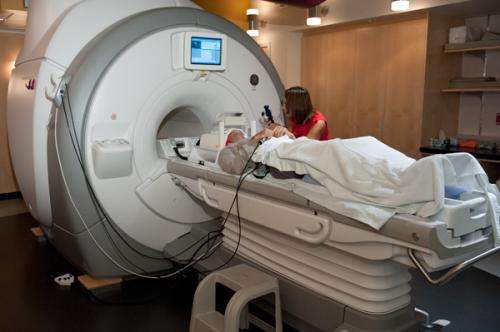
The researchers found that traditional methods of processing fMRI data may lead scientists to overlook smaller brain structures, thus skewing their results. Credit: L.A. Cicero
(Medical Xpress)—Traditional methods of fMRI analysis systematically skew which regions of the brain appear to be activating, potentially invalidating hundreds of papers that use the technique.
Pictures of brain regions "activating" are by now a familiar accompaniment to any neurological news story. With functional magnetic resonance imaging, or fMRI, you can see specific brain regions light up, standing out against the background like night owls' apartment windows.
It's easy to forget that these brain images aren't real snapshots of brain activity. Instead, each picture is the result of many layers of analysis and interpretation, far removed from raw data.
"It's just one representation of brain activity," said Matthew Sacchet, a PhD student in the Neurosciences Program at the Stanford School of Medicine. "As you process the data, it can change."
Sacchet works in the lab of Stanford psychology Associate Professor Brian Knutson, who studies reward processing in a small area of the brain known as the nucleus accumbens. Precisely how that structure activates is at the heart of an ongoing debate about reward circuits – a subject that holds relevance for our understanding of everything from addiction to financial risk-taking.
Unfortunately, according to a paper from Knutson and Sacchet, hundreds of research papers on this circuit may be unintentionally biased. When the labs processed their fMRI findings, many used a one-size-fits-all strategy that skewed which regions of the brain appeared to be activating.
"I honestly think most people want good data," said Knutson. "I'm excited that we can make this kind of research more rigorous.
The paper appeared in the journal NeuroImage.
Too much smoothing
Functional magnetic resonance imaging measures changes in blood flow in the brain. It's a powerful tool, but the signal fMRI actually detects – the result of the magnetic differences between oxygenated and deoxygenated blood – is noisy.
Researchers need to statistically process the data in order to make the resulting data interpretable. One of the most common approaches is known as "spatial smoothing," which involves averaging the activity of each brain region with that of its neighbors.
But fMRI has only been in use since the mid-1990s. Many of the most common analyses in use today are holdovers from older, lower-resolution types of imaging and seem to have some undesired effects on the finer-grained signals fMRI can provide.
Knutson and Sacchet found that when researchers process fMRI data with a traditional "smoothing kernel" of 8mm, they end up averaging their images over too large an area. Activity in smaller brain structures can then be overlooked, or even shifted to areas that receive more blood flow and where the blood oxygenation level-dependent signal is stronger.
"It might seem strange that a systematic bias like that could bias the whole field," Knutson said. "But if half the people use 8mm and half use 4mm, you might end up with very different results, and it could add up."
Reward structure
These statistical pitfalls are particularly glaring when studying the small, structurally complex nucleus accumbens.
Findings from the Knutson Lab, which has been using the smaller, 4mm smoothing kernel for years, suggest that different parts of the nucleus accumbens have different functions. The forward portion seems to distinguish between positive or negative stimuli, reacting specifically to rewards. Meanwhile, the rear section responds more to the intensity of the motivation.
While some other labs have corroborated this finding, others only found activation in the rear half of the structure.
These contradictory findings now appear to have been skewed. Because the back of the nucleus accumbens is larger and surrounded by more blood-infused gray matter than the front, the smoothing step made it appear as if all the nucleus accumbens' activity originated far to the rear.
A collaborator in Germany already has taken the paper's advice, Sacchet said. "She had a colleague reanalyze her data and found the same thing we found."
Knutson emphasized that the research paper doesn't mean "the methods are bunk." Simply improving the way scientists process signals can enhance their ability to locate specific brain functions.
"There may be a debate, but you can resolve that debate with data," he said.
More information: Article: Spatial Smoothing Systematically Biases the Localization of Reward-Related Brain Activity, NeuroImage (doi: 10.1016/j.neuroimage.2012.10.056)
Journal reference:
NeuroImage
Provided by
Stanford University
-
The conflict of reward in depression
Mar 25, 2008 |
not rated yet |
0
-
Functional boost for magnetic resonance imaging
Jan 18, 2011 |
not rated yet |
0
-
New research findings pave the way to more accurate interpretation of brain imaging data
Aug 28, 2009 |
not rated yet |
0
-
In the brain, winning is everywhere
Oct 05, 2011 |
not rated yet |
0
-
Scanning the brain: Scientists examine the impact of fMRI over the past 20 years
Jan 16, 2013 |
not rated yet |
0
-
Motion perception revisited: High Phi effect challenges established motion perception assumptions
Apr 23, 2013 |
3 / 5 (2) |
2
-
Anything you can do I can do better: Neuromolecular foundations of the superiority illusion (Update)
Apr 02, 2013 |
4.5 / 5 (11) |
5
-
The visual system as economist: Neural resource allocation in visual adaptation
Mar 30, 2013 |
5 / 5 (2) |
9
-
Separate lives: Neuronal and organismal lifespans decoupled
Mar 27, 2013 |
4.9 / 5 (8) |
0
-
Sizing things up: The evolutionary neurobiology of scale invariance
Feb 28, 2013 |
4.8 / 5 (10) |
14
-
Pressure-volume curve: Elastic Recoil Pressure don't make sense
4 hours ago
-
If you became brain-dead, would you want them to pull the plug?
20 hours ago
-
MRI bill question
May 15, 2013
-
Ratio of Hydrogen of Oxygen in Dessicated Animal Protein
May 13, 2013
-
Alcohol and acetaminophen
May 13, 2013
-
Marie Curie's leukemia
May 13, 2013
- More from Physics Forums - Medical Sciences
More news stories
For combat veterans suffering from post-traumatic stress disorder, 'fear circuitry' in the brain never rests
Chronic trauma can inflict lasting damage to brain regions associated with fear and anxiety. Previous imaging studies of people with post-traumatic stress disorder, or PTSD, have shown that these brain regions can over-or ...
Neuroscience
6 hours ago |
not rated yet |
0
|
Temporal processing in the olfactory system
The neural machinery underlying our olfactory sense continues to be an enigma for neuroscience. A recent review in Neuron seeks to expand traditional ideas about how neurons in the olfactory bulb might encode information about ...
Neuroscience
17 hours ago |
not rated yet |
0
|
Melon focus headband turns to Kickstarter for rollout plans
(Medical Xpress)—What if the quality of your work depends more on your focus on the piano keys or canvas or laptop than your musical or painting or computing skills? If target users can be convinced, they ...
Neuroscience
17 hours ago |
3.7 / 5 (3) |
0
|
Deep brain stimulation: A fix when the drugs don't work
Neurological disorders can have a devastating impact on the lives of sufferers and their families.
Neuroscience
22 hours ago |
5 / 5 (1) |
0
|
Brain makes call on which ear is used for cell phone
If you're a left-brain thinker, chances are you use your right hand to hold your cell phone up to your right ear, according to a newly published study from Henry Ford Hospital in Detroit.
Neuroscience
May 16, 2013 |
2 / 5 (2) |
0
|
AIDS science at 30: 'Cure' now part of lexicon
Big names in medicine are set to give an upbeat assessment of the war on AIDS on Tuesday, 30 years after French researchers identified the virus that causes the disease.
Now we know why old scizophrenia medicine works on antibiotics-resistant bacteria
In 2008 researchers from the University of Southern Denmark showed that the drug thioridazine, which has previously been used to treat schizophrenia, is also a powerful weapon against antibiotic-resistant bacteria such as ...
Individuals who drink heavily and smoke may show 'early aging' of the brain
Treatment for alcohol use disorders works best if the patient actively understands and incorporates the interventions provided in the clinic. Multiple factors can influence both the type and degree of neurocognitive abnormalities ...
College women exceed NIAAA drinking guidelines more frequently than college men
In order to avoid harms associated with alcohol consumption, in 2009 the National Institute on Alcohol Abuse and Alcoholism issued guidelines that define low-risk drinking. These guidelines differ for men and women: no more ...
Study identifies new approach to improving treatment for MS and other conditions
(Medical Xpress)—Working with lab mice models of multiple sclerosis (MS), UC Davis scientists have detected a novel molecular target for the design of drugs that could be safer and more effective than current FDA-approved ...
23 dead in initiation rites in South Africa
(AP)—Twenty-three youths have died in the past nine days at initiation ceremonies that include circumcisions and survival tests, South African police said Friday.
Mar 09, 2013
Rank: 1 / 5 (1)
♦