Novel drug candidates offer new route to controlling inflammation
May 14, 2012 in Inflammatory disorders
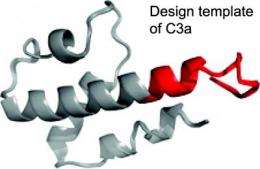
An international team created drug candidates based on the naturally occurring C3a peptide, the chain of molecules shown here. The C3a peptide is a key player in regulating immune responses and drugs that enhance or block its effects could be useful in treating many inflammatory diseases. Credit: Journal of Medicinal Chemistry
Pursuing a relatively untapped route for regulating the immune system, an international team of researchers has designed and conducted initial tests on molecules that have the potential to treat diseases involving inflammation, such as asthma, rheumatoid arthritis, stroke and sepsis.
The team started by creating a three-dimensional map of a protein structure called the C3a receptor, which sits on the surface of human cells and plays a critical role in regulating a branch of the immune system called the complement system. They then used computational techniques to design short portions of protein molecules, known as peptides, that they predicted would interact with the receptor and either block or enhance aspects of its activity. Finally, experimentalists validated the theoretical predictions by synthesizing the peptides and testing them in animal and human cells.
The researchers a collaboration of teams at four institutions on three continents published their results May 10 in the Journal of Medicinal Chemistry.
The collaboration includes Christodoulos Floudas, the Stephen C. Macaleer '63 Professor of Engineering and Applied Science in the Department of Chemical and Biological Engineering at Princeton University; Dimitrios Morikis, professor of bioengineering at the University of California, Riverside; Peter Monk of the Department of Infection and Immunity at the University of Sheffield Medical School, U.K.; and Trent Woodruff of the School of Biomedical Sciences at the University of Queensland, Australia.
The regulation of the complement system so called because it complements the body's central system of immune cells and antibodies is thought to be a possible route to controlling over-active or mistaken immune responses that cause damage. However, few drugs directly target complement proteins, and none targets the C3a receptor, in part because of the complexity of the complement system. In some cases complement activity can help downplay immune responses while in other cases it can stoke even stronger reactions.
The collaborators were able to create peptides that blocked activity of C3a (antagonists) and others that stimulated it (agonists) with unprecedented potency and precision. Their success stems from a novel optimization-based approach, developed in the Floudas lab, for computing how a protein's three-dimensional structure will change when changes are made in the protein's chemical sequence. This ability to design peptides of a desired shape, allowed them to target the C3a receptor in precise ways.
Morikis and his graduate students Chris Kieslich and Li Zhang provided the collaborators the 3D structure of the naturally occurring peptide that normally regulates the C3a receptor in human cells. Using a portion of that structure as a flexible template, Floudas and graduate students Meghan Bellows-Peterson and Ho Ki Fung designed new peptides that were predicted either to enhance or block C3a. Monk and postdoctoral fellow Kathryn Wareham tested the predictions in rat cells, while Woodruff and student Owen Hawksworth tested them in human cells.
Among the conditions potentially treatable through complement regulation is reperfusion injury, which occurs when blood flow is temporarily cut off to some part of the body, as in a heart attack or stroke, and then an inflammatory response develops when the blood returns. Another possible use would be in organ transplantation, in which the body often mounts a destructive immune response against the newly introduced organ. Other common conditions affected by the complement system are rheumatoid arthritis and sepsis.
As next steps, the team will seek to test their peptides in live animal models of inflammation. They also plan to explore more generally the dual role of C3a in inflammation, with an eye toward developing further drug candidates.
Journal reference:
Journal of Medicinal Chemistry
Provided by Princeton University, Engineering School
-
New discovery about the formation of new brain cells
Nov 23, 2009 |
not rated yet |
0
-
Math may help calculate way to find new drugs for HIV and other diseases
Feb 07, 2011 |
not rated yet |
0
-
New 'bouncer' molecule halts rheumatoid arthritis
Sep 07, 2011 |
not rated yet |
0
-
NIAMS scientists find potential new way to block inflammation in autoimmune disease
Jun 19, 2008 |
not rated yet |
0
-
New role for protein molecule that inhibits response of immune-system cells
Nov 09, 2010 |
not rated yet |
0
-
Motion perception revisited: High Phi effect challenges established motion perception assumptions
Apr 23, 2013 |
3 / 5 (2) |
2
-
Anything you can do I can do better: Neuromolecular foundations of the superiority illusion (Update)
Apr 02, 2013 |
4.5 / 5 (11) |
5
-
The visual system as economist: Neural resource allocation in visual adaptation
Mar 30, 2013 |
5 / 5 (2) |
9
-
Separate lives: Neuronal and organismal lifespans decoupled
Mar 27, 2013 |
4.9 / 5 (8) |
0
-
Sizing things up: The evolutionary neurobiology of scale invariance
Feb 28, 2013 |
4.8 / 5 (10) |
14
-
The Durability of Bone: Long Falls
8 hours ago
-
Is energy convertible to matter?
9 hours ago
-
Rotating electron as a dipole is this right?
12 hours ago
-
Dipole term in multipole expansion
16 hours ago
-
Bubbles in a Pre-Boiling/Boiling pot of water
17 hours ago
-
Assumptions of Griffith's fracture theory
May 21, 2013
- More from Physics Forums - Classical Physics
More news stories
Asthma symptoms impair sleep quality and school performance in children
The negative effects of poorly controlled asthma symptoms on sleep quality and academic performance in urban schoolchildren has been confirmed in a new study.
Inflammatory disorders
20 hours ago |
not rated yet |
0
Inflammatory bowel disease raises risk of melanoma
Patients with inflammatory bowel disease (IBD) are at higher risk of melanoma, a form of skin cancer, report researchers at Mayo Clinic. Researchers found that IBD is associated with a 37 percent greater risk for the disease. ...
Inflammatory disorders
May 20, 2013 |
4.5 / 5 (2) |
0
A new 'on' signal for inflammation
(Medical Xpress)—Inflammation is an important response in the body - it helps you to kill off invaders such bacteria that could cause a harmful infection. But if it's chronic or uncontrolled, inflammation can also cause ...
Inflammatory disorders
May 14, 2013 |
5 / 5 (1) |
0
|
New research reveals swimming beneficial for young people with asthma
New research by medical students working in the Breathe Well Centre of Research Excellence at the UTAS School of Medicine has revealed swimming has health benefits for young people with asthma, with no adverse effects on ...
Inflammatory disorders
May 10, 2013 |
5 / 5 (1) |
0
Nearly 5 million asthmatics could benefit from antifungal therapy
An estimated 4,837,000 asthmatics with allergic bronchopulmonary aspergillosis (ABPA) could benefit substantially from antifungal treatment, say researchers from The University of Manchester and the University of Toronto.
Inflammatory disorders
May 08, 2013 |
not rated yet |
0
Study says empathy plays a key role in moral judgments
Is it permissible to harm one to save many? Those who tend to say "yes" when faced with this classic dilemma are likely to be deficient in a specific kind of empathy, according to a report published in the scientific journal ...
Phthalates: Study links chemicals widely found in plastics, processed food to elevated blood pressure in children, teens
Plastic additives known as phthalates (pronounced THAL-ates) are odorless, colorless and just about everywhere: They turn up in flooring, plastic cups, beach balls, plastic wrap, intravenous tubing and—according to the ...
If you can remember it, you can remember it wrong
(Medical Xpress)—Native peoples in regions where cameras are uncommon sometimes react with caution when their picture is taken. The fear that something must have been stolen from them to create the photo ...
B vitamins could delay dementia
(Medical Xpress)—Despite spending billions of dollars on research and development, drug companies have been unable to come up with effective treatments for dementia and Alzheimer's Disease (AD). Now, A. ...
Insight into the dazzling impact of insulin in cells
Australian scientists have charted the path of insulin action in cells in precise detail like never before. This provides a comprehensive blueprint for understanding what goes wrong in diabetes.
Reducing caloric intake delays nerve cell loss
Activating an enzyme known to play a role in the anti-aging benefits of calorie restriction delays the loss of brain cells and preserves cognitive function in mice, according to a study published in the May ...