Gene mutations cause massive brain asymmetry
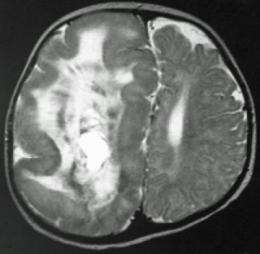
This image depicts hemimegalencephaly. Credit: UC San Diego School of Medicine
Hemimegalencephaly is a rare but dramatic condition in which the brain grows asymmetrically, with one hemisphere becoming massively enlarged. Though frequently diagnosed in children with severe epilepsy, the cause of hemimegalencephaly is unknown and current treatment is radical: surgical removal of some or all of the diseased half of the brain.
In a paper published in the June 24, 2012 online issue of Nature Genetics, a team of doctors and scientists, led by researchers at the University of California, San Diego School of Medicine and the Howard Hughes Medical Institute, say de novo somatic mutations in a trio of genes that help regulate cell size and proliferation are likely culprits for causing hemimegalencephaly, though perhaps not the only ones.
De novo somatic mutations are genetic changes in non-sex cells that are neither possessed nor transmitted by either parent. The scientists' findings a collaboration between Joseph G. Gleeson, MD, professor of neurosciences and pediatrics at UC San Diego School of Medicine and Rady Children's Hospital-San Diego; Gary W. Mathern, MD, a neurosurgeon at UC Los Angeles' Mattel Children's Hospital; and colleagues suggest it may be possible to design drugs that inhibit or turn down signals from these mutated genes, reducing or even preventing the need for surgery.
Gleeson's lab studied a group of 20 patients with hemimegalencephaly upon whom Mathern had operated, analyzing and comparing DNA sequences from removed brain tissue with DNA from the patients' blood and saliva.
"Mathern had reported a family with identical twins, in which one had hemimegalencephaly and one did not. Since such twins share all inherited DNA, we got to thinking that there may be a new mutation that arose in the diseased brain that causes the condition," said Gleeson. Realizing they shared the same ideas about potential causes, the physicians set out to tackle this question using new exome sequencing technology, which allows sequencing of all of the protein-coding exons of the genome at the same time.
The researchers ultimately identified three gene mutations found only in the diseased brain samples. All three mutated genes had previously been linked to cancers.
"We found mutations in a high percentage of the cells in genes regulating the cellular growth pathways in hemimegalencephaly," said Gleeson. "These same mutations have been found in various solid malignancies, including breast and pancreatic cancer. For reasons we do not yet understand, our patients do not develop cancer, but rather this unusual brain condition. Either there are other mutations required for cancer propagation that are missing in these patients, or neurons are not capable of forming these types of cancers."
The mutations were found in 30 percent of the patients studied, indicating other factors are involved. Nonetheless, the researchers have begun investigating potential treatments that address the known gene mutations, with the clear goal of finding a way to avoid the need for surgery.
"Although counterintuitive, hemimegalencephaly patients are far better off following the functional removal or disconnection of the enlarged hemisphere," said Mathern. "Prior to the surgery, most patients have devastating epilepsy, with hundreds of seizures per day, completely resistant to even our most powerful anti-seizure medications. The surgery disconnects the affected hemisphere from the rest of the brain, causing the seizures to stop. If performed at a young age and with appropriate rehabilitation, most children suffer less language or cognitive delay due to neural plasticity of the remaining hemisphere."
But a less-invasive drug therapy would still be more appealing.
"We know that certain already-approved medications can turn down the signaling pathway used by the mutated genes in hemimegalencephaly," said lead author and former UC San Diego post-doctoral researcher Jeong Ho Lee, now at the Korea Advanced Institute of Science and Technology. "We would like to know if future patients might benefit from such a treatment. Wouldn't it be wonderful if our results could prevent the need for such radical procedures in these children?"
Journal reference:
Nature Genetics
Provided by
University of California - San Diego
-
'Brain-only' mutation causes epileptic brain size disorder
Apr 11, 2012 |
not rated yet |
0
-
Clarity begins at exome: Sequencing protein-making part of genome can change diagnosis and patient care
Jun 13, 2012 |
not rated yet |
0
-
Evolved, mutated gene module linked to Joubert syndrome
Jan 26, 2012 |
not rated yet |
0
-
Mutations in gene linked to ciliopathies
Aug 09, 2009 |
not rated yet |
0
-
Intellectual disability is frequently caused by non-hereditary genetic problems
Apr 18, 2011 |
not rated yet |
0
-
Motion perception revisited: High Phi effect challenges established motion perception assumptions
Apr 23, 2013 |
3 / 5 (2) |
2
-
Anything you can do I can do better: Neuromolecular foundations of the superiority illusion (Update)
Apr 02, 2013 |
4.5 / 5 (11) |
5
-
The visual system as economist: Neural resource allocation in visual adaptation
Mar 30, 2013 |
5 / 5 (2) |
9
-
Separate lives: Neuronal and organismal lifespans decoupled
Mar 27, 2013 |
4.9 / 5 (8) |
0
-
Sizing things up: The evolutionary neurobiology of scale invariance
Feb 28, 2013 |
4.8 / 5 (10) |
14
-
Pressure-volume curve: Elastic Recoil Pressure don't make sense
May 18, 2013
-
If you became brain-dead, would you want them to pull the plug?
May 17, 2013
-
MRI bill question
May 15, 2013
-
Ratio of Hydrogen of Oxygen in Dessicated Animal Protein
May 13, 2013
-
Alcohol and acetaminophen
May 13, 2013
-
Marie Curie's leukemia
May 13, 2013
- More from Physics Forums - Medical Sciences
More news stories
Study of young Israelis emphasizes need for avoidance of sun exposure for the very young
A new study conducted using extensive medical records of over one million Israeli adolescents before military service shows clearly how exposure to the Israeli sun of young, light-skinned children increases substantially ...
Cancer
1 hour ago |
not rated yet |
0
Genetic diversity within tumors predicts outcome in head and neck cancer
A new measure of the heterogeneity – the variety of genetic mutations – of cells within a tumor appears to predict treatment outcomes of patients with the most common type of head and neck cancer. In the May 20 issue ...
Cancer
5 hours ago |
not rated yet |
0
Molecular marker from pancreatic 'juices' helps identify pancreatic cancer
Researchers at Mayo Clinic have developed a promising method to distinguish between pancreatic cancer and chronic pancreatitis—two disorders that are difficult to tell apart. A molecular marker obtained from pancreatic ...
Cancer
5 hours ago |
not rated yet |
0
New smartphone application improves colonoscopy preparation
The use of a smartphone application significantly improves patients' preparation for a colonoscopy, according to new research presented today at Digestive Disease Week (DDW). The preparation process, which begins days in ...
Cancer
May 19, 2013 |
not rated yet |
0
Research examines new methods for managing digestive health
Research presented at Digestive Disease Week (DDW) explores new methods for managing digestive health through diet and lifestyle.
Cancer
May 19, 2013 |
not rated yet |
1
Vitamin D could provide new and effective treatments for asthma
(Medical Xpress)—Scientists at King's College London have discovered that Vitamin D has the potential to significantly reduce the symptoms of asthma. The study, led by Professor Catherine Hawrylowicz from ...
Rethinking treatment goals improves results for 'untreatable' anorexics
(Medical Xpress)—Patients with the most severe and dangerous form of chronic anorexia are more likely to make a significant improvement towards recovery and stay in therapy if traditional psychological treatments are re-focused ...
Rise in type 2 diabetes amongst young
The number of young people diagnosed with type 2 diabetes has seen the sharpest rise over the last twenty years compared to a background of a general increase across the board, new University research has ...
Pre-proceedings process fails to reduce length of care proceedings, but can help divert cases from court
A major new report on a procedure that aims to reduce the duration of care proceedings for children has found it made no significant difference to what happened in court, and cases lasted just as long regardless of whether ...
Report reveals impact of public injecting
New research undertaken on the streets of Richmond and Abbotsford has revealed increasing health risks for people who inject drugs and significant community concern over the impact of injecting in public ...
Wireless ultrasound transducers help physicians
Siemens has presented the world's first ultrasound system with wireless transducers. The system's transducers, which can be easily operated with one hand, transmit ultrasound images via radio waves to the ...
Jun 25, 2012
Rank: not rated yet