Brake on nerve cell activity after seizures discovered: Gene expression initiates protective electrical response
December 19, 2012 in Neuroscience

Brake on nerve cell activity after seizures discovered

Enlarge

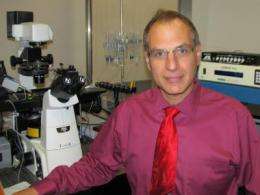
Mark S. Shapiro, Ph.D., University of Texas Health Science Center San Antonio, found that an organizational protein plays a key role in neuroprotective response machinery during and after a seizure. Credit: The University of Texas Health Science Center San Antonio

Given that epilepsy impacts more than 2 million Americans, there is a pressing need for new therapies to prevent this disabling neurological disorder. New findings from the neuroscience laboratory of Mark S. Shapiro, Ph.D., at The University of Texas Health Science Center at San Antonio, published Dec. 20 in the high-impact scientific journal, Neuron, may provide hope.

"A large fraction of epilepsy sufferers cannot take drugs for their disorder or the existing drugs do not manage it," said Dr. Shapiro, professor of physiology in the School of Medicine. "As a result, many opt for surgery to remove the hippocampus, a part of the brain where memories are stored but also where seizures are often localized. The heart-wrenching choice is between their memories and the epilepsy."

Genes go into action

A major finding of the study is that selected genes get switched on during and after a seizure, sending swarms of signals to reduce uncontrolled firing of . A medication that amplifies this response after a person's initial seizure could thus prevent and the onset of devastating epilepsy.

Uncontrolled electrical activity by specialized electricity-producing called "" triggers . One in 10 people have a lifetime risk of suffering a seizure, which can occur for a variety of reasons including traumatic brain injury, stroke or .

A powerful brake

Although not all seizures lead to epilepsy, some trigger changes in the brain that heighten the risk of the disorder. Dr. Shapiro's research sheds light on why most isolated seizures do not lead to full-blown epilepsy, whereas others do. An ion channel called the "M-channel" acts as a powerful "brake" on hyper-excitability in the brain. Another organizational protein, called AKAP79, acting much like an air-traffic controller, calls in more M channels as part of neuroprotective response machinery.

"In addition to epilepsy, the findings have implications for relief from chronic pains, cardiovascular disease and recovery from mood disorders," he added.

Pharmacological therapy to enhance M-channel gene expression or AKAP79 function "could jump-start this neuroprotective mechanism to prevent a seizure from turning into epilepsy," Dr. Shapiro said. "Administering it right after a could be very effective."

It was not known that electrical activity could regulate M-channel genes, Dr. Shapiro said. Nor was it known that the AKAP79 organizer protein, which coordinates many aspects of M-channel function, could turn on their genes in a person's DNA. By increasing M-channel expression in the brain, uncontrolled electrical firing of nerve cells in the brain is sharply controlled.

Mouse experiments

The Shapiro lab team records electrical currents and performs imaging in living nerve cells to measure M-channel activity. This study included inducing seizures in healthy mice. After a seizure, of M-channels in the hippocampus increased more than 10-fold within 24 hours, Dr. Shapiro said. This protective effect was completely absent in mice lacking the mouse version of the AKAP79 gene.

"Because excessive firing of nerve cells is also involved in chronic pains, such as migraines, mood disorders and hypertension, increasing M-channel signals to reduce nerve-cell firing could also likely be effective in treating those conditions," Dr. Shapiro said.

This is only the second research paper from The University of Texas Health Science Center at San Antonio to be published by Neuron since 1996.

Journal reference: Neuron search and more info website

Provided by University of Texas Health Science Center at San Antonio search and more info website

5 /5 (3 votes)  

Rank 5 /5 (3 votes)
Relevant PhysicsForums posts

More news stories

Reducing caloric intake delays nerve cell loss

Activating an enzyme known to play a role in the anti-aging benefits of calorie restriction delays the loss of brain cells and preserves cognitive function in mice, according to a study published in the May ...

Neuroscience created 6 hours ago | popularity 5 / 5 (3) | comments 0 | with audio podcast

B vitamins could delay dementia

(Medical Xpress)—Despite spending billions of dollars on research and development, drug companies have been unable to come up with effective treatments for dementia and Alzheimer's Disease (AD). Now, A. ...

Neuroscience created 9 hours ago | popularity 4.9 / 5 (9) | comments 0 | with audio podcast report

Waiting for a sign? Researchers find potential brain 'switch' for new behavior

You're standing near an airport luggage carousel and your bag emerges on the conveyor belt, prompting you to spring into action. How does your brain make the shift from passively waiting to taking action when ...

Neuroscience created 10 hours ago | popularity 5 / 5 (1) | comments 0 | with audio podcast

If you can remember it, you can remember it wrong

(Medical Xpress)—Native peoples in regions where cameras are uncommon sometimes react with caution when their picture is taken. The fear that something must have been stolen from them to create the photo ...

Neuroscience created 11 hours ago | popularity 4.2 / 5 (5) | comments 0 | with audio podcast report

Study shows where scene context happens in our brain

In a remote fishing community in Venezuela, a lone fisherman sits on a cliff overlooking the southern Caribbean Sea. This man –– the lookout –– is responsible for directing his comrades on the water, ...

Neuroscience created 13 hours ago | popularity 4 / 5 (1) | comments 0 | with audio podcast


New sleeping pill poised to hit US markets

An experimental sleeping pill from US drug company Merck is effective at helping people fall and stay asleep, according to reviewers at the US Food and Drug Administration, which could soon approve the new drug.

Insight into the dazzling impact of insulin in cells

Australian scientists have charted the path of insulin action in cells in precise detail like never before. This provides a comprehensive blueprint for understanding what goes wrong in diabetes.

Antidepressant reduces stress-induced heart condition

A drug commonly used to treat depression and anxiety may improve a stress-related heart condition in people with stable coronary heart disease, according to researchers at Duke Medicine.

Drugs found to both prevent and treat Alzheimer's disease in mice

Researchers at USC have found that a class of pharmaceuticals can both prevent and treat Alzheimer's Disease in mice.

Enrichment therapy effective among children with autism, study finds

Children with autism showed significant improvement after six months of simple sensory exercises at home using everyday items such as scents, spoons and sponges, according to UC Irvine neurobiologists.

Study finds vitamin C can kill drug-resistant TB (w/ video)

In a striking, unexpected discovery, researchers at Albert Einstein College of Medicine of Yeshiva University have determined that vitamin C kills drug-resistant tuberculosis (TB) bacteria in laboratory culture. The finding ...