Scientists discover how HIV virus gains access to carrier immune cells to spread infection
December 18, 2012 in HIV & AIDS

Scientists discover how HIV virus gains access to carrier immune cells to spread infection

Enlarge

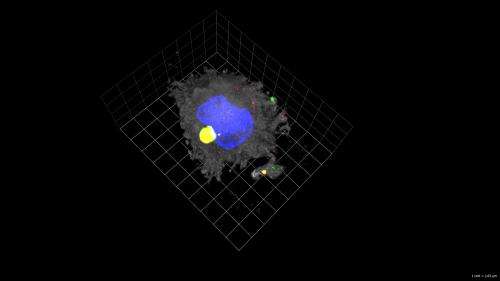
A three-dimensional reconstruction of a mature dendritic cell (in gray) where HIV (in red) is stored with the new receptor identified, Siglec-1 (in green). The yellow color appears when the virus (in red) and the receptor (in green) localize within the same compartment of the cell. In blue, the nucleus of the dendritic cell. Credit: Public Library of Science

Scientists from the AIDS Research Institute IrsiCaixa have identified how HIV, the virus that causes AIDS, enters the cells of the immune system enabling it to be dispersed throughout an organism. The new study is published December 18 in the open access journal PLOS Biology.

One of the reasons why we do not yet have a cure for is that the virus infects of the immune system that would normally fight such an infection. The main targets of HIV are named CD4 T lymphocytes (so called because they have the protein CD4 in their membrane), and while more than 20 different drugs are available today to help control HIV, all of them act by blocking the cycle that HIV follows to infect these CD4 T lymphocytes. However, these treatments do not fully act on another cell of the immune system, the dendritic cell, which takes up HIV and spreads it to target CD4 T lymphocytes.

Mature dendritic cells are responsible for activating an by CD4 T lymphocytes, but when they carry viruses, their contact with T lymphocytes causes the virus to be passed on, thus increasing viral spread.

The results continue the research led by ICREA researchers at IrsiCaixa, Javier Martínez-Picado, and Nuria Izquierdo-Useros, in collaboration with research groups from Heidelberg University, Germany, and the University of Lausanne, Switzerland. This team published a previous paper in April 2012, in which they identified , called gangliosides, located on the surface of HIV that are recognized by dendritic cells and are necessary for viral uptake. The new results now identify a molecule on the surface of dendritic cells that recognizes and binds the gangliosides and allows HIV to be taken up by dendritic cells and transmitted to its ultimate target: T lymphocytes.

"We have observed that the protein that acts as a lock for the entrance of HIV could also facilitate the entrance of other viruses," explains Nuria Izquierdo-Useros. "Therefore, our results could also help us understand how other infections might exploit this mechanism of dispersion."

In order to identify the precise molecule located on the membrane of the dendritic cells capable of capturing HIV, the researchers studied one family of proteins that are present on the surface of these cells, called Siglecs. It is known that these proteins bind to the gangliosides on the HIV surface. In the laboratory, they mixed the virus with dendritic cells that displayed different quantities of Siglec-1, and found that a higher quantity of Siglec-1 led to those dendritic cells capturing more HIV, which in turn allowed for enhanced transmission of HIV to CD4 T lymphocytes, a process called trans-infection.

The team then tried inhibiting the Siglec-1 protein. Doing so in the laboratory, they found that the dendritic cells lost their capacity to capture HIV and, importantly, they also lost their ability to transfer HIV to CD4 T lymphocytes. With all these data, the scientists concluded that Siglec-1 is the molecule responsible for entrance into the , and could therefore become a new therapeutic target.

"We had the key and now we have found a lock," explains Javier Martínez-Picado. "Now we are already working on the development of a drug that could block this process to improve the efficacy of the current existing treatments against AIDS".

More information: Izquierdo-Useros N, Lorizate M, Puertas MC, Rodriguez-Plata MT, Zangger N, et al. (2012) Siglec-1 Is a Novel Dendritic Cell Receptor That Mediates HIV-1 Trans-Infection Through Recognition of Viral Membrane Gangliosides. PLoS Biol 10(12): e1001448. doi:10.1371/journal.pbio.1001448

Journal reference: PLoS Biology search and more info website

Provided by Public Library of Science search and more info website

5 /5 (3 votes)  

Rank 5 /5 (3 votes)
Related Stories
Relevant PhysicsForums posts

More news stories

'Gap' for HIV vaccine efforts after latest setback

The hunt for an HIV vaccine has gobbled up $8 billion in the past decade, and the failure of the most recent efficacy trial has delivered yet another setback to 26 years of efforts.

HIV & AIDS created 11 hours ago | popularity not rated yet | comments 0

AIDS science at 30: 'Cure' now part of lexicon

Big names in medicine are set to give an upbeat assessment of the war on AIDS on Tuesday, 30 years after French researchers identified the virus that causes the disease.

HIV & AIDS created May 18, 2013 | popularity 5 / 5 (1) | comments 0

Peer-referral programs can increase HIV-testing in emergency departments

Researchers at the University of Cincinnati (UC) have found that incorporating a peer-referral program for HIV testing into emergency departments can reach new groups of high-risk patients and brings more patients into the ...

HIV & AIDS created May 17, 2013 | popularity not rated yet | comments 0

HIV no barrier to getting liver transplant, study finds

(HealthDay)—Liver transplants to treat a common type of liver cancer are a viable option for people infected with HIV, according to new research.

HIV & AIDS created May 17, 2013 | popularity not rated yet | comments 0

Twin epidemics: HIV and Hepatitis C in the urban Northeast

A new Yale study looks at the scope and consequences of a burgeoning health problem in the cities of the U.S. Northeast: concurrent infection with both HIV and Hepatitis C (HCV). The study appears online ...

HIV & AIDS created May 17, 2013 | popularity not rated yet | comments 0


Researchers identify a potential new risk for sleep apnea: Asthma

Researchers at the University of Wisconsin have identified a potential new risk factor for obstructive sleep apnea: asthma. Using data from the National Institutes of Health (Heart, Lung, and Blood Institute)-funded Wisconsin ...

Computational tool translates complex data into simplified 2-dimensional images

In their quest to learn more about the variability of cells between and within tissues, biomedical scientists have devised tools capable of simultaneously measuring dozens of characteristics of individual ...

Study finds that sleep apnea and Alzheimer's are linked

A new study looking at sleep-disordered breathing (SDB) and markers for Alzheimer's disease (AD) risk in cerebrospinal fluid (CSF) and neuroimaging adds to the growing body of research linking the two.

New theory on genesis of osteoarthritis comes with successful therapy in mice

Scientists at Johns Hopkins have turned their view of osteoarthritis (OA) inside out. Literally. Instead of seeing the painful degenerative disease as a problem primarily of the cartilage that cushions joints, ...

Ginger compounds may be effective in treating asthma symptoms

Gourmands and foodies everywhere have long recognized ginger as a great way to add a little peppery zing to both sweet and savory dishes; now, a study from researchers at Columbia University shows purified components of the ...

Alzheimer's leaves bilingual victims stranded in Canada

The devastating effect of Alzheimer's disease on bilingual people has been thrown into focus in Canada, where the sudden loss of a second language can leave sufferers feeling like strangers in their own country.